How do you forecast reputation trends and risks?
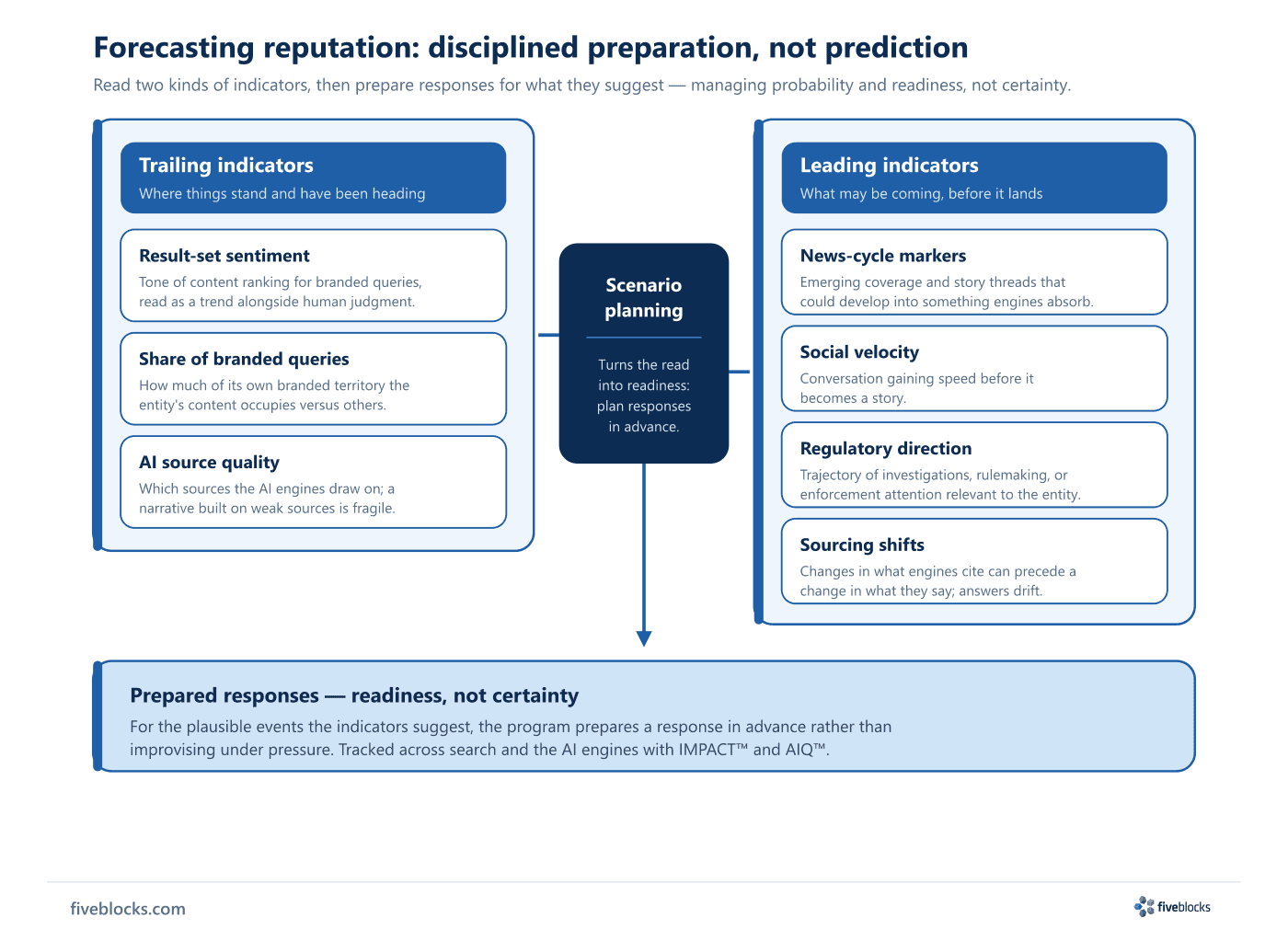
Forecasting reputation means reading two kinds of signals and planning against them. Trailing indicators (sentiment, share of branded queries, the source quality AI engines draw on) show where things have been heading; leading indicators (news-cycle markers, social velocity, regulatory direction, shifts in how engines source) point to what may be coming. Scenario planning turns that read into responses prepared in advance.
Forecasting reputation trends and risks is disciplined preparation rather than prediction. It rests on two kinds of indicators and on planning for what they suggest, without claiming to know what will happen.
Trailing indicators: where things stand and where they have been heading
Trailing indicators describe the current picture and its recent trajectory. Their direction shows where reputation is moving if nothing changes.
- Result-set sentiment
- The overall tone of the content ranking for branded queries, tracked as a trend rather than a snapshot. Sentiment is a directional signal to be read alongside human judgment, because automated classification is imperfect on nuance, sarcasm, and context.
- Share of branded queries
- How much of the entity’s own branded territory its controlled and authoritative content occupies, versus peers and other parties.
- AI source quality
- Which sources the AI engines are drawing on. A narrative built on weak or hostile sources is fragile whatever its current tone.
Leading indicators: what may be coming
Leading indicators point ahead. Read together, they give an early sense of emerging risk before it lands in the result set.
- News-cycle markers
- Emerging coverage and story threads that could develop into something search and the engines absorb.
- Social velocity
- Conversation gaining speed before it becomes a story.
- Regulatory direction
- The trajectory of investigations, rulemaking, or enforcement attention relevant to the entity.
- Sourcing shifts
- Changes in how the AI engines source and phrase answers. Engine answers are generated fresh, vary from model to model, and drift over time, so a change in what the engines cite can precede a change in what they say.
Scenario planning: readiness in advance
The third element turns the indicator read into readiness. For the plausible events the indicators point to, the program prepares a response ahead of time instead of improvising under pressure. This manages probability and readiness rather than certainty, but a program that watches the right indicators and has plans ready responds faster than one caught flat.
We track these signals across search with IMPACT™ and across the AI engines with AIQ™, which reports what the major engines say across ChatGPT, Gemini, Copilot, Perplexity, Claude, Grok, Google AI Overviews, and Google AI Mode.
Last reviewed: 20/05/2026
