What is sentiment analysis and how does it apply to reputation?
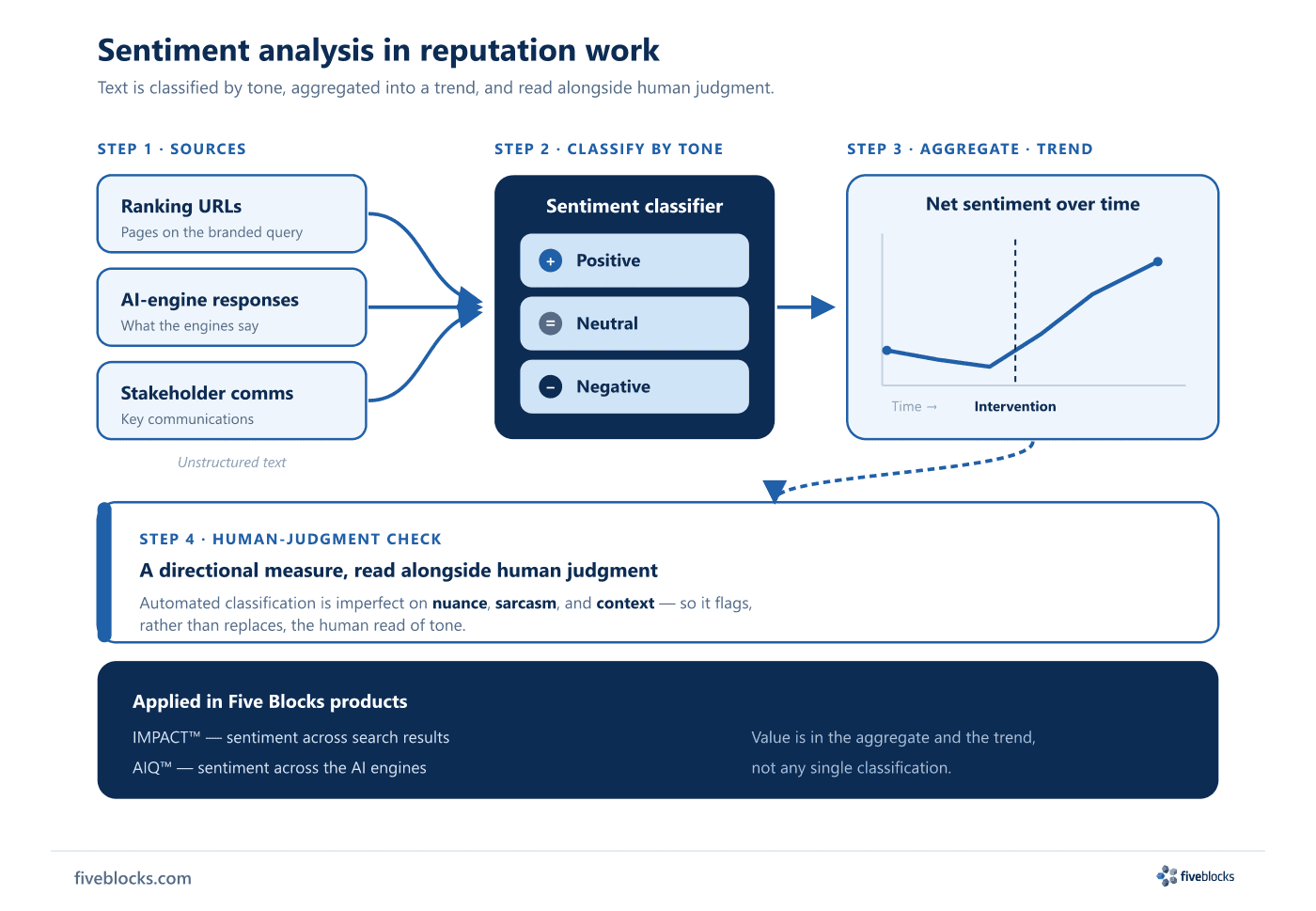
Sentiment analysis classifies content as positive, neutral, or negative. In reputation work it is applied to ranking URLs, AI-engine responses, and stakeholder communications to track which way overall tone is moving and whether an intervention shifted it.
Sentiment analysis classifies content by tone: positive, neutral, or negative. In reputation work, it is what turns large volumes of text into a signal that can be measured.
Where it is applied
- Ranking URLs: the pages that rank for branded queries, so the page-one picture can be scored.
- AI-engine responses: what the engines say about the entity, so the narrative can be tracked by tone.
- Stakeholder communications, where relevant.
What the measure is for
What matters is the aggregate and the trend, not any single classification. The measure shows which way the overall tone of the result set or the AI narrative is moving, and whether an intervention shifted it.
The honest caveat
Automated sentiment classification is imperfect on nuance, sarcasm, and context. Treat it as a directional measure to be read alongside human judgment, not as ground truth. Used that way, it shows whether reputation work is changing perception.
We apply sentiment analysis within IMPACT™ for search and AIQ™ for the AI engines, and report both the trend and the impact of interventions.
Last reviewed: 20/05/2026
