How do you build a multi-channel reputation monitoring program?
Cover the channels where reputation forms: search, the AI engines, Wikipedia, social, review platforms, news, and, where needed, the dark web. Then unify them into a single data layer with threshold-tuned alerting and integrated reporting. That unification is what makes it a program rather than seven disconnected tools, because it lets you read the whole reputation picture together instead of channel by channel.
A multi-channel monitoring program watches every layer where reputation is formed and contested, then pulls those layers together so the picture is coherent rather than fragmented. Unification is what separates a program from seven disconnected tools: one data layer holds the signals, alerting is tuned to thresholds that mean something, and reporting reads the channels as one connected picture.
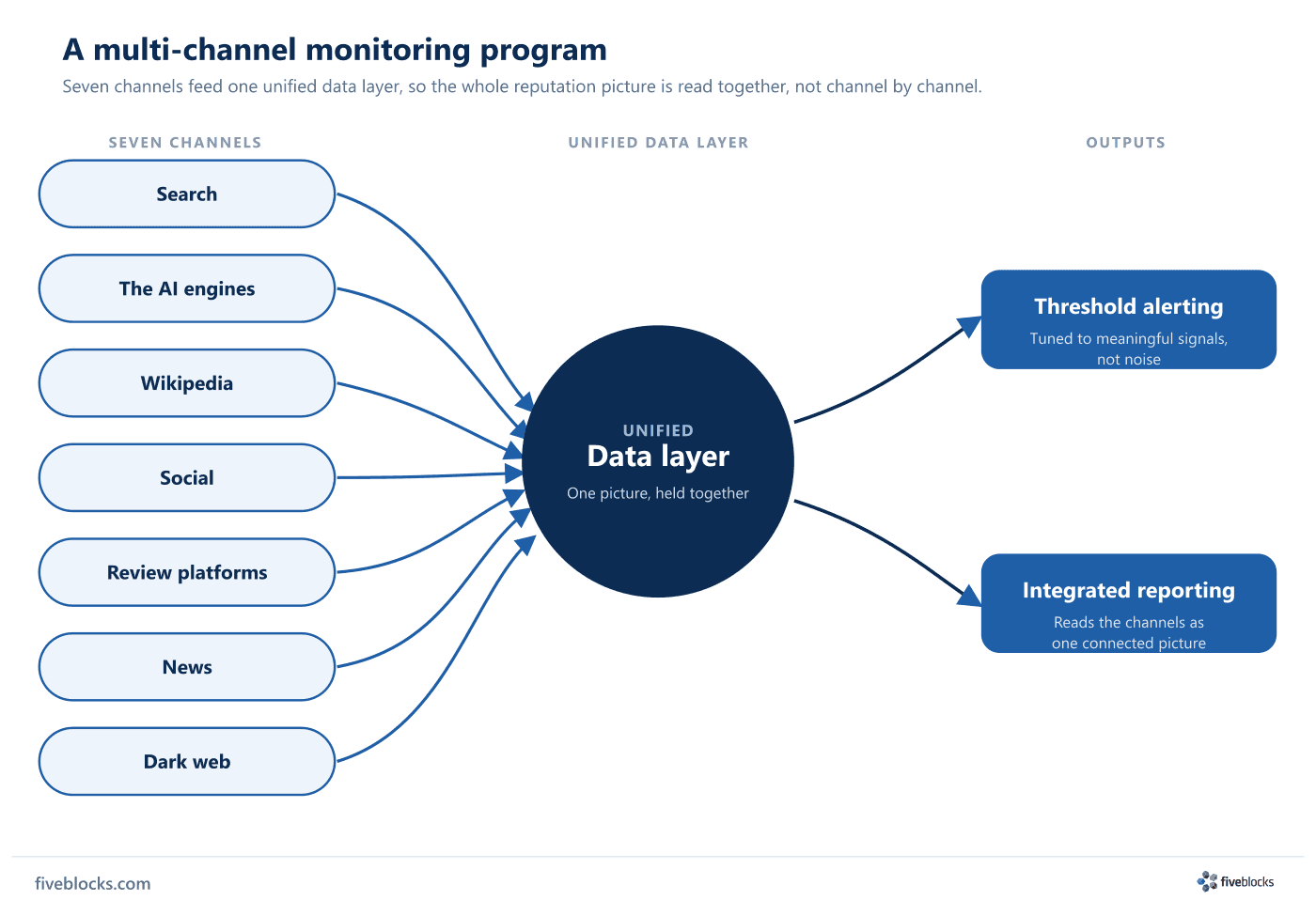
The channels to cover
- Search
- The core result set. What appears varies by geography and language, so tracking covers priority queries across locations and languages, not a single view.
- The AI engines
- Where stakeholders increasingly get their answers: ChatGPT, Gemini, Copilot, Perplexity, Claude, Grok, Google AI Overviews, and Google AI Mode.
- Wikipedia
- One of the most-visited sites on the internet and a heavily consulted reference. The article needs its own watch.
- Social
- Where issues often start and pick up speed. Velocity here is frequently visible before a story breaks.
- Review platforms
- Where customer and employee perception accumulates; AI engines synthesize recurring themes across these platforms into their answers.
- News
- Where coverage breaks, and where an emerging story can be caught while it is still forming.
- Dark web
- For organizations that need it, the closed channels where some threats originate before reaching the open web.
What makes it a program
Two things separate a real program from scattered alerts: unification and signal-to-noise tuning. Everything lands in one data layer, alert thresholds are set high enough to be worth acting on, and structured reporting presents the channels as one picture. Integration is the point. A problem in one channel often explains or predicts a symptom in another, and reading them separately misses the connection. Tuning is what keeps the program feeding decisions instead of flooding inboxes.
How Five Blocks builds it
Five Blocks builds this around IMPACT™ for search, AIQ™ for the AI engines, and WikiAlerts™ for Wikipedia, integrated with social, review, and news monitoring. Dark web coverage is added for organizations that require it.
Last reviewed: 20/05/2026
