What is the difference between reputation monitoring and reputation intelligence?
Monitoring is the data layer: the continuous capture of signals that answers "what is happening." Intelligence is the synthesis layer: the interpretation, prioritization, and strategy that answer "what to do about it." Both are required, and tools that conflate them tend to deliver only the first.
The difference comes down to capturing signals versus making sense of them. Monitoring answers what is happening; intelligence answers what to do about it. Both are necessary, and conflating the two is a common way a reputation program underdelivers.
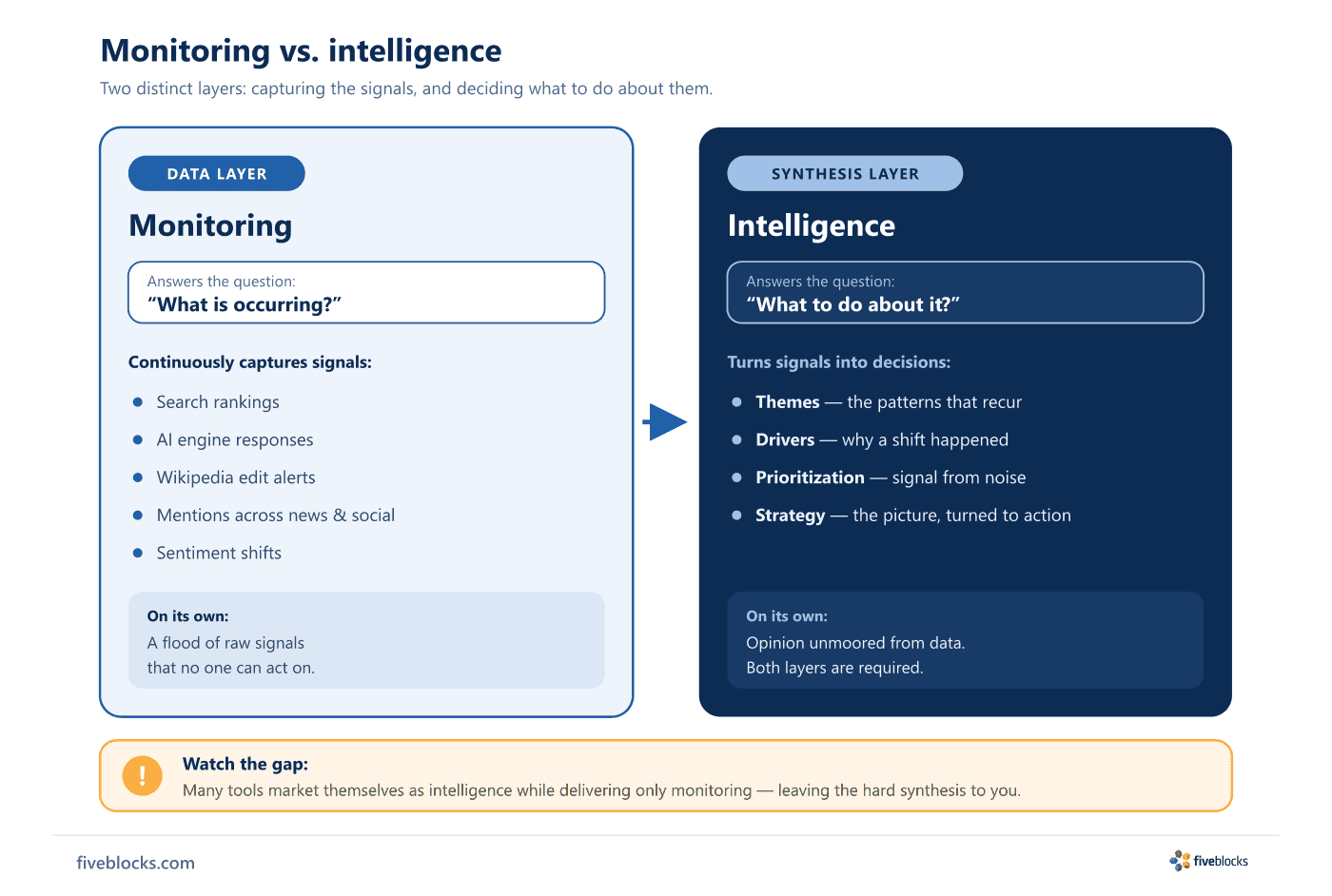
Monitoring: the data layer
Monitoring is the continuous capture of what is occurring across the places a reputation forms: search, the AI engines, Wikipedia, social, and news. It produces the raw material: rankings, AI responses, edit alerts, mentions, and sentiment shifts. That material is necessary, but on its own it is a feed of signals and nothing more. General-purpose monitoring tools such as Meltwater, Cision, and LexisNexis scan outlets and alert on brand mentions. Social tools like Brandwatch, Sprinklr, and Mention track mentions and detect sentiment shifts. All of them capture signal well. None of them does the interpreting for you.
Intelligence: the synthesis layer
Intelligence turns that feed into decisions. Interpretation identifies themes and diagnoses what is driving a shift instead of only noting that one happened. Prioritization separates signal from noise. Strategy translates the picture into action. This is analytical work that takes a position, and no dashboard produces it on its own.
Why both are required
| Reputation monitoring | Reputation intelligence | |
|---|---|---|
| What it is | The data layer | The synthesis layer |
| Question it answers | What is occurring? | What to do about it? |
| Output | Signals: rankings, AI responses, edits, mentions, sentiment | Themes, drivers, prioritization, and strategy |
| On its own | A flood no one can act on | Opinion unmoored from data |
Intelligence without monitoring is opinion detached from evidence. Monitoring without intelligence is a flood no one can act on. The distinction is worth drawing because many tools present themselves as intelligence while delivering only monitoring, which leaves the hard synthesis to the client. The two layers only pay off together.
How Five Blocks handles each layer
We run the monitoring through IMPACT™ for search, AIQ™ for the AI engines, and WikiAlerts™ for Wikipedia. AIQ™ tracks how a brand is represented across eight engines (ChatGPT, Copilot, Gemini, Google AI Overviews, Perplexity, Grok, Claude, and Google AI Mode), so you can see which version of your brand story is winning and where. The intelligence is the deliverable built on top of that data: the interpreted, prioritized output where decisions actually get made.
Last reviewed: 20/05/2026
