How do you use natural language processing to analyze reputation data?
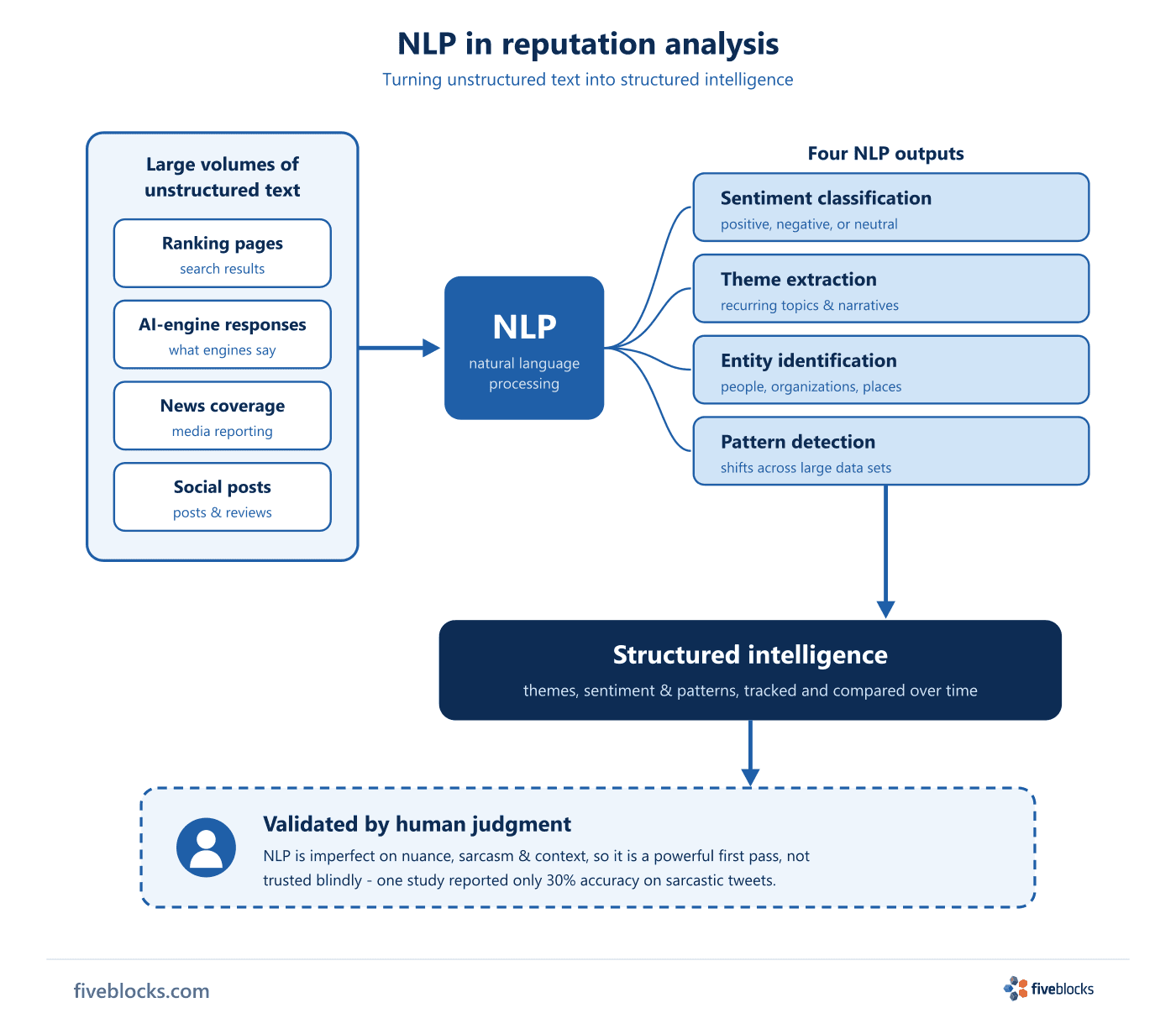
Natural language processing classifies sentiment, extracts recurring themes, identifies and disambiguates entities, and detects patterns across large volumes of content. That converts unstructured text into structured intelligence. NLP is imperfect on nuance, sarcasm, and context, so it works as a first pass that human judgment validates rather than a result to trust blindly.
Natural language processing is what makes reputation analysis possible at scale. The relevant text – ranking pages, AI-engine responses, news coverage, and social posts – runs well past what any team could read by hand. NLP turns that volume into structured signal a program can analyze and a leader can act on.
What NLP does with reputation data
- Classifies sentiment
- Examines text such as social posts, reviews, and coverage to determine whether the expressed opinion is positive, negative, or neutral. Tone across a large body of content gets measured instead of read one item at a time.
- Extracts themes
- Pulls out the recurring topics and narratives running through coverage, so a program can see what is being said across the whole body of content rather than in one article.
- Identifies entities
- Inspects text for known entities – people, organizations, places – and disambiguates who and what is being discussed, including brand mentions that carry no hyperlink.
- Detects patterns
- Finds relationships and shifts across large data sets that no human would catch document by document.
The output is structured intelligence: unstructured web content converted into themes, sentiment, and patterns that can be tracked and compared over time.
A first pass, not ground truth
Automated NLP is imperfect on nuance, sarcasm, and context. Research on sentiment analysis with large language models found that models struggled with sarcastic text: one study reported accuracy as low as 30% on sarcastic tweets in a specialized domain. The same content can also be classified differently depending on which model reads it and how the text is phrased. So NLP is a first pass that human judgment validates, not a result to trust blindly. Used that way, it lets a program reason across the whole body of content instead of a handful of documents.
We apply NLP within IMPACT™ and AIQ™ to turn large volumes of content into themes, sentiment, and patterns.
Last reviewed: 20/05/2026
