What is reputation intelligence and how does it differ from monitoring?
Reputation intelligence is the synthesis of monitoring data into strategy - themes, drivers, peer comparisons, and prioritized recommendations - whereas monitoring alone produces raw signals without interpretation.
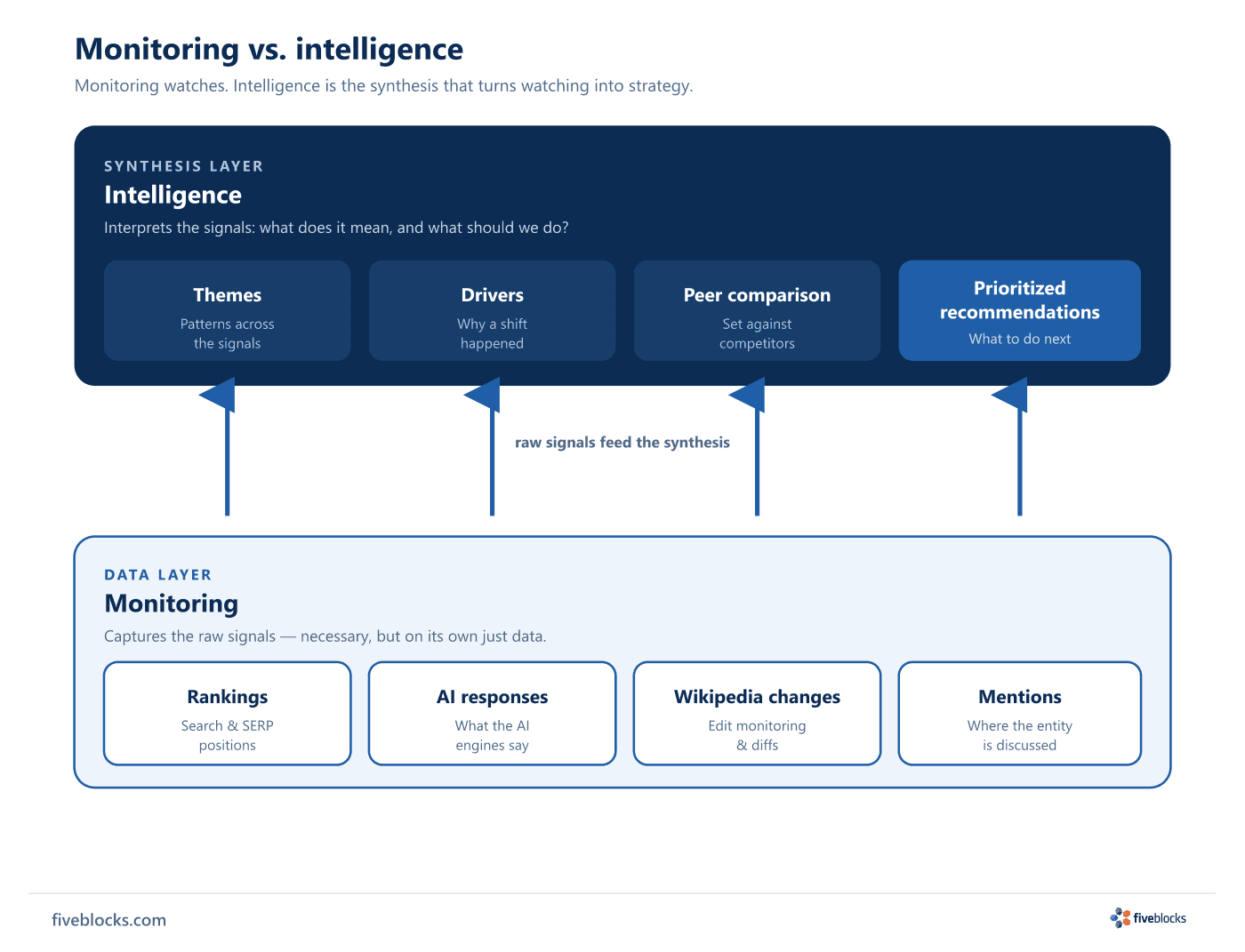
Reputation intelligence sits above monitoring. Monitoring captures the signals; intelligence interprets them into something an organization can act on. The raw material – rankings, AI-engine responses, Wikipedia changes, mentions – is necessary, but on its own it is just data. Intelligence is the synthesis: naming the themes across those signals, diagnosing what drove a shift rather than just noting the shift, setting the entity against its peers, and turning all of it into prioritized recommendations.
Monitoring vs. intelligence at a glance
| Monitoring | Intelligence | |
|---|---|---|
| Role | The data layer | The synthesis layer |
| Output | Raw signals: rankings, AI-engine responses, Wikipedia changes, mentions | Themes, drivers, peer comparison, prioritized recommendations |
| Question it answers | What is happening? | What does it mean, and what should we do about it? |
| For a decision-maker | Necessary, but data alone can overwhelm rather than inform | Turns watching into strategy an organization can act on |
Why synthesis does the work
Data without interpretation overwhelms rather than informs. A leader handed a thousand data points is no better off than one handed none. Most of what a reputation program is worth lives in this synthesis layer, because synthesis is what turns watching into strategy. That means real analysis with a point of view, not a prettier dashboard.
In practice, the data from IMPACT™ (search and SERP tracking), AIQ™ (what the major AI engines say), and WikiAlerts™ (Wikipedia edit monitoring) is the input. The intelligence – themes, drivers, prioritized recommendations – is the deliverable, because that is what decisions get made on.
Last reviewed: 20/05/2026
