What is a vulnerability assessment for digital reputation?
A digital vulnerability assessment maps six exposure categories: entity signal gaps (missing Wikidata identifiers, incomplete schema, fragmented sameAs links), SERP fragility (single-asset dominance, hostile content within range), missing Wikipedia presence, AI source quality across leading AI engines, social platform exposure, and monitoring coverage gaps. The output is a prioritized risk register that ranks recommended interventions by effort and risk, and it becomes the roadmap for proactive reputation work.
A digital vulnerability assessment finds where a company’s digital footprint would take damage if it were tested. It examines six exposure categories and delivers a prioritized risk register: specific recommended interventions ranked by effort and risk, which then becomes the roadmap for proactive reputation work.
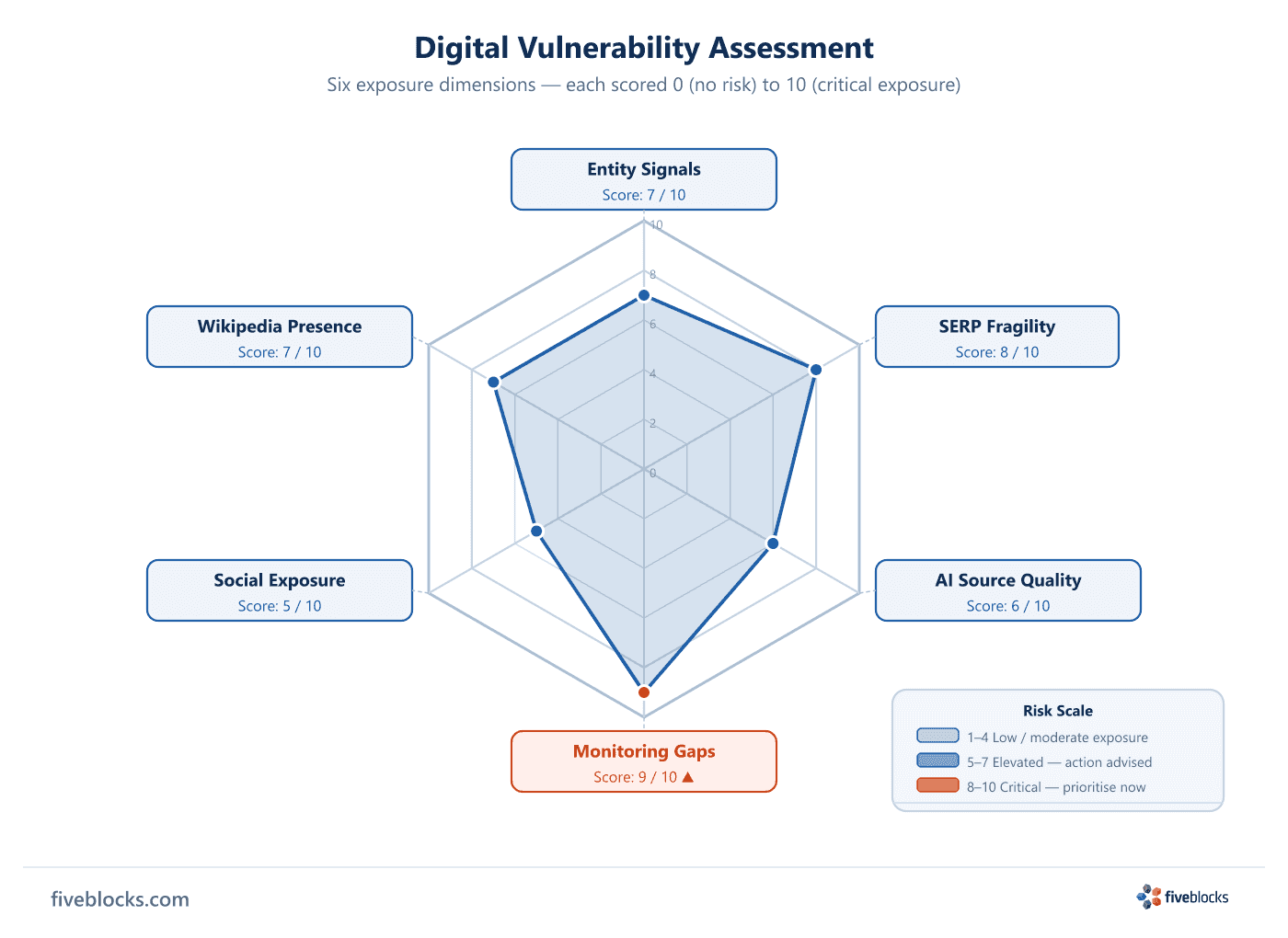
- Entity signals
- Missing Wikidata identifiers, incomplete schema markup, and fragmented sameAs links mean the search and AI engines may fall back on weaker sources when they describe the company. Thin entity infrastructure is a structural problem that reaches every other channel.
- SERP fragility
- The page-one composition for branded queries is checked for single-asset dominance, hostile or outdated content within ranking range, and owned properties that have lost authority. A fragile SERP turns manageable problems into crises because it gives the engines nowhere better to send traffic.
- Wikipedia presence
- Missing or thin Wikipedia coverage is a recurring finding and an exposure category on its own. The article, or its absence, shapes how the AI engines describe the company, how journalists summarize it, and what stakeholders read first.
- AI source quality
- Running structured prompts through the eight engines AIQ currently tracks shows which sources the models actually weight and whether any of them are problematic, outdated, or misattributed. Most companies have never audited this layer.
- Social platform exposure
- Glassdoor, Reddit, LinkedIn, and platform-specific communities are checked for sentiment, narrative concentration, and the odds that their content is being pulled into AI engine responses.
- Monitoring coverage gaps
- Where would the company miss a problem until it had already escalated? Coverage gaps in search monitoring, AI narrative tracking, and social listening are mapped and ranked by the severity of the blind spot they create.
Findings are ranked by risk severity and intervention effort together, which keeps the roadmap practical: high-risk, low-effort fixes go first, and complex structural work is sequenced behind them.
Last reviewed: 19/05/2026
