What does ‘crisis-proofing’ a reputation actually involve?
Crisis-proofing a reputation is better described as building crisis-resistance: an infrastructure that absorbs a shock without losing the underlying picture. The five layers are entity strengthening (Wikidata, schema, sameAs, Knowledge Graph), a current and well-sourced Wikipedia article, authoritative owned content on sensitive topics, continuous monitoring through IMPACT and AIQ, and pre-approved response templates with named owners and twice-yearly drills.
The term “crisis-proofing” overpromises. No infrastructure makes a reputation invulnerable. The accurate term is crisis-resistance: an infrastructure that absorbs a shock without losing the underlying picture. Built well, it decides whether a serious event becomes a chapter or a defining narrative. The five layers are distinct, and each has to be in place before the event, not assembled under pressure.
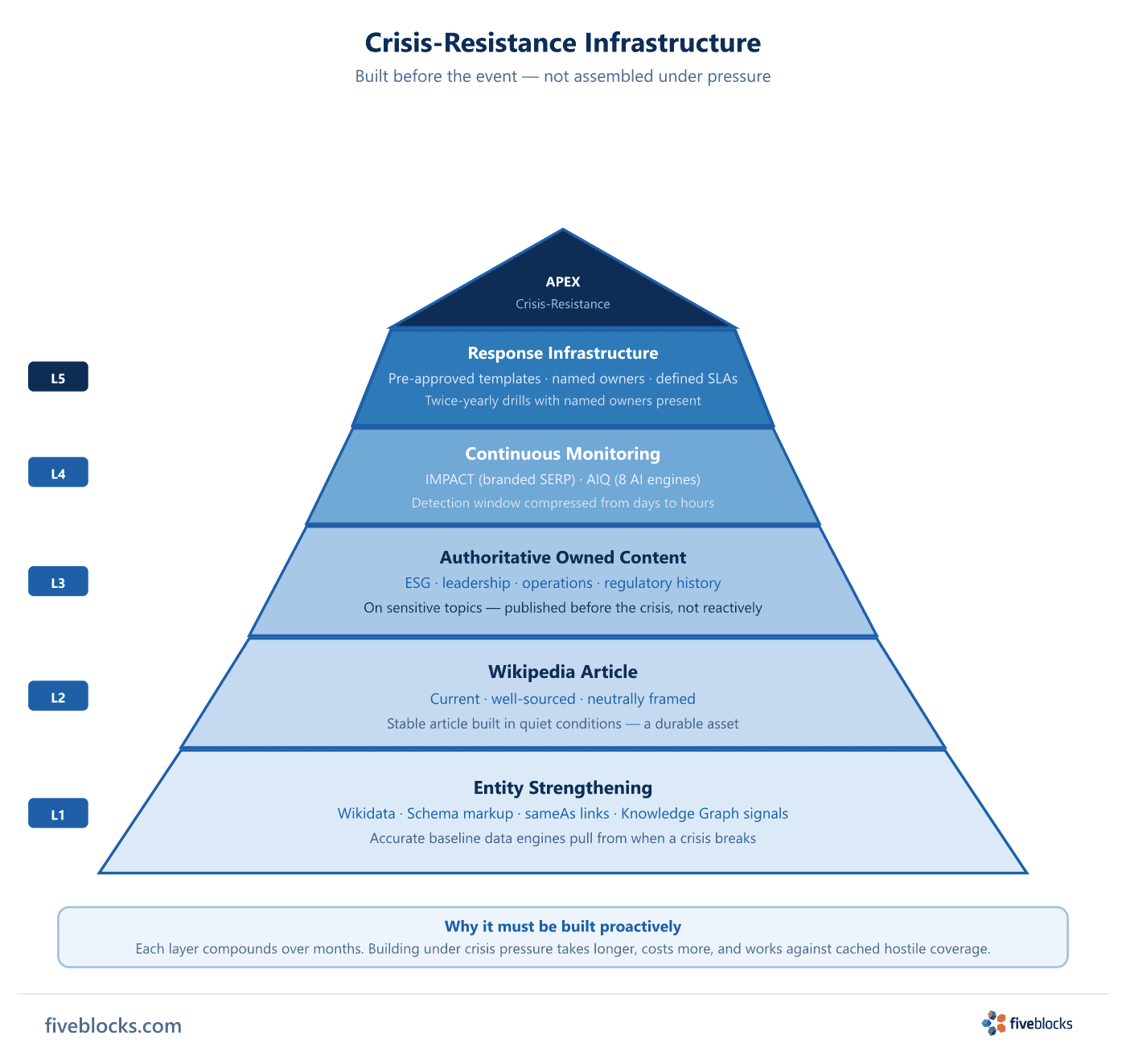
The five infrastructure layers
- Entity strengthening
- Wikidata records, Organization and Person schema markup, sameAs links to verified profiles, and Knowledge Graph signals have to be current and accurate. When a crisis breaks, the engines pull from whatever baseline data they hold; good entity signals mean that baseline is accurate rather than a distorted starting point.
- Wikipedia presence
- The article has to be current, well-sourced, and neutrally framed before any crisis. Articles edited at the last minute under contested conditions rarely hold. Experienced editors are wary of significant changes that coincide with a hostile story, and rushed edits are more likely to be reverted than accepted. A stable, accurate article written in quiet conditions is a durable asset; a stub or an outdated article is a liability.
- Authoritative owned content on sensitive topics
- ESG practices, leadership background, operational standards, regulatory history, wherever a crisis is most likely to land, owned pages on those topics give the press and AI engines material to cite that is not the contested version. This content has to exist before the crisis, because content published reactively carries less authority than an established page with age and inbound links.
- Continuous monitoring
- IMPACT tracks the branded SERP across priority queries continuously, so any shift in ranking composition shows up within hours. AIQ monitors what the eight major AI engines: ChatGPT, Copilot, Gemini, AI Overview, Perplexity, Grok, Claude, and Google AI Mode, are saying about the brand in real time, catching narrative shifts before they cache widely. Together they cut the detection window from days to hours.
- Pre-approved response infrastructure
- Response templates reviewed by counsel for each likely scenario. Named owners with defined decision authority and SLAs. Escalation triggers stated explicitly rather than left to judgment. Twice-yearly drills with the named owners present. The drills are what turn a document into a practiced capability; a playbook that has never been exercised is not crisis infrastructure, it is a filing artifact.
Why it must be built proactively
Most of the durable work above: Wikipedia article work, source-layer entity engineering, authoritative content build-out, builds up over months. It cannot be fast-tracked under crisis conditions. Wikipedia editors are skeptical of major article changes that appear the week a hostile story breaks. AI engines weight recently published content lower than the established record. Building the same infrastructure under crisis pressure takes longer, costs more, and runs up against entrenched contested coverage that has already cached and spread. Clients who run consistent proactive programs absorb crises more cleanly than those who do not.
Last reviewed: 19/05/2026
