Why is being proactive more effective than reacting to a crisis?
Proactive reputation infrastructure: Wikipedia, Knowledge Panel, owned content, entity signals, is far cheaper to build before a crisis than after. The same work under crisis pressure costs significantly more, takes longer, and has to fight entrenched contested coverage that has already spread across the digital record.
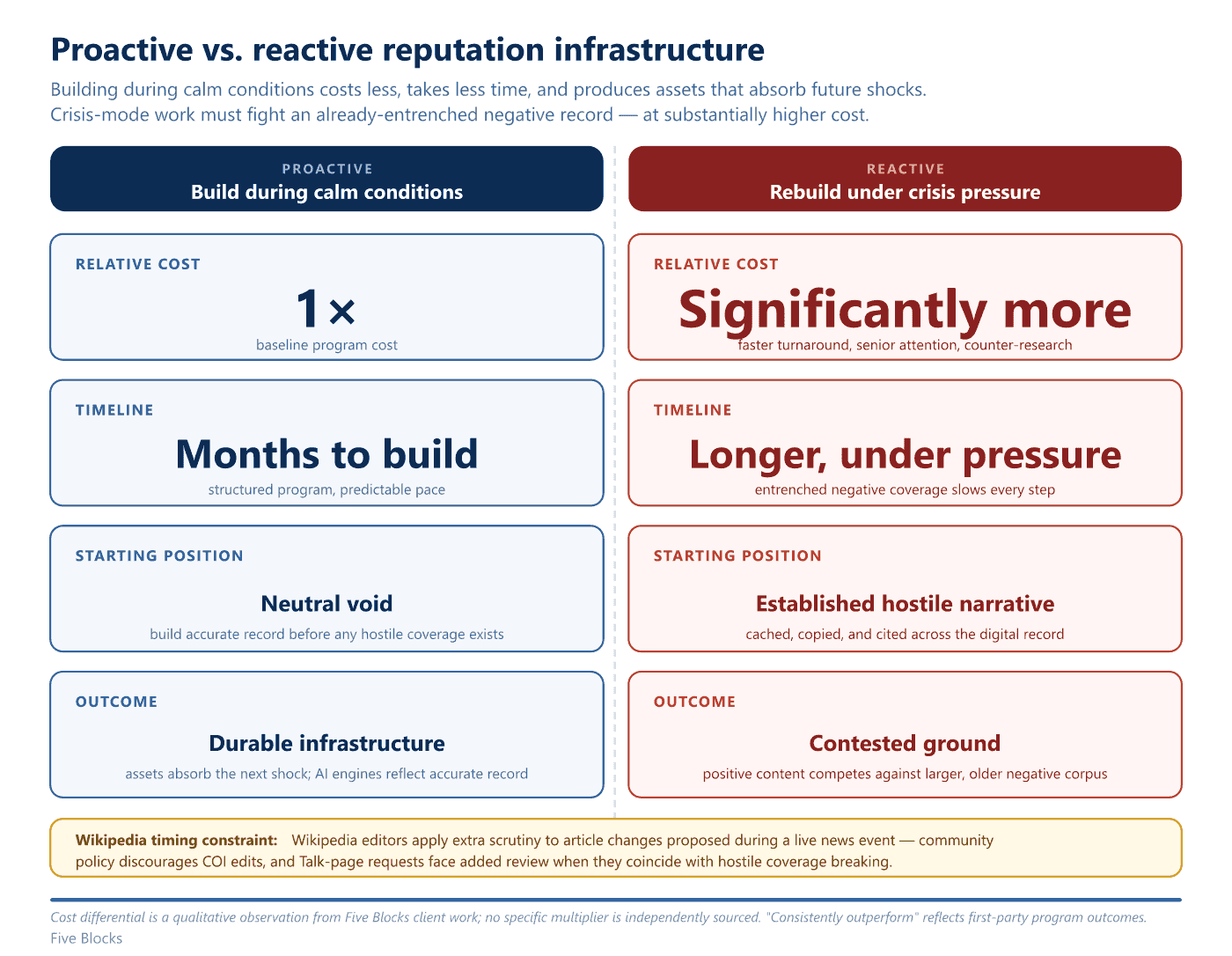
The economics of proactive versus reactive reputation work are not close. Building an accurate Wikipedia article, a stable Knowledge Panel, current entity signals, and authoritative owned content during calm conditions takes months, but it produces durable assets that absorb the next shock. The same work under crisis pressure costs significantly more, takes longer, and has to fight entrenched contested coverage that has already been cached, copied, and quoted across the digital record.
Why reactive work is harder, and more expensive
- Higher cost under pressure. Crisis-mode work needs faster turnaround, more senior attention, and more research to counter established negative coverage, which pushes costs well above what proactive programs require.
- The Wikipedia timing constraint. Wikipedia editors are cautious about significant article changes proposed the week a hostile story breaks. Community policy discourages direct edits by parties with a conflict of interest, and the Talk-page edit-request process, already the correct channel, gets extra scrutiny when the request coincides with a live news event.
- Contested coverage becomes entrenched. Once hostile coverage has been cached, republished, and cited across the digital record, each new source references the earlier ones. Correcting the record means displacing an established narrative rather than building into a neutral void.
- AI engines reflect the established record. AI answer engines synthesize from the corpus of indexed content. Crisis-period positive content competes against a larger, older body of negative or contested material that was already part of the training and retrieval base.
What consistent proactive programs produce
Clients who run consistent proactive programs, keeping Wikipedia coverage accurate, entity signals current, and owned content authoritative on sensitive topics, do better on crisis outcomes. The infrastructure absorbs the shock instead of collapsing under it. The cost gap between building proactively and rebuilding reactively is the clearest financial argument for treating reputation as ongoing infrastructure rather than emergency spend.
Last reviewed: 19/05/2026
