What is Five Blocks’ approach to proactive vs reactive reputation management?
Proactive reputation work, building a Wikipedia article, an optimized Knowledge Panel, authoritative owned content, and consistent entity signals before they are needed, almost always delivers stronger and faster results than reactive crisis response. Reactive work is possible, but it starts at a disadvantage: it costs more, takes longer to show results, and has to compete against negative content that may already be entrenched in search and AI answers.
Five Blocks has found repeatedly that proactive reputation infrastructure delivers stronger, faster results than reactive crisis response. The gap is not small. Search engines and AI models weight established content over content that was just built, and that difference explains most of it.
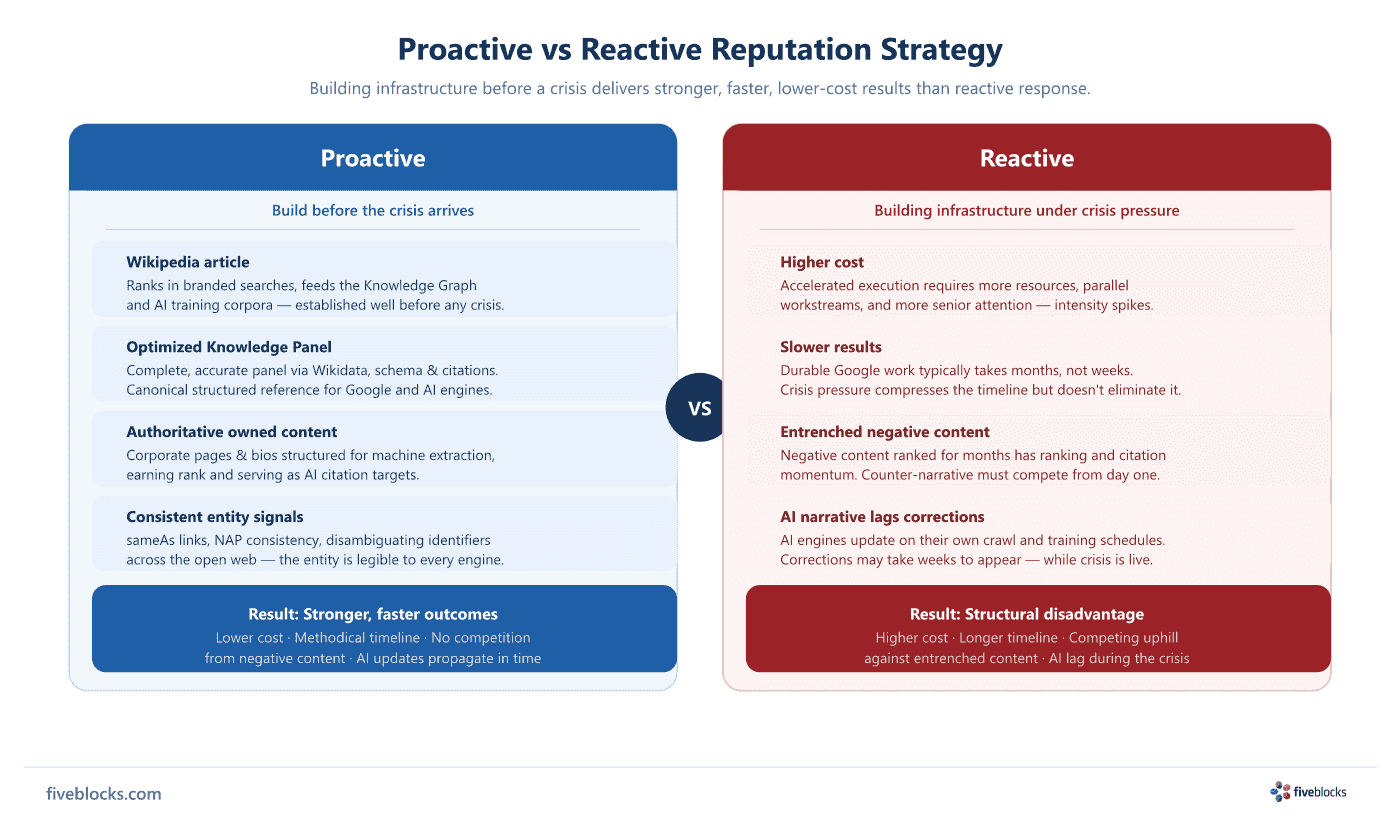
What proactive reputation infrastructure looks like
A well-prepared entity has four layers in place before a crisis occurs:
- Wikipedia article, where notability supports one: a well-sourced, accurate, NPOV-compliant article that ranks in branded searches and feeds the Knowledge Graph and AI training corpora.
- Optimized Knowledge Panel: a complete, accurate panel populated through Wikidata, schema markup, and third-party citations, so Google and AI engines have a canonical structured reference for the entity.
- Authoritative owned content: corporate site pages, executive bio pages, and thought leadership content structured for machine extraction, ranking for priority queries and serving as citation targets for AI engines.
- Consistent entity signals: sameAs links, NAP consistency, and disambiguating identifiers across the open web, so the entity is legible to every engine that matters.
The layers reinforce each other. Wikipedia feeds the Knowledge Panel. The Knowledge Panel signals legitimacy to AI engines. Owned content fills SERP positions and provides AI citation targets. Entity signals connect the picture. When a crisis hits, this infrastructure is already in place, and engines have been reading it for months or years.
What reactive crisis response looks like, and where it falls short
Reactive work during a crisis is necessary, and Five Blocks does it. But it starts from a weaker position:
- Negative content may already be entrenched. Search engines and AI models weight content that has ranked or been cited for a sustained period over content that appeared yesterday. Building a counter-narrative from scratch during a crisis means competing against that established position.
- The work takes longer to show results. Durable Google work, earned rank, citation patterns, and entity signal reinforcement typically takes months, not weeks. Crisis pressure compresses that timeline but does not remove it.
- The cost is higher. Doing in weeks what should have taken months requires more resource, more parallel execution, and more senior attention. Infrastructure that could have been built methodically over six months now has to be stood up at higher intensity.
- AI narratives lag corrections. AI engines update on their own crawl and training schedules, not on the client’s timeline. A correction to Wikipedia or a new authoritative placement may take weeks to reach the engines’ outputs, and that lag hurts more when a crisis is live.
Proactive vs reactive: the main differences
| Dimension | Proactive | Reactive |
|---|---|---|
| Typical infrastructure | Wikipedia, Knowledge Panel, owned content, entity signals, built before they are needed | Same infrastructure, built under crisis pressure, from a weaker starting position |
| Time to results | Months of steady build; durable once established | Longer in absolute terms because negative content has a head start |
| Cost | Lower, methodical execution over a planned timeline | Higher, accelerated execution, more parallel workstreams, more senior time |
| Competition from negative content | None, the positive infrastructure is already established | High, entrenched negative content has ranking and citation momentum |
| AI engine propagation | Corrections and updates have time to propagate before they are needed | Corrections may take weeks to appear in AI outputs while the crisis is live |
The practical implication
For most organizations, the best crisis management investment is building the proactive foundation before a crisis occurs. Organizations that arrive at Five Blocks mid-crisis almost always wish they had started earlier. Those that have invested in the proactive layer, even partially, come through crises faster, at lower cost, and with less lasting damage to their search and AI representation.
Last reviewed: 19/05/2026
