What is reactive reputation management?
Reactive reputation management addresses problems that have already emerged - hostile news cycles, AI misrepresentations, Wikipedia attacks. It is slower and costlier than proactive work because the negative results have already accumulated authority and Google sets the pace. A disciplined program still corrects the record, builds authoritative counter-content, and rebalances the SERP and the AI narrative over time.
Reactive reputation management addresses problems that have already emerged, and it comes with constraints the client did not choose. A negative article from a major outlet has already accumulated link authority and freshness signals. An inaccurate Wikipedia sentence has already been quoted by an AI engine. A name SERP has already settled into a problematic composition.
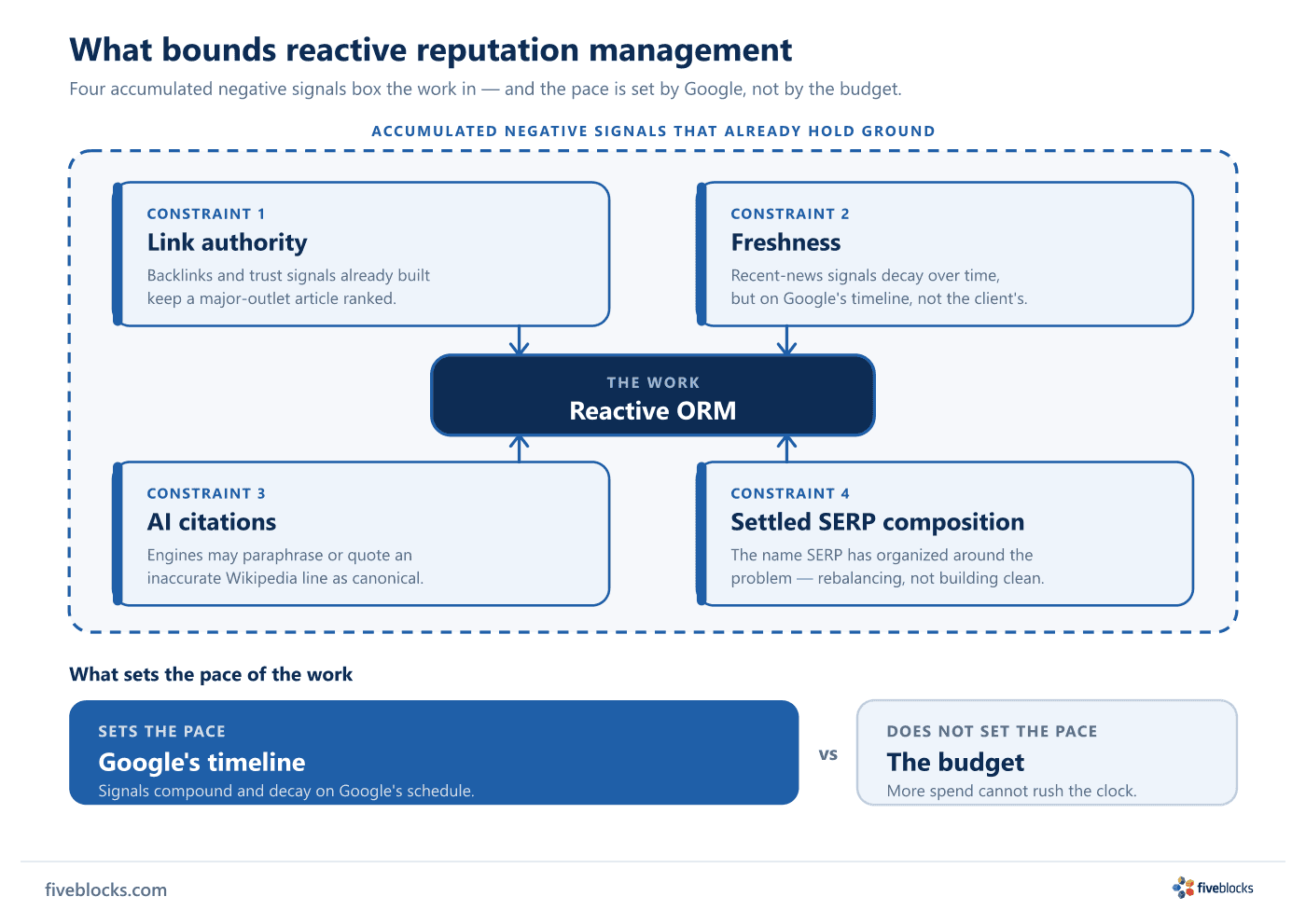
Why reactive work is bounded by what is already there
The work is still doable, but the pace is set by Google, not by the budget. Each accumulated negative signal has to be worked down or displaced, and that takes time:
- Link authority. A major-outlet article has already built backlinks and trust signals that keep it ranked, and an unaddressed piece can hold a top-page branded position for a long time.
- Freshness. The negative coverage carries recent-news freshness signals. These decay over time and reduce its prominence, but on Google’s timeline, not the client’s.
- AI citations. Once an inaccurate line is published, AI engines may paraphrase or quote it, particularly when it sits in a Wikipedia article that engines treat as a canonical reference.
- Settled SERP composition. The name SERP has already organized itself around the problem, so the program is rebalancing an established page rather than building a clean one.
The honest trade-offs
Reactive engagements run longer and cost more per month, and they start with a candid assessment of which outcomes are realistic. The program will improve the situation measurably, but it will not erase the prior six months of news coverage by month two. Anyone promising otherwise is either inexperienced or selling something else.
What reactive work does well
Accepting those constraints is not the same as accepting the situation. Within them, reactive reputation management still does substantial work:
- Corrects the record. Where a claim is inaccurate, the path forward is accurate counter-content and, for a canonical source like Wikipedia, a disclosed, policy-compliant correction request on the article’s Talk page, so engines that cite it begin quoting the accurate version.
- Builds authoritative counter-content. Substantive, well-sourced material earns the link authority and freshness that displace an unaddressed negative over time. This rebalances the name SERP toward an accurate composition rather than fighting each result one by one.
- Strengthens the entity’s own signals. Consistent, structured facts across owned properties and entity records such as Wikidata give both Google and AI engines a reliable reference to anchor to, which is what shifts the AI narrative at the source.
- Measures the movement. Continuous monitoring of the SERP and of what AI engines actually say, the kind AIQ and IMPACT run, turns “it feels better” into tracked, reportable change and flags new problems early.
The work is exacting: sequencing corrections, counter-content, entity signals, and monitoring against Google’s timeline rather than a wished-for one. This is where a firm like Five Blocks does its job, running reactive programs candidly, on evidence, without promising the impossible.
Last reviewed: 19/05/2026
