What is online reputation management?
Online reputation management is the practice of shaping how a brand, executive, or organization is accurately represented across the digital layers where people form opinions: Google search, the AI answer engines, Wikipedia, the Knowledge Graph, and the authoritative sources those engines synthesize. The work is structural, not promotional.
Online reputation management is the practice of shaping how a brand, executive, or organization appears across the digital layers where people decide what to think about them. It is structural, not promotional. The goal is not to generate positive content but to make sure the authoritative sources, entity signals, and content infrastructure that engines weight most heavily reflect the company or person accurately.
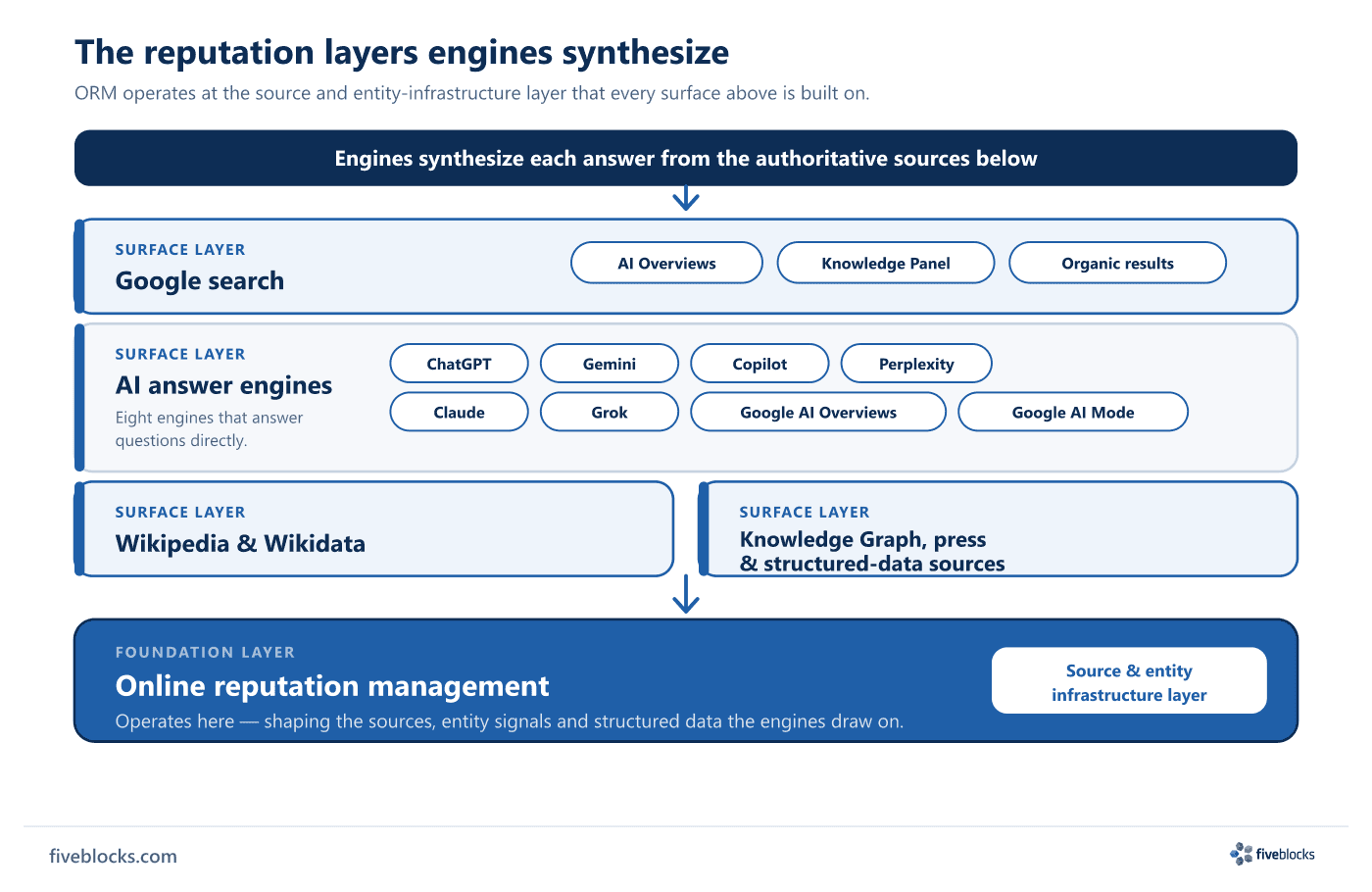
The layers a reputation lives in
A reputation is assembled across several connected layers, each of which feeds the others:
- Google search. The branded results page, including AI Overviews, the Knowledge Panel, and organic results.
- AI answer engines. The engines that now answer questions about companies and people directly: ChatGPT, Gemini, Copilot, Perplexity, Claude, Grok, Google AI Overviews, and Google AI Mode.
- Wikipedia. Heavily weighted in the training corpora of major LLMs, a frequent retrieval target, and a primary feed into the Knowledge Graph and Wikidata.
- The Knowledge Graph and Wikidata. The machine-readable entity layer that engines such as Gemini query directly for canonical facts, and that populates the Google Knowledge Panel.
- Press, structured data, and third-party sources. The coverage, schema markup, and business references the engines draw on and rank by authority when assembling an answer.
Why the work is structural
AI engines do not give you an editable output you can correct. They synthesize each answer from underlying source content, weighting it by authority, recency, and entity context. So the way to influence them is to shape the sources, entity signals, and structured data the models draw on, not the engines themselves. That is why reputation management works at the source and entity-infrastructure layer.
Done well, the work is largely invisible: people find what they need to find when they search.
Last reviewed: 19/05/2026
