How is AI reputation management different from traditional SEO?
SEO targets ranking on Google for keyword queries. AI reputation management targets the content and framing of AI responses across the popular LLMs; the eight engines AIQ currently tracks are ChatGPT, Copilot, Gemini, AI Overview, Perplexity, Grok, Claude, and Google AI Mode. It tracks which sources are cited, how the narrative changes, and how the brand compares to peers. The unit of measurement, toolset, source ecosystem, and success criteria are all different.
SEO and AI reputation management both care about how brands appear online, but the unit of measurement, toolset, source ecosystem, and success criteria are different. Treat one as a version of the other and the work misses the actual problem.
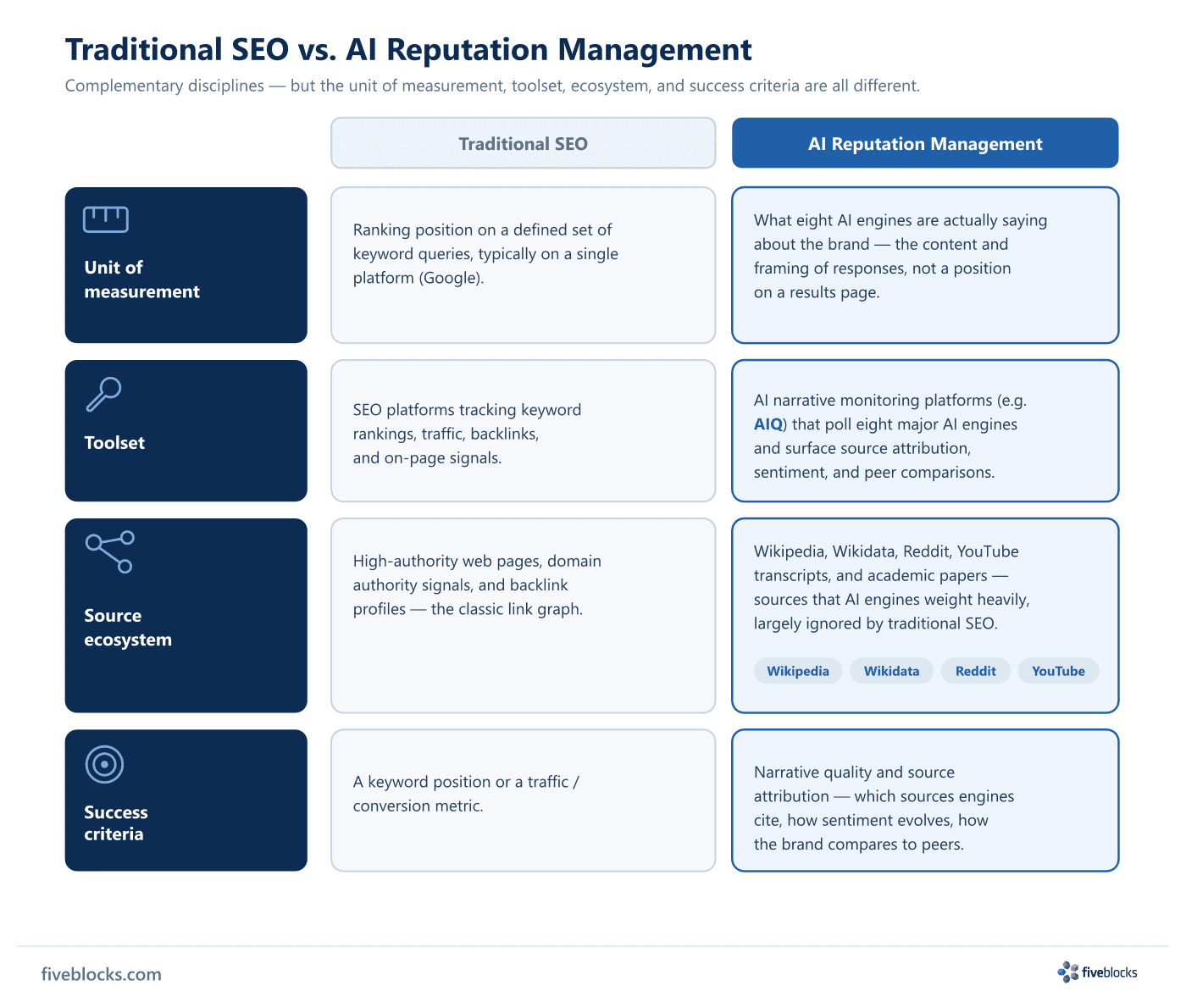
Traditional SEO vs. AI reputation management
| Traditional SEO | AI reputation management | |
|---|---|---|
| Unit of measurement | Ranking position on a defined set of keyword queries, usually on one platform (Google) | What the leading AI engines actually say about the brand, the content and framing of AI responses, not a position on a results page |
| Toolset | SEO platforms tracking keyword rankings, traffic, backlinks, and on-page signals | AI narrative monitoring platforms (such as AIQ) that poll the eight engines AIQ currently tracks and surface source attribution, sentiment, themes, and peer comparisons |
| Source ecosystem | High-authority web pages, domain authority signals, and backlink profiles, the classic link graph | Wikipedia, Wikidata, Reddit, YouTube transcripts, and academic papers, which carry heavy weight in AI training and retrieval and which traditional SEO largely ignored |
| Success criteria | A keyword position or a traffic / conversion metric | Narrative quality and source attribution: which sources the engines cite, how sentiment and themes are changing, and how the brand compares to peers across each engine |
Why the distinction matters
AI engines do not rank pages; they synthesize answers. The question is not “where do we rank” but “what are ChatGPT, Gemini, Perplexity, and the rest actually saying about us, and why.” The sources AI engines weight, Wikipedia, Reddit threads, academic citations, and video transcripts, have little to do with the backlink-and-keyword graph that SEO optimizes. A brand can rank first on Google and still be described inaccurately, incompletely, or unfavorably across every major AI engine.
SEO and AI reputation management are complementary, but the work, the tools, and the way success is measured differ enough that running one program and expecting it to cover the other leaves a gap.
Last reviewed: 19/05/2026
