How is ORM different from standard SEO for brand management?
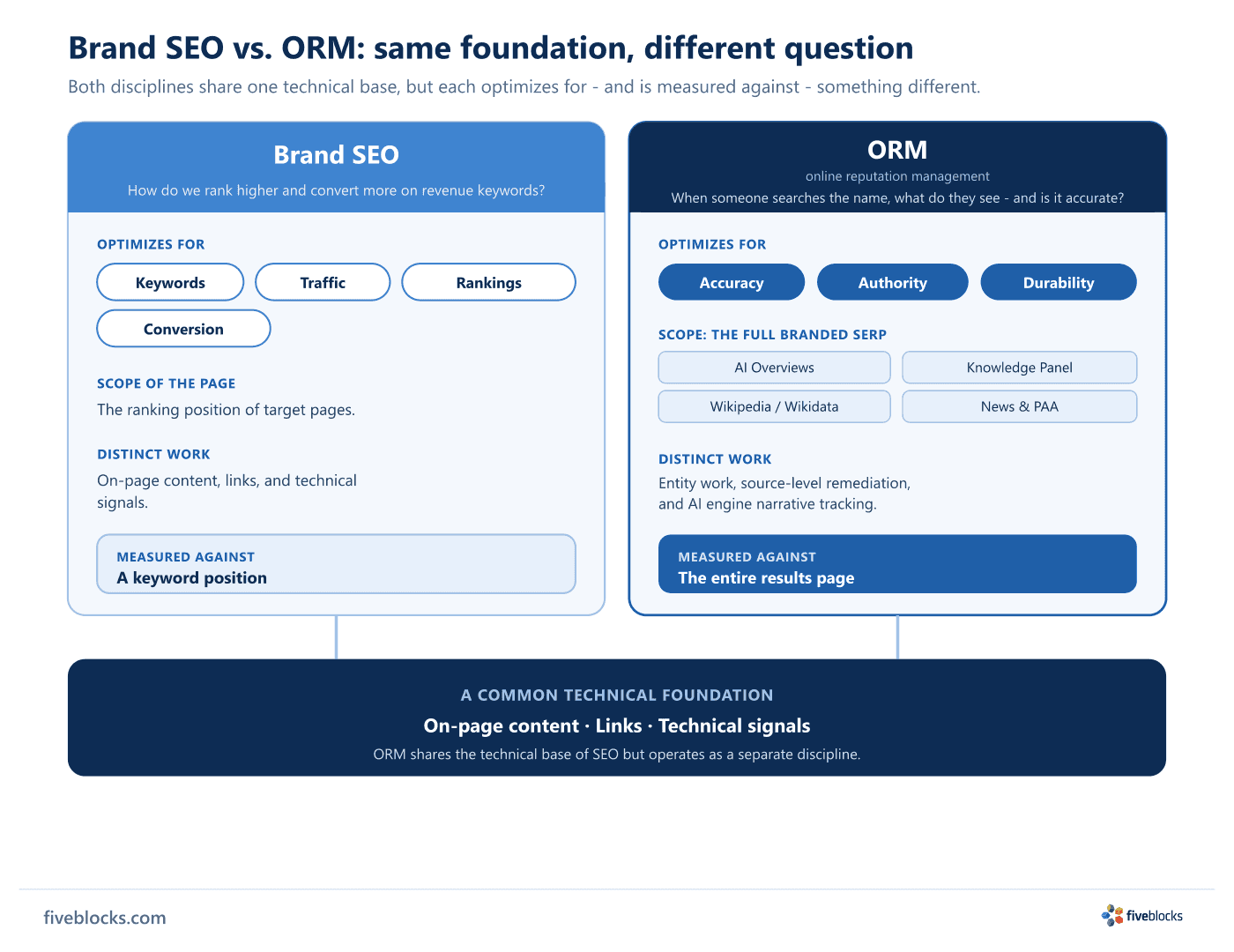
Brand SEO optimizes for commercial keywords, traffic, and conversion. ORM optimizes the entire branded SERP - including AI Overviews, Knowledge Panels, news, and reputational queries - for accuracy, authority, and durability, measured against the whole results page rather than a keyword position.
Brand SEO and ORM share the same technical foundation but answer different questions. Brand SEO asks: how do we rank higher and convert more traffic on the keywords that drive sales. ORM asks: when an investor, journalist, regulator, customer, or candidate searches the brand or an executive’s name, what do they actually see, and is it accurate, authoritative, and complete.
Brand SEO vs. ORM at a glance
| Brand SEO | ORM (online reputation management) | |
|---|---|---|
| Core question | How do we rank higher and convert more on revenue keywords | When someone searches the name, what do they see – and is it accurate, authoritative, and complete |
| Optimizes for | Keyword rankings, traffic, and conversion | Accuracy, authority, and durability of the whole branded results page |
| Scope of the page | The ranking position of target pages | The full branded SERP: AI Overviews, Knowledge Panel, news box, People Also Ask, and reputational queries |
| Distinct work it forces | On-page content, links, and technical signals | Wikipedia and Wikidata entity work, source-level remediation of inaccurate articles, Knowledge Panel optimization, and AI engine narrative tracking |
| Measured against | A keyword position | The entire results page |
The work ORM forces that SEO rarely touches
The ORM question forces work that brand SEO rarely touches: Wikipedia and Wikidata entity work, source-level remediation of inaccurate articles, Knowledge Panel optimization, AI engine narrative tracking, and the full composition of the branded SERP – the news box, People Also Ask, and AI Overviews.
That is the core distinction. ORM is measured against the entire results page, not a single keyword position. It shares the technical foundation of SEO but runs as a separate discipline.
Last reviewed: 19/05/2026
