How do you stress-test your digital reputation before a major announcement?
Pre-announcement stress-testing runs three workstreams in sequence: AI narrative testing via AIQ across the eight engines it tracks, journalist query simulation against current owned content, and a SERP vulnerability audit for announcement-related queries. Addressing the gaps identified usually takes two to four weeks of focused work before public exposure.
Companies stress-test their digital reputation before M&A deals, major product launches, executive appointments, and significant strategic shifts. The work runs across three workstreams, each producing specific findings you can act on.
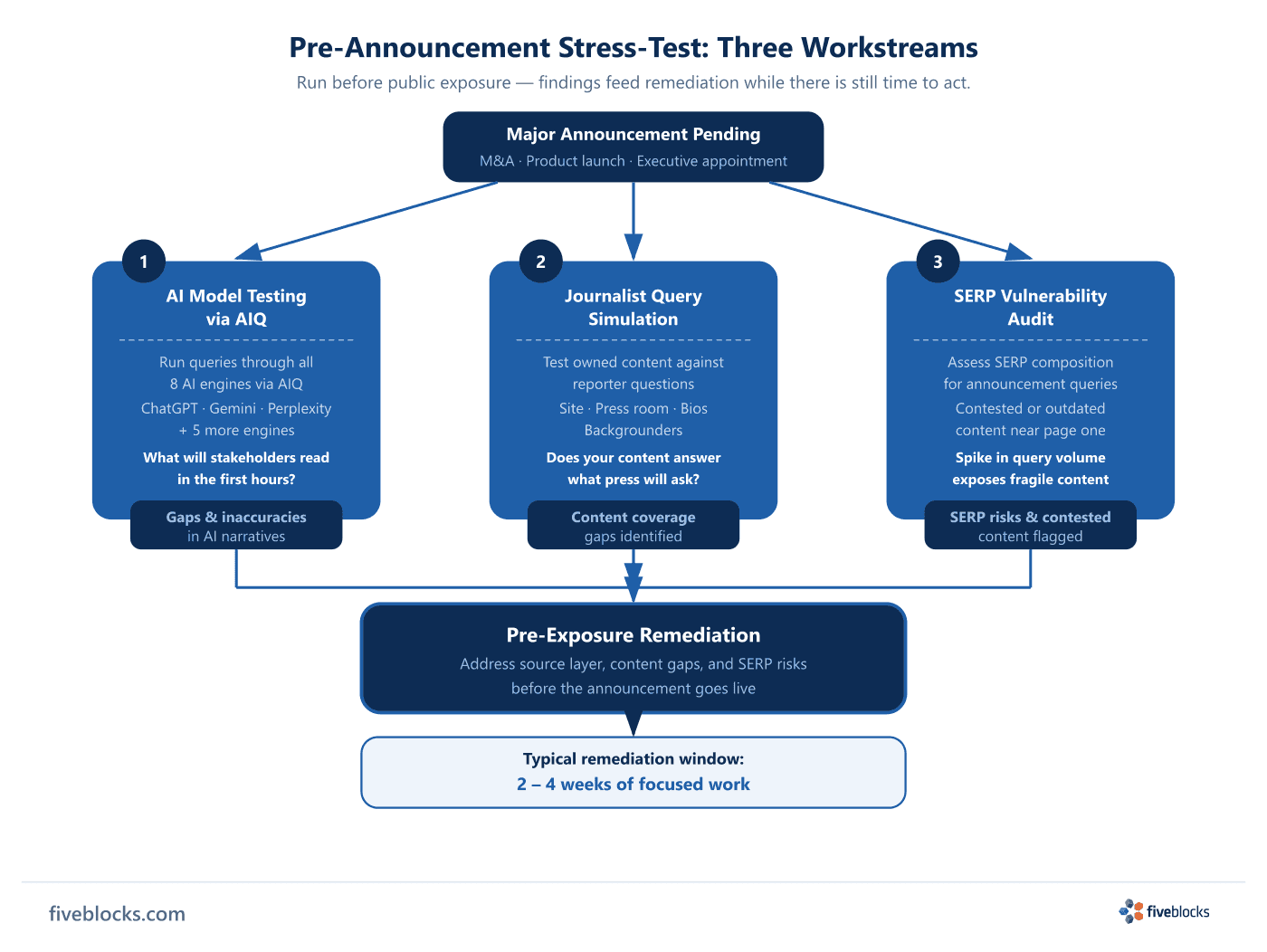
Step 1: AI model testing via AIQ
Run the announcement-related queries through the eight AI engines AIQ tracks. This shows what stakeholders will actually read in the first hours after the announcement goes live. You fix the gaps and inaccuracies at the source layer before public exposure, while there is still time.
Step 2: Journalist query simulation
Test whether current owned content answers the questions reporters will ask. Journalists covering a major announcement query the company’s site, press room, leadership bios, and backgrounders. Running those queries before publication rather than after exposes the gaps in coverage.
Step 3: SERP vulnerability audit
Review the search-result composition for the relevant queries and find contested or outdated content that will become more visible once the announcement raises search interest. A major announcement spikes query volume, and any fragile content near page one is exposed by that spike.
Effort and timeline
Fixing the gaps across these three workstreams usually takes two to four weeks of focused work. Companies that finish this work before exposure report better day-one and week-one digital outcomes on major announcements than those that skip it.
Last reviewed: 19/05/2026
