How do you know if Google recognizes your company as an entity?
Check whether the systems return the company as a resolved entity: look for a Google Knowledge Panel, confirm a clean Wikidata entry exists, and read how the major AI engines describe it across models. Confident, consistent answers indicate strong recognition; hedged, wrong, or conflated answers indicate weak entity signals.
You can test whether Google recognizes a company as an entity by looking at what the systems actually return. Run these three checks in order. A confident result on all three is the recognition signal you want.
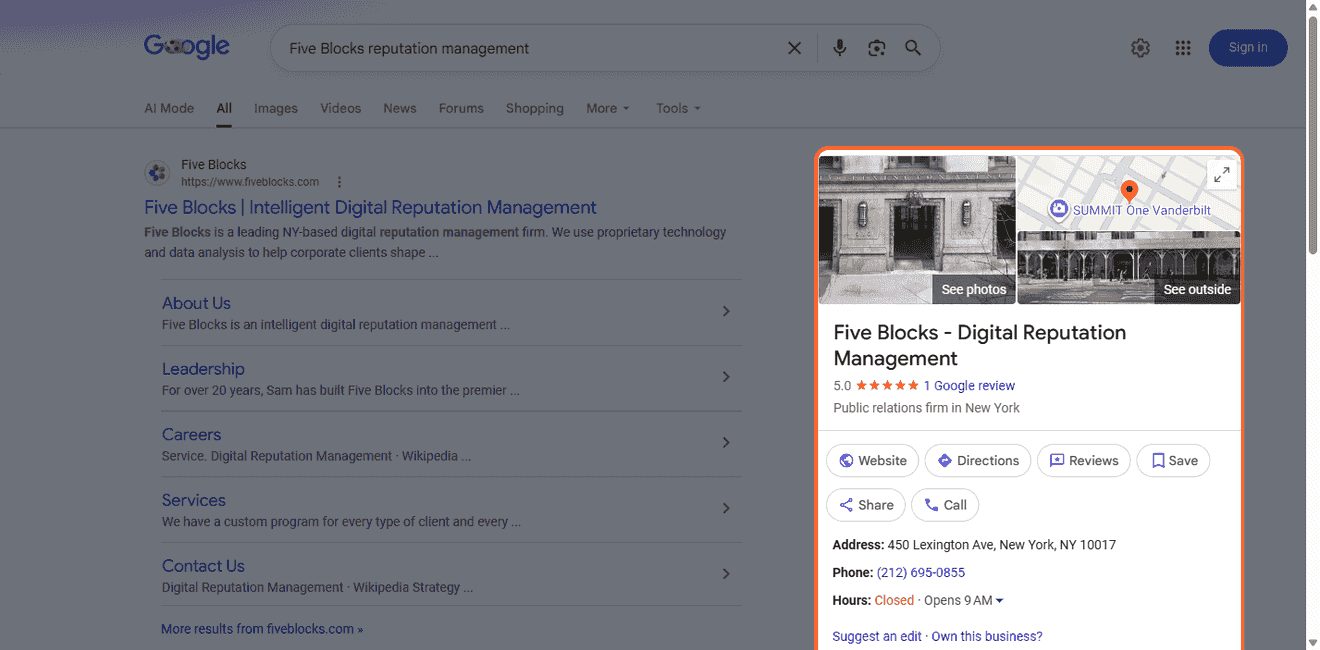
Step 1: Look for a Knowledge Panel
Search the company name on Google and check whether a Knowledge Panel appears. Its presence means Google has resolved the entity from its Knowledge Graph with enough confidence to display it. Panels are generated automatically and cannot simply be requested. The accuracy of what the panel shows then tells you the quality of the signals underneath.
Step 2: Query Wikidata for the entity
Search Wikidata, the free, structured knowledge database maintained by the Wikimedia Foundation, for the company and confirm a clean, linked entry exists. Wikidata is one of the primary sources behind Google’s Knowledge Graph and Knowledge Panels, and AI engines query it directly for entity facts. A complete entry with a unique identifier is a strong recognition signal.
Step 3: Read how AI engines describe the company
Ask the major AI engines to describe the company and compare the answers across ChatGPT, Gemini, Copilot, Perplexity, Claude, Grok, Google AI Overviews, and Google AI Mode. The same query can return materially different answers across engines, so read several at once:
- Confident result (strong recognition): accurate answers that agree across models indicate the engines have resolved the entity and trust the signals behind it.
- Hedged result (weak signals): vague, hedged, wrong, or conflated answers, especially an engine confusing the company with a same-named entity, indicate thin entity infrastructure or a resolution failure.
Step 4: Run it as a standing diagnostic
We run this check with AIQ as a standard diagnostic, comparing side by side how each of the eight engines AIQ currently tracks describes the entity, and we cross-reference the search layer with IMPACT™. What a company believes about itself and what the systems actually return often diverge, and that gap is where the entity work starts.
Last reviewed: 20/05/2026
