Can you actually control what Google shows about you?
You can't fully control what Google shows about you, but you can shape it by working the inputs the algorithm reads: entity signals, structured data, and authoritative owned and earned content. The honest framing is influence, not control.
Anyone promising full control of Google search results is either misinformed or lying. Google’s algorithm weighs authority, relevance, and user behavior that no single party owns. What you can shape is the input layer the algorithm reads.
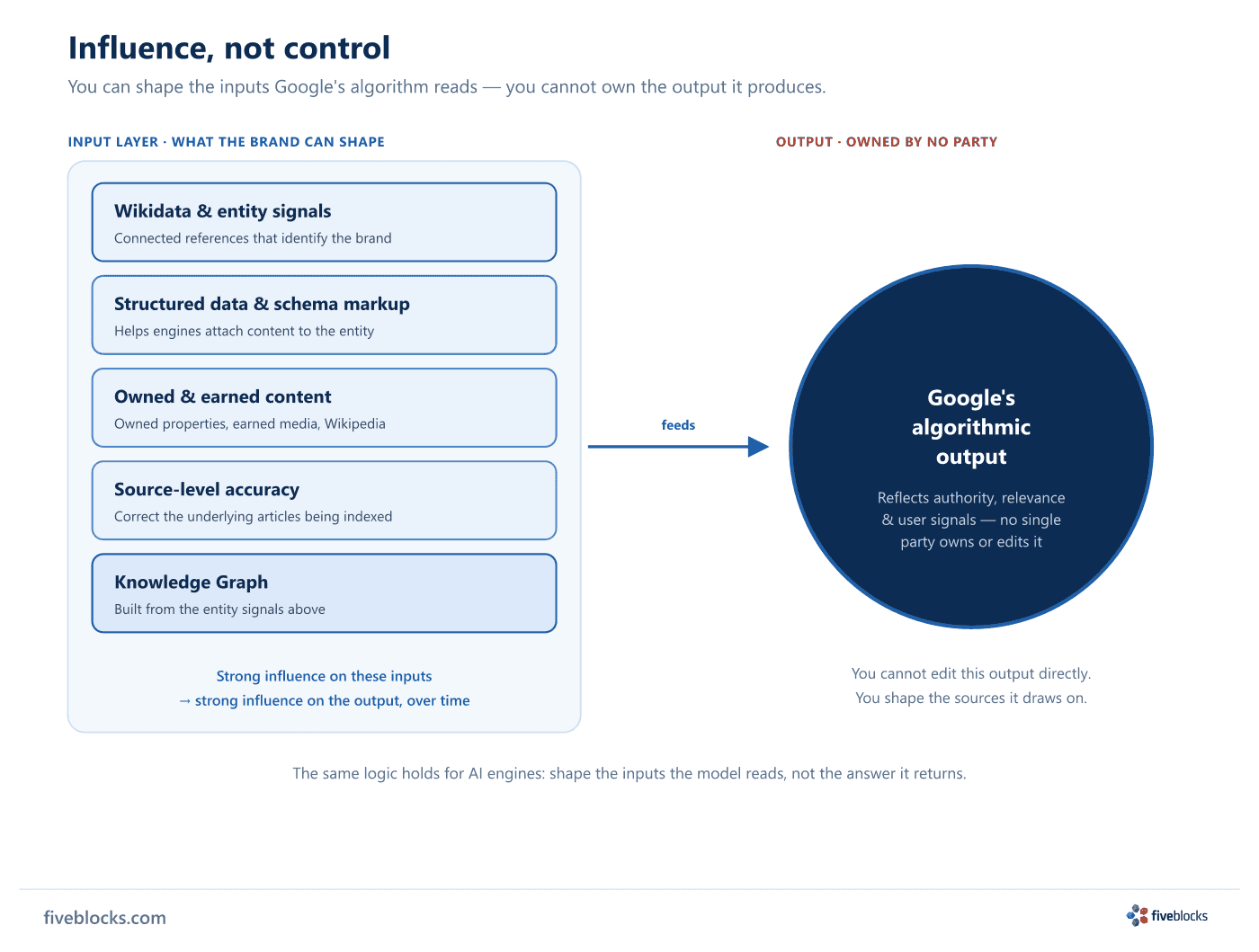
What you can actually shape
You cannot edit Google’s output directly, but you can influence the sources it draws on. Move those inputs and, over time, the output moves with them.
- Entity signals, the connected web of references that identify the brand to Google and feed the Knowledge Graph and Knowledge Panel (Wikidata, structured data, consistent profiles).
- Structured data and schema markup, the standardized format that helps search and AI engines understand what a page asserts and attach it to the correct entity, which affects whether that content is surfaced.
- Authoritative content, owned properties, earned media, and Wikipedia. Engines weight sources by credibility, so coverage in credible, independent outlets shapes answers more than adding owned pages.
- Source-level accuracy, correcting the underlying articles being indexed instead of trying to override them downstream.
Influence vs. control
The same logic holds for AI engines. Model outputs cannot be edited or manipulated directly, so influence comes from shaping the sources the models draw on. Whether the target is Google or an AI engine, the job is the same: you work the inputs, you do not command the output.
Last reviewed: 19/05/2026
