What does a reputation management engagement actually involve?
Quick answer
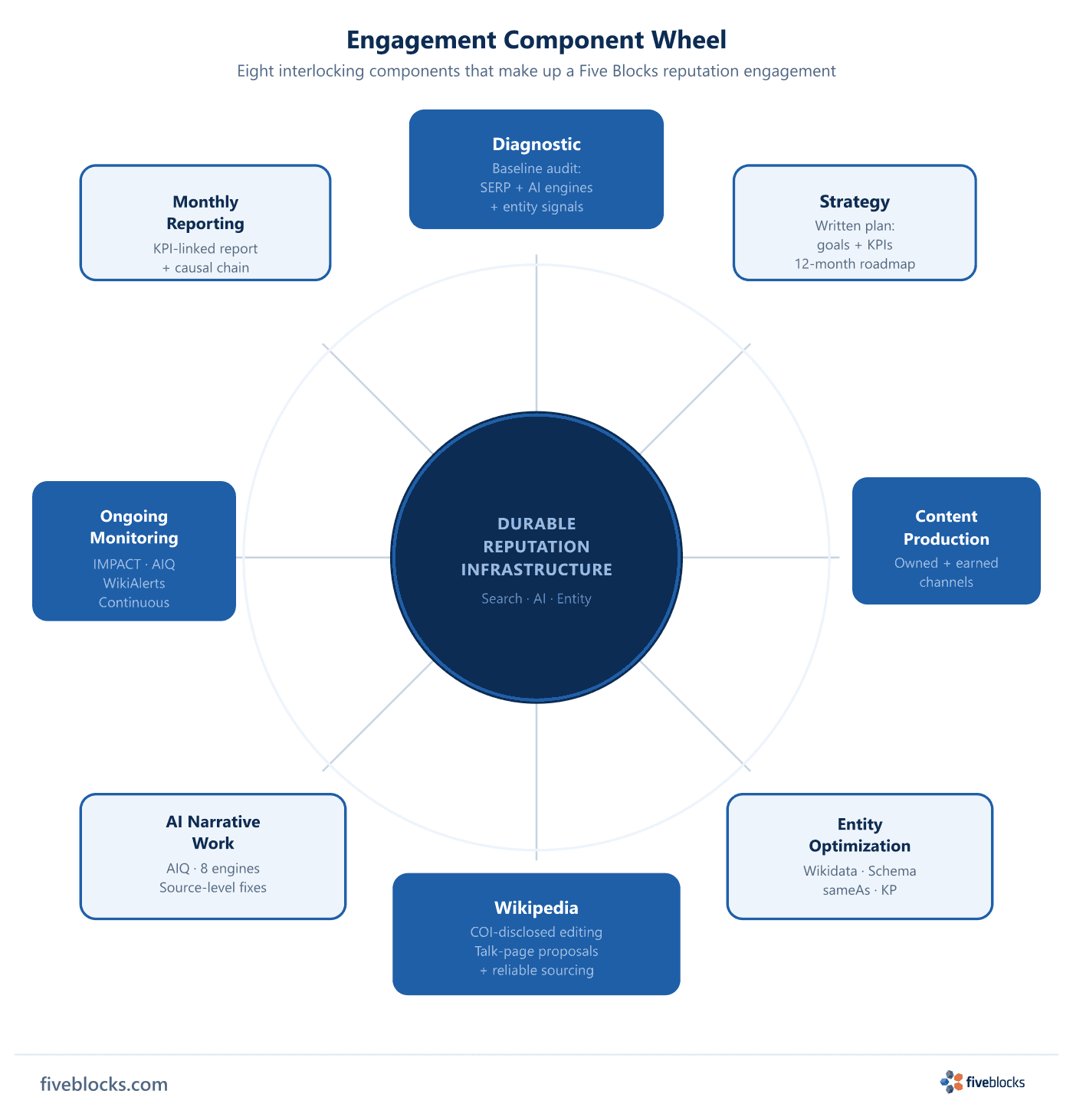
A reputation management engagement from Five Blocks covers eight core components: an upfront diagnostic, a written strategy, content production, entity optimization (Wikidata, schema, sameAs links, Knowledge Panel), Wikipedia engagement under disclosed COI rules where applicable, AI narrative work using AIQ across eight tracked engines, continuous monitoring through IMPACT and WikiAlerts, and a structured monthly report tied to agreed KPIs.
A reputation management engagement is built from a set of interlocking components. The mix and emphasis vary by client, but the core stays the same across every engagement.
- Upfront diagnostic
- Before any intervention begins, the engagement opens with a baseline audit: what the search results look like today, what AI engines say about the client, where entity signals are weak or missing, and what the competitive and reputational situation requires.
- Written strategy
- The diagnostic feeds a written strategy document that prioritizes interventions and sets twelve-month goals against measurable KPIs. This becomes the governing document for the engagement.
- Content production
- Original content is created across owned properties (the client’s own site and channels) and earned channels (media coverage, contributed articles, third-party profiles) to build the source layer that search and AI engines read from.
- Entity optimization
- The client’s entity infrastructure is audited and strengthened: Wikidata entry accuracy, Organization and Person schema markup with sameAs links that connect the entity across authoritative profiles, and Knowledge Panel health. A clean, consistent entity signal is what search and AI engines use to identify and describe the client correctly.
- Wikipedia engagement
- Where the client has or should have a Wikipedia article, Five Blocks works through Wikipedia’s disclosed conflict-of-interest (COI) process, proposing changes on the Talk page with reliable secondary sourcing, and independent editors review and apply any accepted edits. Undisclosed paid editing violates Wikipedia’s terms of use and is never used. Wikipedia is among the strongest disambiguation signals search engines use, and AI engines including ChatGPT, Gemini, Perplexity, and Copilot weight it heavily.
- AI narrative work
- Using AIQ, Five Blocks identifies what eight major AI engines: ChatGPT, Copilot, Gemini, AI Overviews, Perplexity, Grok, Claude, and Google AI Mode, currently say about the client and traces those outputs back to their source-level drivers. Interventions target the underlying sources rather than the AI outputs directly, since AI model outputs cannot be edited or manipulated directly.
- Ongoing monitoring
- Continuous tracking runs across IMPACT (search result positions and SERP features across keywords, locations, and languages), AIQ (AI engine narrative polling across the eight tracked engines), and WikiAlerts (Wikipedia live-edit notifications for the client’s article). Together these tools catch changes as they happen rather than in a periodic snapshot.
- Monthly reporting
- A structured written report is delivered each month. It ties progress back to the agreed objectives, with the underlying data available, and connects each metric to the interventions that drove it, so the client can see the causal chain.
Last reviewed: 19/05/2026