What should you expect in the first 90 days of a reputation management engagement?
The first 90 days of a reputation engagement go to diagnosis and foundation, not headline results. The work covers mapping the SERP, the AI narrative, the Wikipedia and Knowledge Panel state, and entity signals; ranking the gaps; launching content and entity-signal work; and setting baseline reporting. Initial movement on priority queries is usually visible by quarter-end.
The first 90 days of a reputation engagement build the foundation rather than deliver finished results. Structural shifts take longer than a quarter. What the first three months produce is a clear diagnostic picture, a prioritized plan, early execution against the highest-impact gaps, and the baseline data every later measurement is compared against.
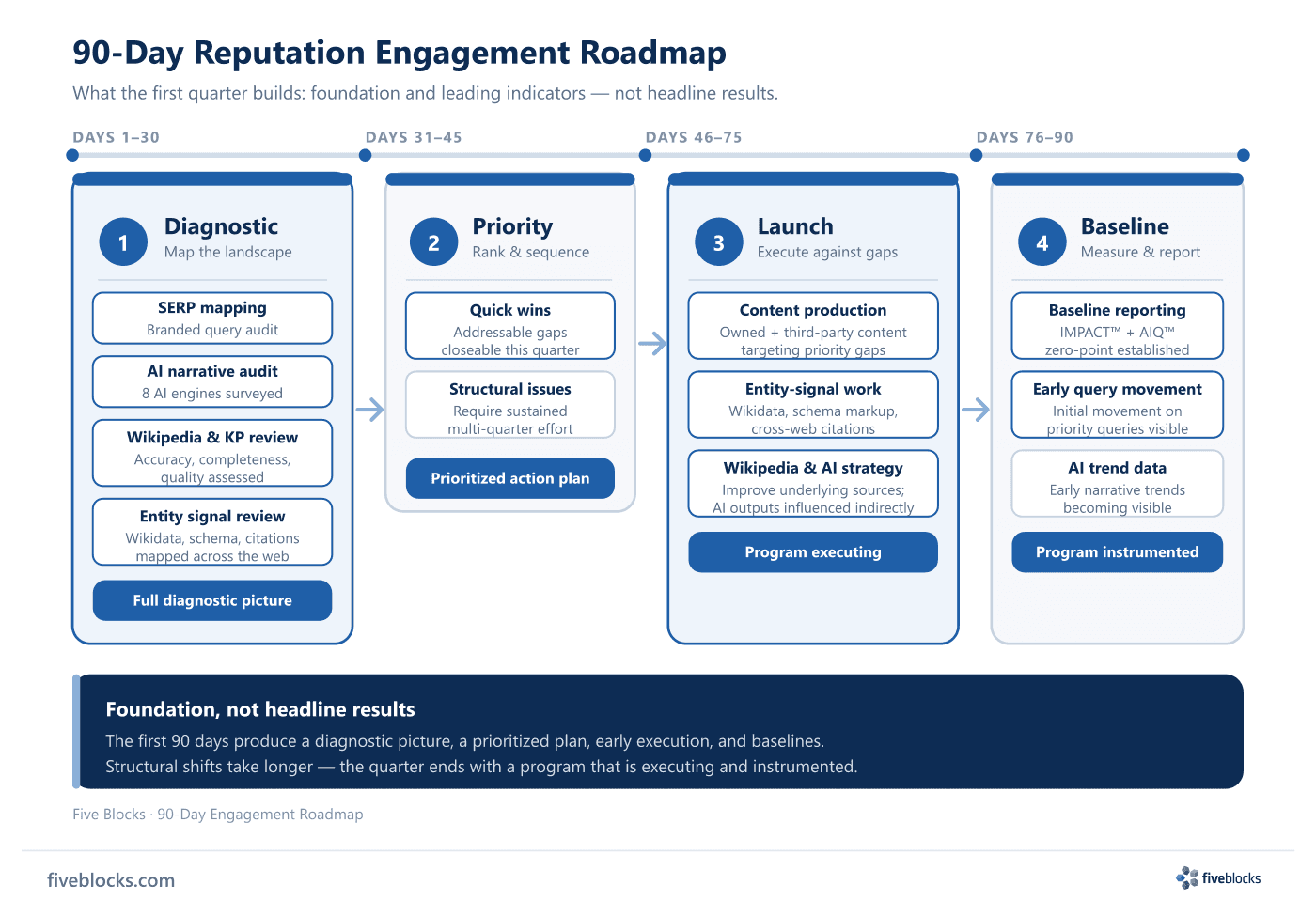
Phase 1: diagnostic
- SERP mapping: Audit which results appear for priority branded queries, including news, review sites, owned properties, Wikipedia, and the Knowledge Panel, and record what each one says about the entity.
- AI narrative audit: Survey how major AI engines (ChatGPT, Gemini, Perplexity, Copilot, Grok, Claude, AI Overview, Google AI Mode) characterize the brand, and document the inaccuracies and the gaps in the narrative.
- Wikipedia and Knowledge Panel review: Assess whether a Wikipedia article exists and how accurate and well-built it is; check the Knowledge Panel for correctness and completeness.
- Entity signal review: Map the references that identify the organization to search and AI platforms: Wikidata, schema markup, structured data, and third-party citations.
Phase 2: prioritization
- Rank the gaps by impact: which are doing the most damage to reputation or discoverability, and which are quick wins that can be closed early.
- Separate structural issues, which require sustained effort, from addressable items that can move within the quarter.
Phase 3: launch
- Content production: Start creating or improving authoritative owned and third-party content aimed at the priority gaps.
- Entity-signal work: Strengthen Wikidata, schema markup, and cross-web citations so platforms can identify and describe the entity accurately.
- Wikipedia and AI strategy: Set the approach for Wikipedia, where applicable, and for the sources AI engines draw on. AI outputs cannot be edited directly, so influence comes from improving those underlying sources.
Phase 4: baseline reporting and early indicators
- Set baseline measurements with IMPACT™ and AIQ™ so later progress is tracked against a fixed starting point.
- By the end of the quarter, initial movement on priority queries and early trend data on AI narratives are usually visible, while larger structural shifts continue to build.
The honest expectation for the quarter is foundation and leading indicators, not a finished result. Authoritative content and entity signals take time to be indexed, cited, and weighted by search and AI platforms. By day 90 the program is executing and instrumented, and early signal is on record.
Last reviewed: 20/05/2026
