How long do reputation management engagements typically last?
Most reputation management engagements run as 6- or 12-month programs, because durable change in search results, AI engine narratives, and Wikipedia comes from sustained structural work that will not happen in weeks. Ongoing programs continue through renewals; shorter advisory or diagnostic projects are available for bounded needs.
Reputation management engagements typically run as 6- or 12-month programs, and the length reflects how reputation actually changes rather than an arbitrary contract term. Durable shifts in a branded result set, the AI engine narrative, or how an entity is recognized come from sustained structural work: building and strengthening authoritative content, editing Wikipedia patiently and with disclosure, deploying entity signals and then waiting for the systems to register them. None of that happens in weeks, which is why a real horizon is built into most programs.
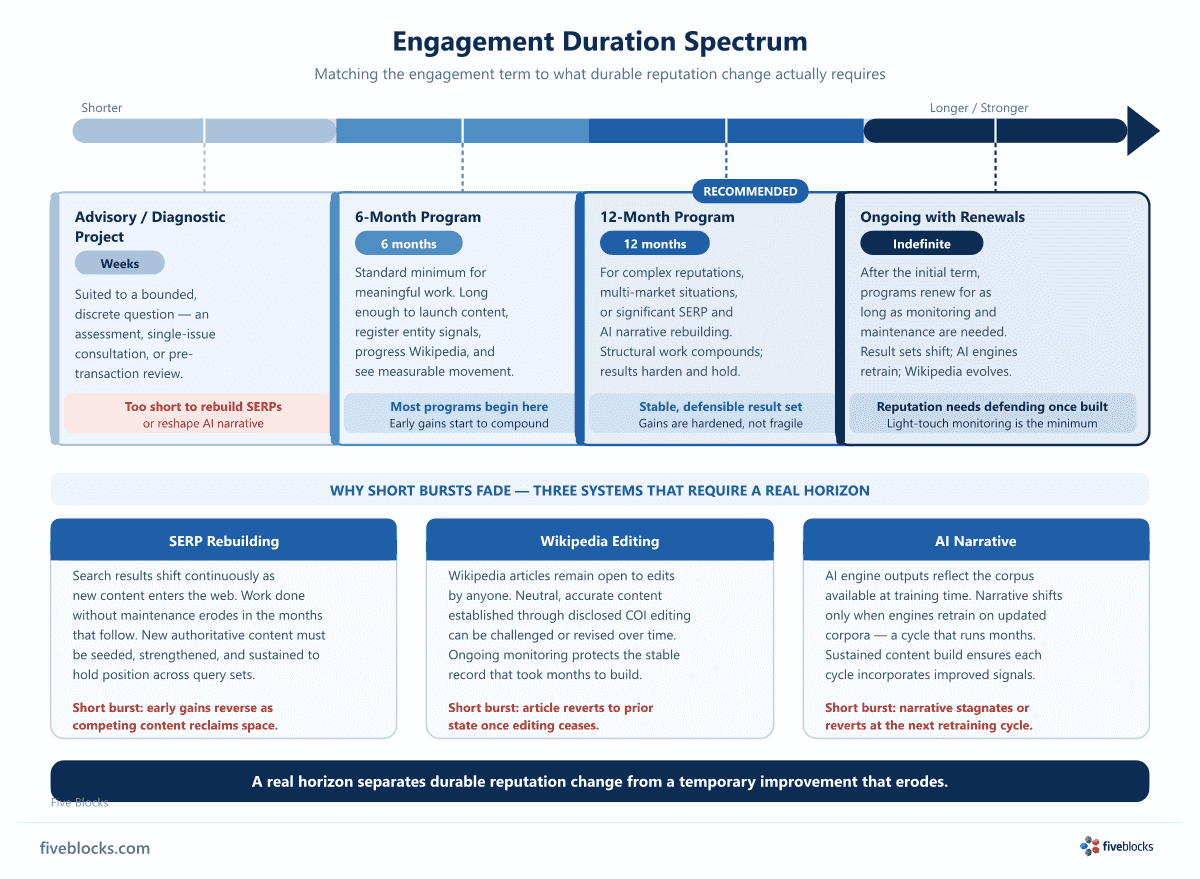
Why a short burst fades. Search results and AI narratives shift continuously. New content enters the web, AI engines retrain on updated corpora, and other editors change Wikipedia articles. Work done without ongoing maintenance erodes over the months that follow. The horizon is what separates durable reputation change from a temporary improvement.
The engagement duration spectrum
- Advisory or diagnostic project (weeks to a few months). Fits a bounded need: a discrete assessment, a single-issue consultation, a pre-transaction review. It delivers a clear output, but it does not run long enough to rebuild the result set or reshape the AI narrative.
- 6-month program. The standard minimum for meaningful reputation work. Long enough to launch content, register entity signals, move Wikipedia forward where applicable, and see measurable movement on priority queries. Most programs begin here.
- 12-month program. The recommended horizon for more complex reputations, multi-market situations, or large-scale AI and SERP rebuilding. It gives the structural work time to compound and produces a stable, defensible result set instead of early gains that have not yet hardened.
- Ongoing with renewals. After the initial term, programs continue through renewals for as long as maintenance and monitoring are needed. Once built, a reputation has to be defended: result sets shift, AI narratives change with each engine retraining cycle, and Wikipedia stays open to edits by anyone. Light-touch monitoring is the floor; active programs keep building and defending.
Matching the term to the goal
Match the engagement length to what the situation requires. A finite, bounded question fits a project. A concern about the ongoing digital footprint (what a search returns, what AI engines say, how the entity is represented on Wikipedia) needs a program. We scope the term to the actual need and set out the reasoning in the Letter of Engagement.
Last reviewed: 20/05/2026
