What should an annual reputation management review include?
Quick answer
An annual reputation management review covers KPI movement against baseline, peer benchmarks, work completed, and business-outcome attribution for the year past, then sets forward strategy with adjusted scope and budget for the year ahead. It draws on IMPACT™, AIQ™, and WikiAlerts™ data for both the retrospective and the prospective halves.
An annual reputation review is where you step back from monthly execution and ask whether the program is doing what it was built to do. It has two halves: a retrospective that accounts for the year past and a prospective that recalibrates for the year ahead.
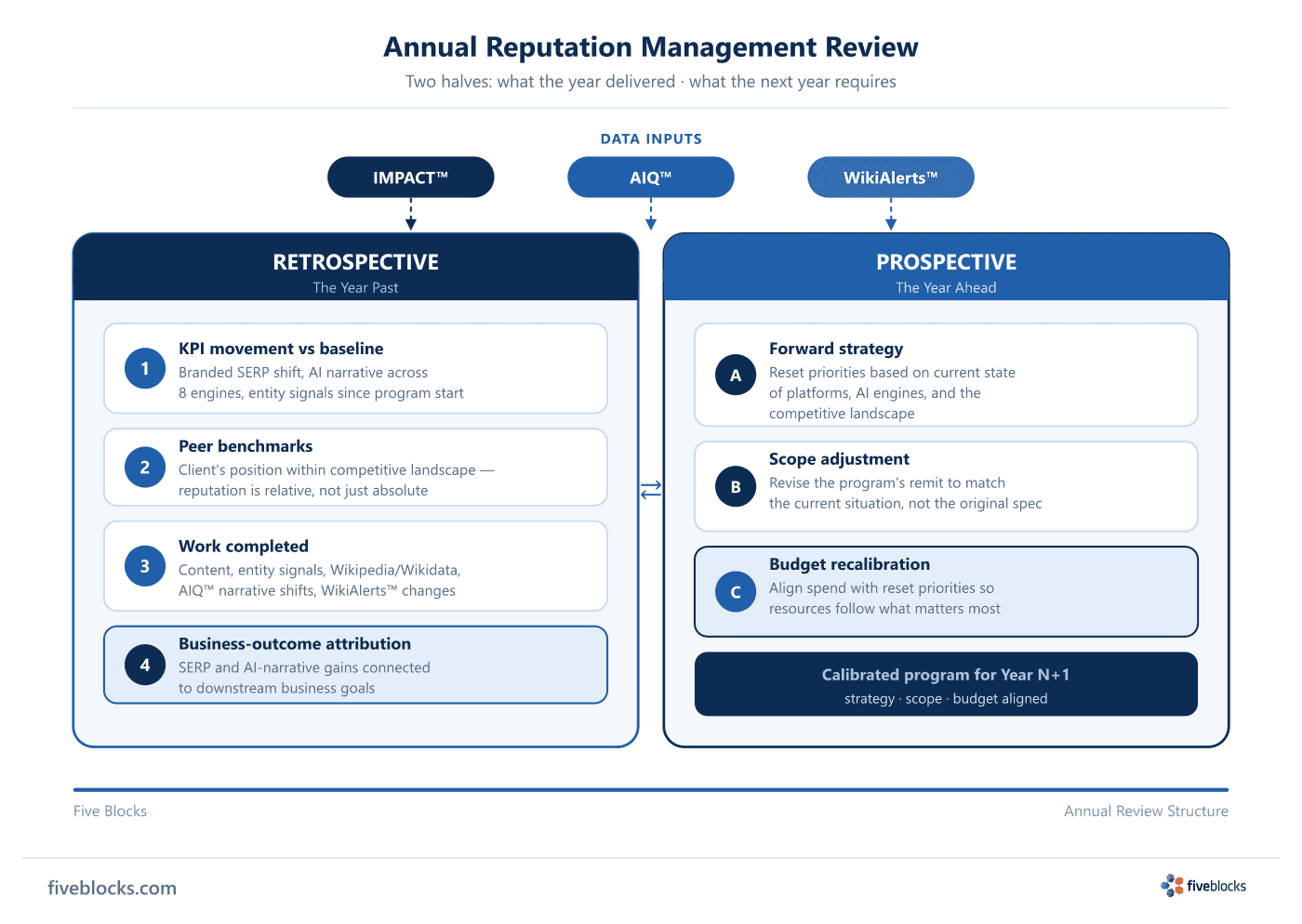
Retrospective: what the year delivered
- KPI movement against baseline
- How the branded result set, the AI narrative across the eight AI engines AIQ™ currently monitors, and the entity signals have shifted since the program began. Progress is measured against the original baseline captured in IMPACT™, not asserted.
- Peer benchmarks
- Reputation is relative. Standing against competitors matters as much as absolute movement, so the review sets the client’s position next to its peers.
- Work completed and platforms managed
- An itemised account of the year’s activity: content production, entity-signal work, Wikipedia and Wikidata contributions, AIQ™-monitored narrative shifts, and WikiAlerts™-tracked article changes. The list exists so the work is on record and can be checked.
- Business-outcome attribution
- Where the data supports it, the review ties SERP and AI-narrative improvements to the business goals they serve.
Prospective: what the next year requires
- Forward strategy
- A fresh read on priorities for the coming year, based on what the platforms, the AI engines, and the competition look like now. All three keep changing.
- Scope adjustment
- Revising the program’s remit to match the current situation instead of carrying the original scope forward unchanged.
- Budget recalibration
- Aligning spend with the reset priorities, so the money goes to the work that matters most in the year ahead.
Last reviewed: 20/05/2026
