How do you create an entity optimization plan from scratch?
Build the entity from the foundation up: define the canonical name and description, establish the entity home and claim authoritative profiles, deploy schema with sameAs links, secure third-party citations, build a complete Wikidata entry, then pursue Wikipedia only where genuine notability supports it. The order matters - canonical definition before linking, Wikidata before Wikipedia - and each stage is checked against how AI engines describe the entity.
Building entity optimization from scratch follows a fixed order, because the layers depend on each other and doing them out of sequence wastes work. The canonical identity has to exist before other signals can match it, the assets you link to have to exist before the links can point to them, and the structured record (Wikidata) comes before any narrative article (Wikipedia). The steps below run from foundation to final piece, and each one names the dependency that fixes its place in the order.
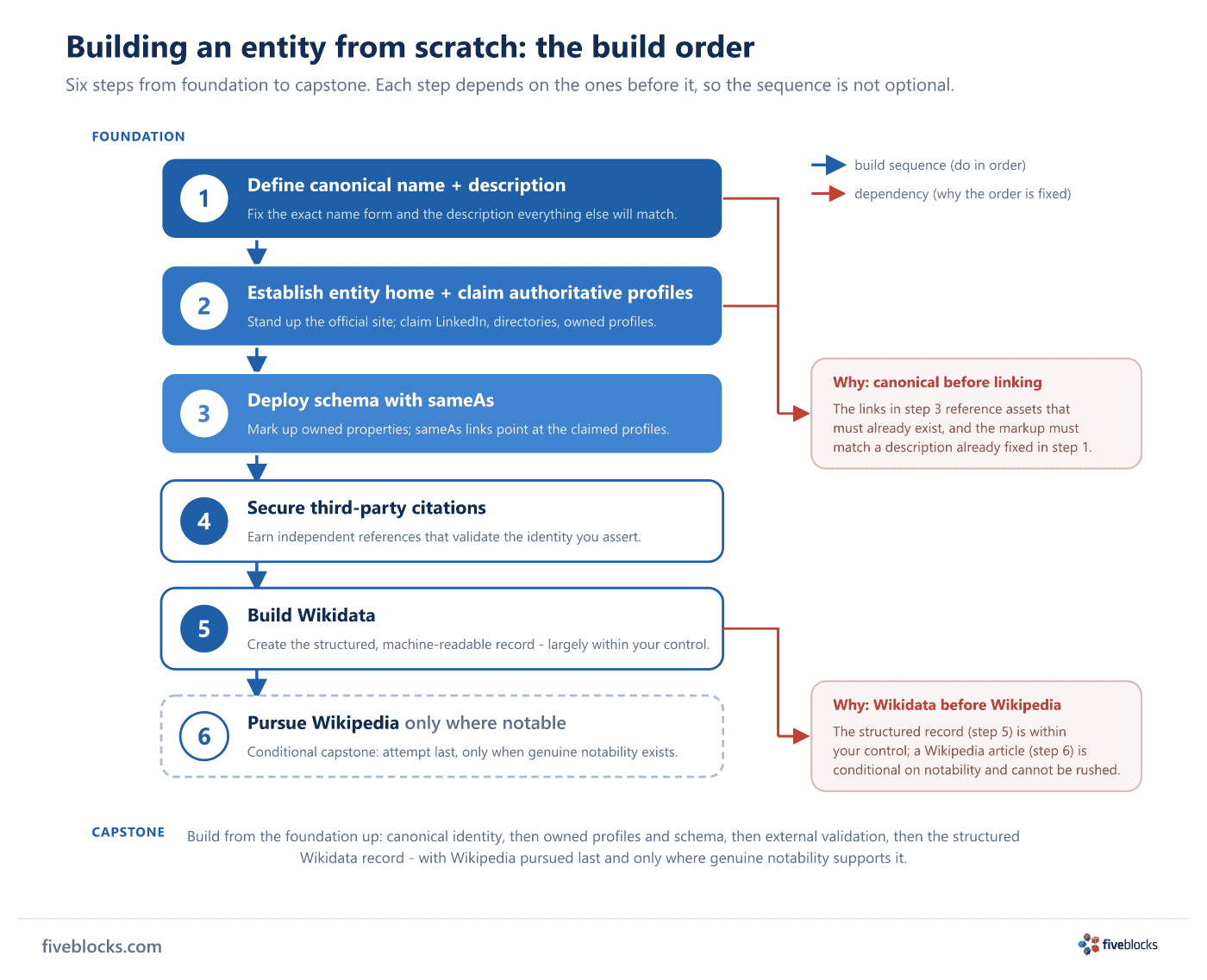
The build sequence
- Define the canonical identity. Fix the exact name form and the description that every other signal will match. Recognition depends on consistency, so this comes first: everything downstream is built to agree with it.
- Establish the entity home and claim authoritative profiles. Stand up the official site as the entity home, and claim the anchors the entity will be linked to: LinkedIn, authoritative directories, and other owned or controlled profiles. These have to exist before anything can reference them. Entity signals are a connected web of references that identify the subject to platforms and feed the Google Knowledge Panel, so you put those reference points in place before the linking that ties them together.
- Deploy schema with
sameAslinks. Mark up the owned properties with structured data, usingsameAsto point at the profiles claimed in the previous step. Schema markup and structured data help search and AI engines understand what a page asserts and attach it to the correct entity, and thesameAslinks tell the systems that those separate references are one identity. This step depends on steps 1 and 2: the canonical description gives the markup its content, and the profiles give thesameAslinks their targets. - Secure third-party citations. Earn references from independent sources to build external corroboration and co-occurrence. Owned signals assert the identity; third-party citations validate it, which is why they follow the owned-property work rather than preceding it.
- Build a complete, well-linked Wikidata entry. Create the structured, machine-readable record and link it into the entity stack. Google’s Knowledge Panel pulls its description and main facts from Wikipedia and Wikidata, so the structured record carries a lot of weight, and it is largely within your control, unlike a Wikipedia article.
- Pursue Wikipedia only where notability supports it. Attempt a Wikipedia article last, and only when genuine notability exists, because an article created without it risks deletion. Build the structured record (Wikidata) first; the narrative article comes after.
Why the order matters
Two dependencies drive the whole sequence:
- Canonical definition before linking. The exact name and description (step 1) and the profiles and entity home (step 2) must be in place before schema and
sameAslinking (step 3), because the links reference assets that have to exist to be useful and the markup has to match a description that has already been fixed. - Wikidata before Wikipedia. The structured record (step 5) is largely within your control and feeds the Knowledge Panel, while a Wikipedia article (step 6) is conditional and cannot be rushed. Wikipedia’s general notability standard requires significant coverage in multiple reliable, independent, secondary sources, and it judges corporate notability against a stricter bar (WP:NCORP) that excludes press releases, sponsored content, and routine business announcements. Editing on behalf of a paying client must also be done under disclosed conflict-of-interest rules. Wikipedia is therefore the last, conditional step, not an early one.
Verify each stage
Each stage is checked against the outcome that matters: how the AI engines describe the entity. Re-testing the engine answers with AIQ at each stage confirms that the signals are landing and resolving to one identity before the next layer is added, so the work is measured by representation, not by tasks completed.
Last reviewed: 20/05/2026
