How do you create an entity optimization roadmap?
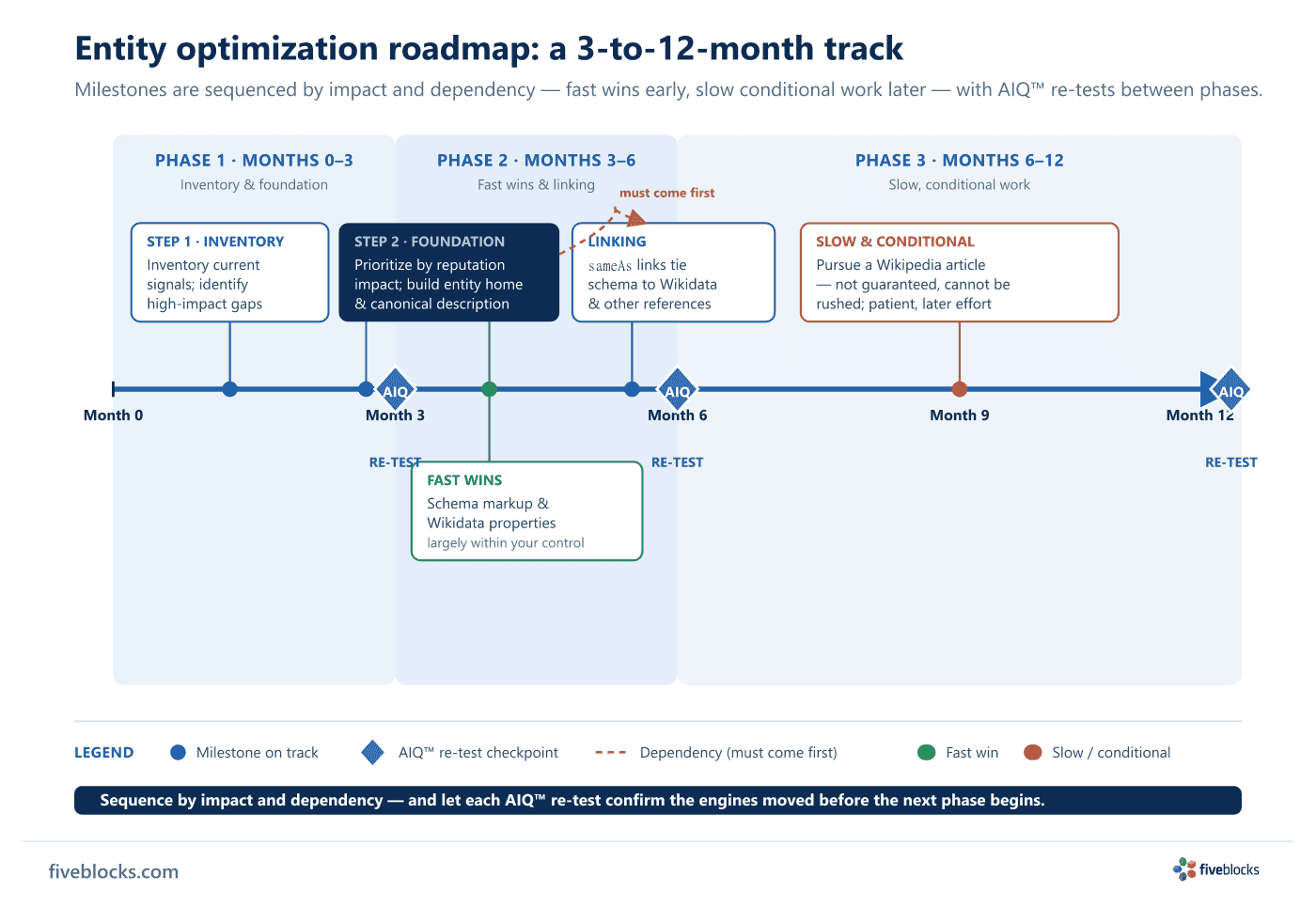
Inventory your current entity signals, identify the highest-impact gaps, prioritize by reputation impact, and sequence the work over a realistic horizon (typically 3 to 12 months) with measurable milestones. The roadmap turns a gap analysis into an ordered plan that respects dependencies and builds in checkpoints to re-test how AI engines describe the entity.
An entity optimization roadmap turns a gap analysis into an ordered plan you can hold people to. Entity work has dependencies, so order matters: start in the wrong place and you can waste months on signals that have nothing to attach to yet. The roadmap sets out which signals to build, in what order, and how you will measure progress.
How to build the roadmap
- Inventory current signals. Take stock of Knowledge Panel status, Wikipedia and Wikidata presence, schema coverage, citation quality, and how consistently the entity is described across sources. Entity signals are a connected web of references that identify the subject to platforms and feed the Google Knowledge Panel, so the inventory has to cover all of them, not just the website.
- Identify the highest-impact gaps. These are not always the obvious ones. A resolution failure that splits an executive into two separate entities usually matters far more than a missing directory listing, because it breaks how every downstream system understands who the subject is.
- Prioritize by reputation impact. Rank the gaps by how much closing each one will change how search and AI engines describe the entity, rather than by how easy the task is.
- Sequence over a realistic horizon. Lay the work out across a practical timeline, commonly 3 to 12 months, with milestones, because some pieces are fast and some are slow and conditional (see below).
- Build in measurement checkpoints. Schedule points where you re-test the AI engine answers with AIQ, so you judge progress by how the systems describe the entity, not by tasks completed.
Respect the dependencies
Some signals have to exist before others can point to them. The entity home and the canonical description come first; the sameAs links that tie schema markup to Wikidata, Wikipedia, and other references come after, because they point at assets that have to be in place to be useful. Schema markup and structured data help search and AI engines understand what a page asserts and attach it to the correct entity, and Google’s Knowledge Panel pulls its description and key facts from Wikipedia and Wikidata. So the order you establish these in decides whether the signals reinforce each other or contradict one another.
Fast wins versus slow, conditional work
- Fast wins (sequence early): schema markup and Wikidata properties are largely within your control and can be done relatively quickly. Knowledge Panel signals can be influenced through Wikidata, so these are worth doing early.
- Slow, conditional work (sequence later): a Wikipedia article is not guaranteed and cannot be rushed. Wikipedia’s notability standard requires significant coverage in multiple reliable, independent, secondary sources, and it judges corporate notability against a stricter bar (WP:NCORP) that excludes press releases, sponsored content, and routine business announcements. Editing on behalf of a paying client also has to be done under disclosed conflict-of-interest rules. That makes a Wikipedia article a conditional, patient effort that belongs later in the roadmap, not an early milestone.
Why sequencing this way works
Ordering the work by impact and dependency means each milestone has something solid to build on, and the AIQ re-test checkpoints confirm the changes are actually moving the engine answers before the next phase starts. You end up with a plan that spends effort where it changes how the entity is represented, not a checklist that closes tasks without moving the outcome.
Last reviewed: 20/05/2026
