What is an entity gap analysis?
An entity gap analysis maps where an entity's recognition signals - Knowledge Panel, Wikipedia, Wikidata, schema, description consistency, and third-party citations - stand today against the standard the systems require, and delivers a prioritized plan rather than a flat checklist.
An entity gap analysis maps where an entity’s signals stand today against where they need to be for accurate recognition. It opens most entity engagements. Rather than guessing what to fix, you inventory the full signal set, score each against the standard the systems require, and turn the result into a sequenced plan.
What gets inventoried
The analysis works through the signals that determine whether search and AI engines can resolve and describe the entity confidently:
- Knowledge Panel – whether one exists and whether what it shows is accurate.
- Wikipedia – the state of the article, or whether notability supports creating one.
- Wikidata – the completeness and accuracy of the entry.
- Schema – the structured data on owned properties.
- Description consistency – whether the name, description, and key facts match across profiles.
- Third-party citations – the quality and independence of external coverage.
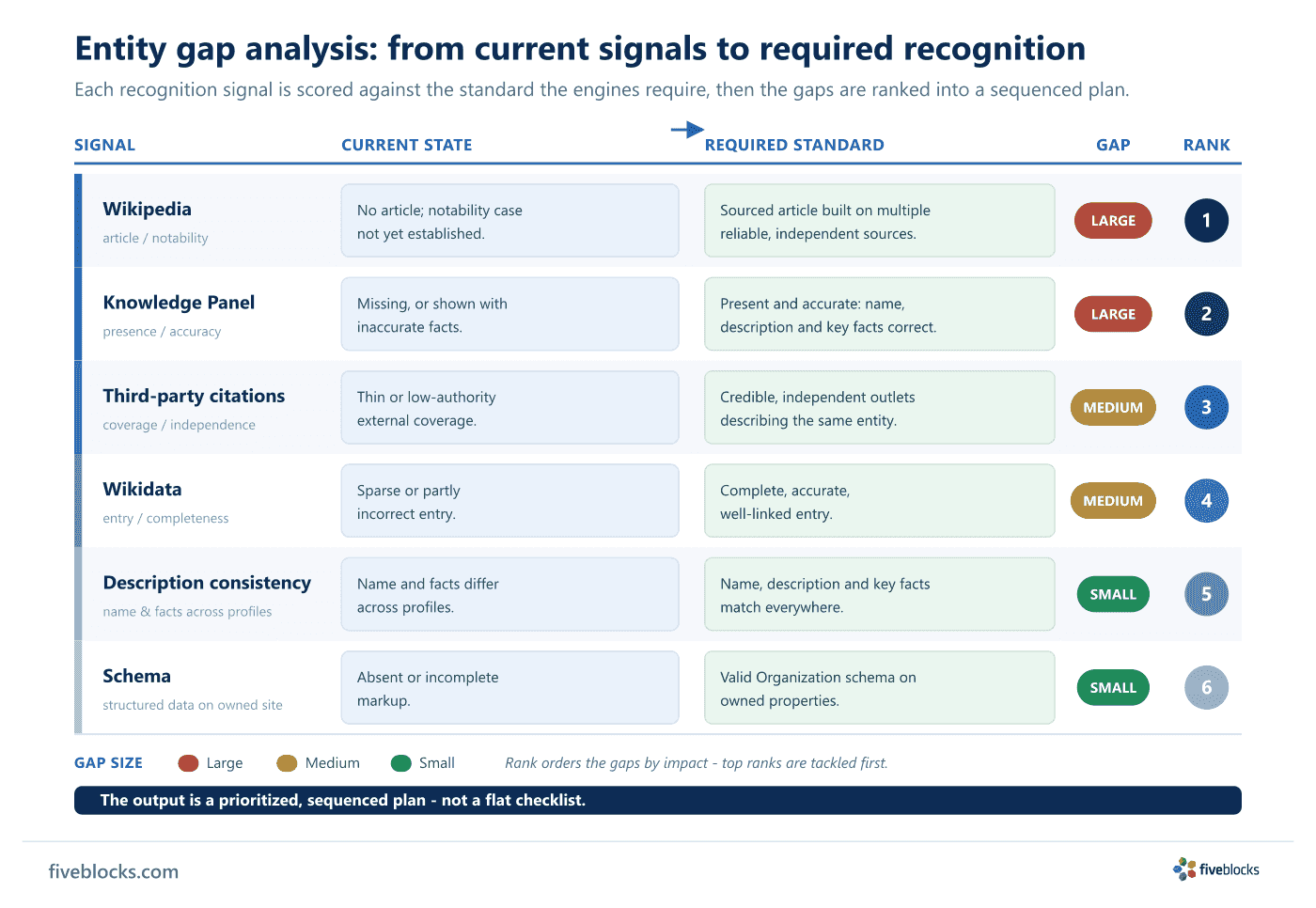
How the gaps are assessed and ranked
Each signal is scored against the standard the systems need to resolve and describe the entity confidently, and the gaps are ranked rather than listed flat:
- Inventory the current state – establish what exists today for each signal and how accurate it is.
- Compare against the required standard – assess each signal against what accurate recognition demands, which exposes where the gaps are.
- Test how the gaps actually manifest – run the entity through the AI engines with AIQ to see how the gaps show up in real model answers. A gap that produces a wrong AI summary is more urgent than one that is merely incomplete.
- Prioritize and sequence – rank by impact: which gaps do the most damage, which are quick wins, and which need longer work like a Wikipedia article.
The output is a prioritized, sequenced plan. That is what turns entity work from guesswork into a structured program.
Last reviewed: 20/05/2026
