How do you handle entity optimization for a newly merged company?
Consolidate the identity across the whole stack: 301-redirect the deprecated brand domains to the surviving entity home so their authority transfers, update schema to the merged structure (parentOrganization/subOrganization), refresh Wikidata and update Wikipedia where notable, claim the Knowledge Panels and fix the underlying sources so they actually update, and reset authoritative directory listings to the merged entity - then monitor that engines resolve to one entity rather than the legacy ones.
A newly merged company has an entity problem most organizations never face: two or more established identities that have to resolve into one surviving entity, or into a defined new structure, without search and AI systems reading the change as confusion or loss. The work is consolidation across the whole stack at once, so that authority lands on the surviving entity instead of splitting between the legacy ones. The steps below run from redirecting the old domains through to checking how the engines describe the merged company.
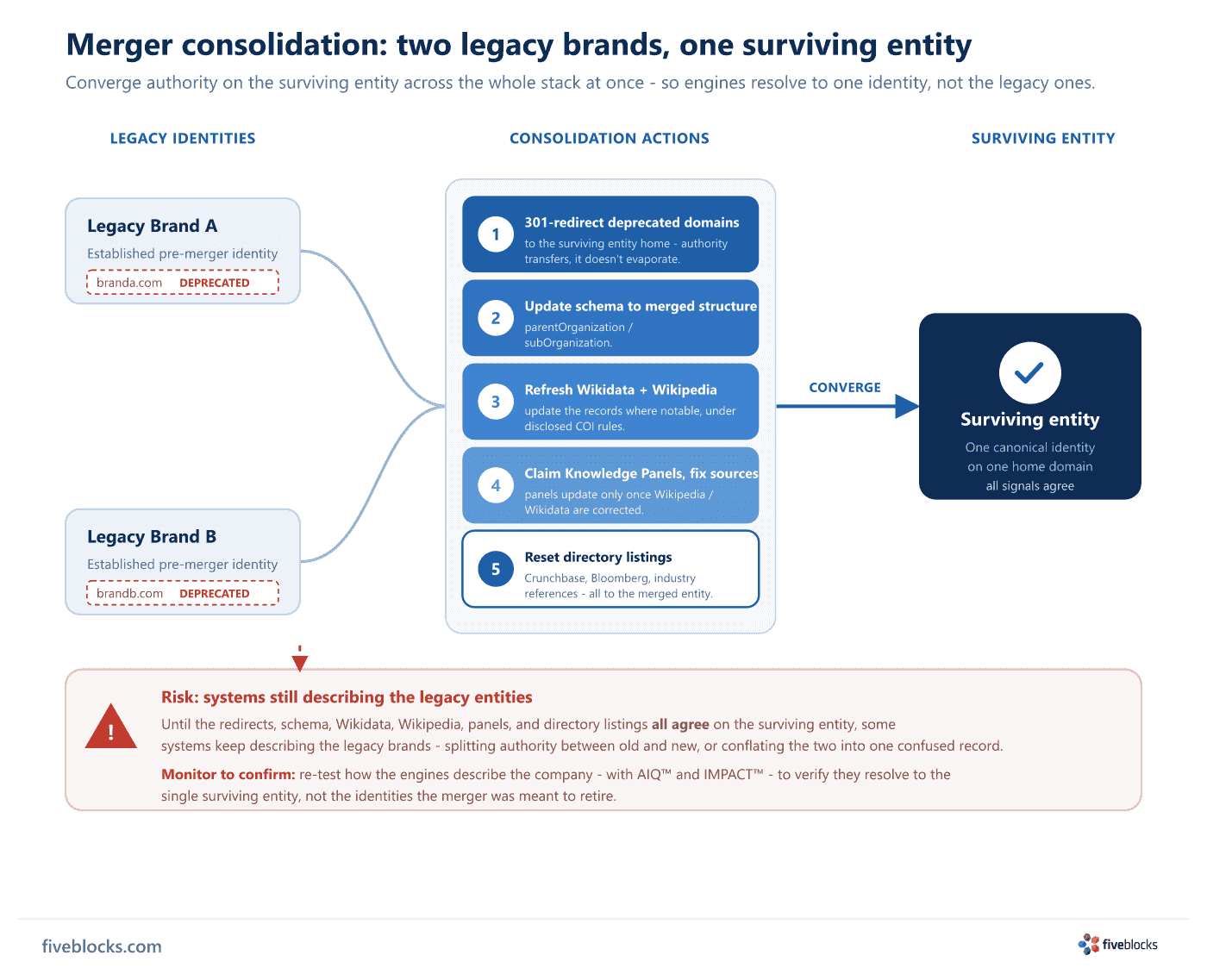
Consolidate the merged identity, step by step
- Redirect the deprecated brand domains. Point the legacy brand domains to the surviving entity home with 301 redirects. A 301 preserves link equity when moving from a deprecated or legacy domain to a new location, so redirecting the old brand domains to a surviving domain transfers their accumulated authority to the surviving entity rather than letting it evaporate.
- Update schema to the merged structure. Revise the structured data to describe the new reality, a unified entity, or a parent and its subsidiaries expressed with
parentOrganizationandsubOrganization. Schema markup and structured data help search and AI engines understand what a page asserts and attach it to the correct entity, so the markup has to state the merged structure for the systems to read it correctly. - Refresh Wikidata and update Wikipedia where notable. Update the Wikidata record to reflect the merger, and, where the entities are notable, update Wikipedia to describe it. Wikipedia supports rebrandings by moving the article and keeping the old name as a ‘formerly known as’ redirect, and any editing done for a paying client is conducted under disclosed conflict-of-interest (COI) rules. Both records matter because Google’s Knowledge Panel pulls its description and key facts from Wikipedia and Wikidata, and those are among the sources AI engines use to identify entities.
- Claim the Knowledge Panels and fix the underlying sources. Claim the panels for the merged entity and suggest corrections. A panel claim lets a verified representative manage a limited set of fields and suggest corrections to the rest, but the substantive facts are generated from underlying sources, chiefly Wikipedia and Wikidata, so the panel updates only once those sources are corrected. Fixing the sources (steps 2 and 3) is what makes the panel actually change.
- Reset authoritative directory listings. Update directory and reference listings: Crunchbase, Bloomberg, and industry references, to the merged identity. Entity signals are a connected web of references that identify a company to platforms and feed the Knowledge Panel, so leaving these on the legacy entities keeps stale references in that web.
- Monitor how the engines resolve the merged entity. Re-test how search and the AI engines describe the company, with AIQ and IMPACT™, to confirm they resolve to the single surviving entity rather than continuing to describe the legacy ones.
The risk: systems that keep describing the legacy entities
The main risk in a merger is that the systems keep describing the legacy entities, split authority between old and new, or conflate the two. That is why the consolidation is done across the whole stack at once rather than one surface at a time, and why the last step is verification: until the redirects, schema, Wikidata, Wikipedia, panels, and directory listings all agree on the surviving entity, some systems will go on resolving to the identities the merger was supposed to retire. Checking the engine answers is how you confirm the merged identity has taken hold.
Last reviewed: 20/05/2026
Sources (4)
- Submit feedback on content about you - Knowledge Panel Help support.google.com
- How Google's Knowledge Graph works (and where panel info comes from) blog.google
- Site Moves and Migrations | Google Search Central | Documentation developers.google.com
- Change of Address tool - Search Console Help support.google.com
