What is an entity in the context of search and AI?
An entity is a uniquely identifiable thing - a person, brand, place, product, or concept - that search and AI systems treat as a distinct node with its own attributes and relationships, not just a string of keywords.
An entity is a thing that search and AI systems recognize as a distinct, identifiable subject with its own attributes and relationships, as opposed to a keyword, which is just a string of characters. This distinction is the basis of modern reputation work.
Entity vs. keyword: the standard example
Take the word “apple,” which can resolve to several different things:
- Apple Inc. (an entity)
- The company – with a CEO, a headquarters, products, and a Wikipedia article.
- apple the fruit (a different entity)
- A separate, distinct thing with its own attributes and relationships.
- “apple” (a keyword)
- Just a string of characters that could mean either entity.
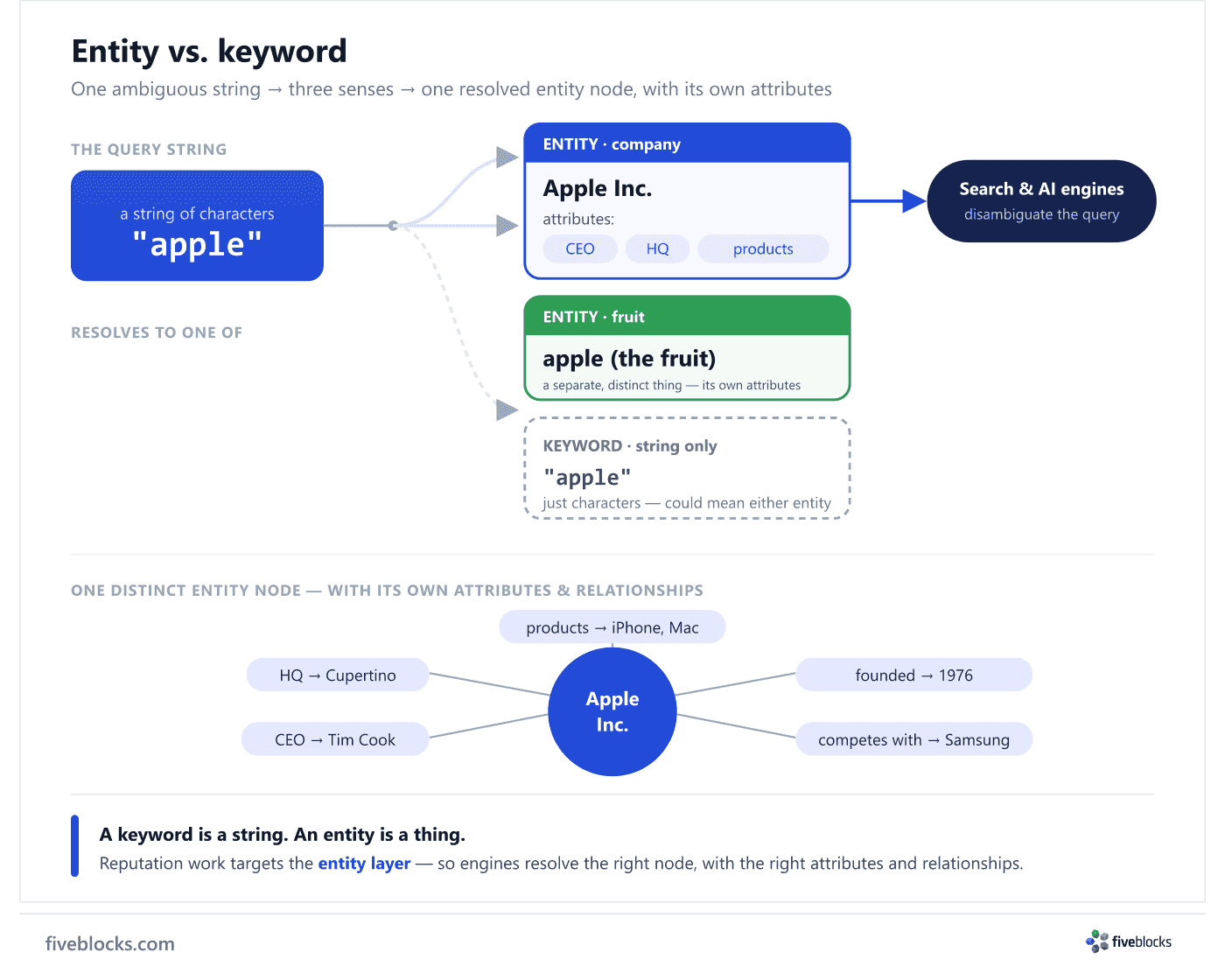
Google and the AI engines resolve which entity a query refers to, then assemble what they know about that specific node to answer.
Why this matters for reputation
This is why reputation work has shifted from optimizing for keywords to building entity recognition. The goal is for Google and the AI engines to know, with high confidence:
- who or what a client is,
- what attributes attach to them, and
- which other entities they relate to.
We call this the entity layer of the work. Getting it right is what enables the Knowledge Panel, the AI summary, and accurate disambiguation downstream.
Last reviewed: 20/05/2026
