What is grounding in AI and why does it matter for reputation?
Grounding ties an AI response to specific, checkable sources rather than letting the model answer freely from its training. Grounded systems are easier to influence by improving those sources, but they pass source errors straight through. Ungrounded systems make things up more often and are harder to move with new content.
Grounding means tying an AI response to specific, identifiable sources rather than letting the model answer freely from its training. Engines that search the live web are grounded by design. Perplexity, ChatGPT Search, and Google AI Overviews show citations and keep their answers to the sources they pull in. How grounded an engine is determines how a reputation program works on it.
Grounded vs. ungrounded systems: the reputation trade-off
The more grounded a system is, the more improving its sources pays off, and the more directly a bad source corrupts the answer. The two modes cut in opposite directions.
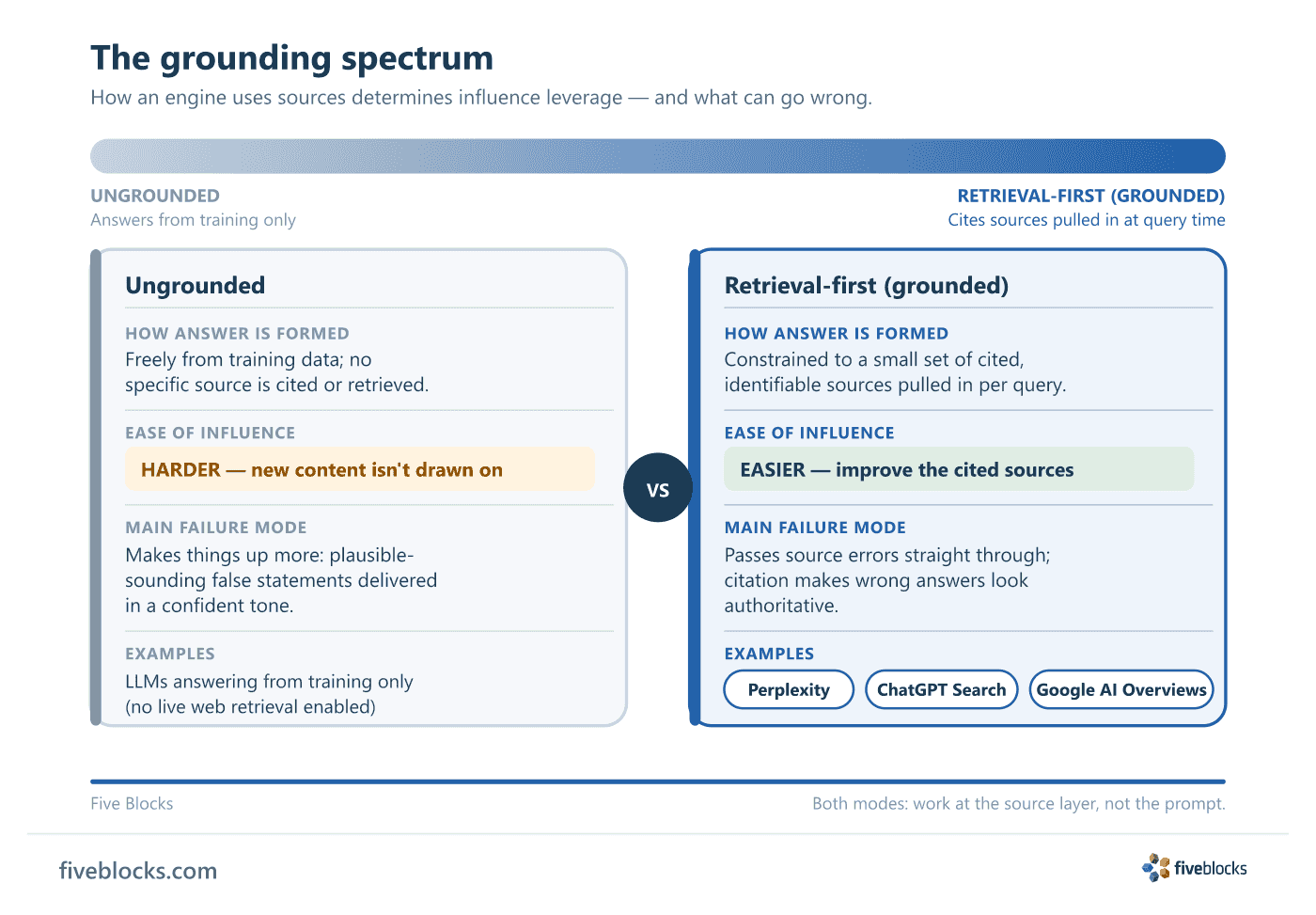
| Dimension | Grounded (searches the live web) | Ungrounded (answers from training only) |
|---|---|---|
| Example engines | Perplexity, ChatGPT Search, Google AI Overviews | A model answering from its training data with no live web search |
| How the answer is formed | Held to a small set of identifiable, cited sources pulled in when you ask | Written freely from the training data, with no tie to a specific source |
| Ease of influence | Easier. Improving the cited sources changes the answer | Harder. New content can’t shape an answer the model isn’t drawing on |
| Main failure mode | Passes source errors straight through. A wrong source produces a wrong answer, and the citation makes it look authoritative | Makes things up more. Plausible-sounding false statements delivered in a confident tone |
What this means for a reputation program
A reputation program works on both modes, adjusting for how each one behaves. On grounded engines, the biggest gains come from improving the specific sources being pulled in and cited. On ungrounded engines the work is slower and runs through the wider set of sources the model was trained on. Either way, the work is on the sources, not the prompt.
Last reviewed: 19/05/2026
