How does misinformation spread through AI systems?
Misinformation spreads through AI systems mechanically: a weakly-sourced claim gets summarized by one engine, which strips the original caveats; that summary is republished elsewhere and looks like a new independent source; a second engine then cites the republished version as corroboration. Within a few cycles, the same wrong fact can appear across multiple engines, each citing a different downstream source for the same original error.
The misinformation pathway through AI systems is usually mechanical, not intentional. A weakly-sourced claim appears on the web. An AI engine summarizes it in response to a user query and strips the original caveats in the process, because summaries drop hedging language. That summary, now cleaner and more confident-sounding than its source, gets republished or quoted on a blog or news outlet. A second engine retrieves the republished version, treats it as an independent corroborating source, and folds it into its own response. Within a few cycles, the same wrong claim can appear across several engines, each citing a different downstream source for the same original error.
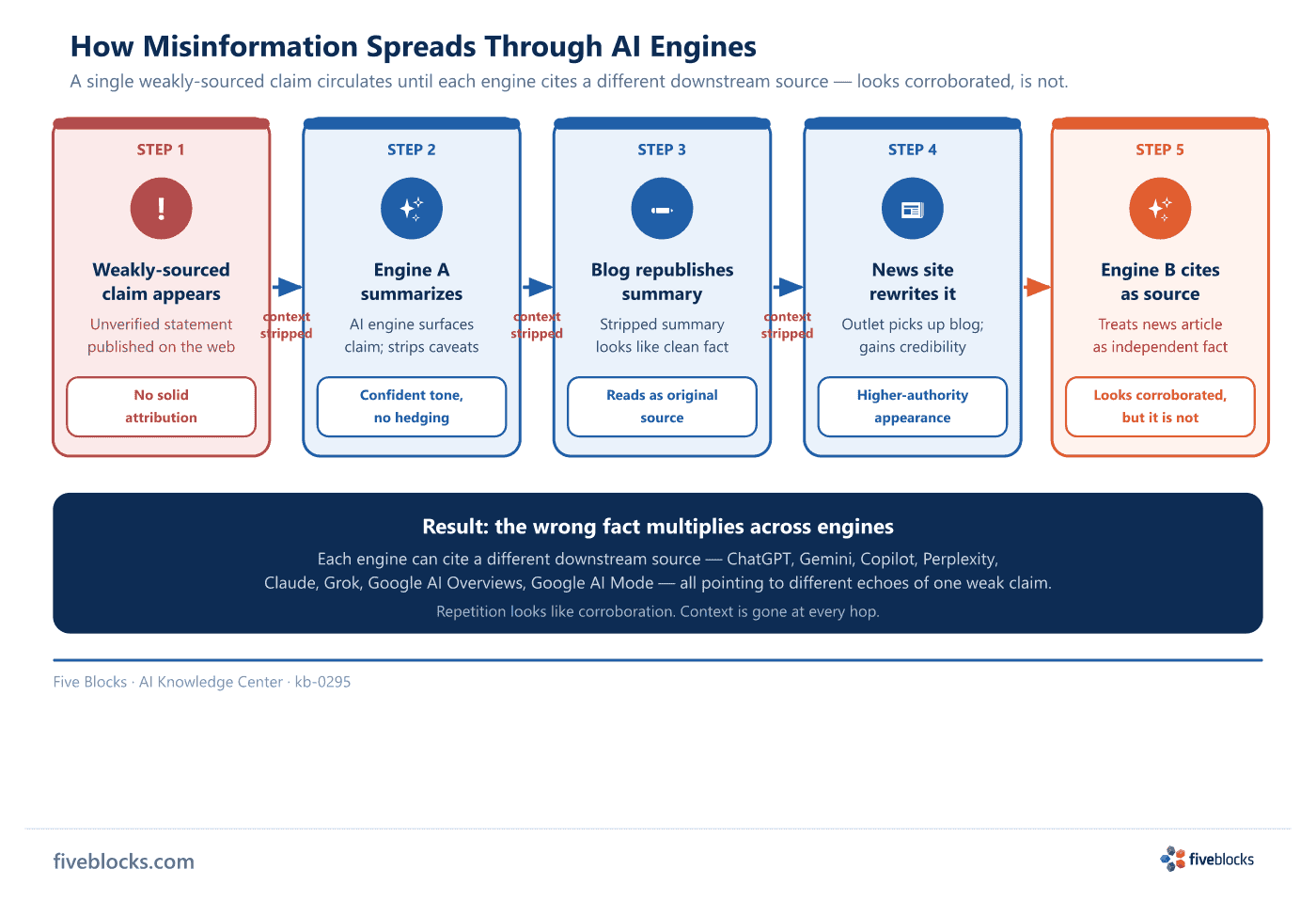
How each step amplifies the problem
- Weakly-sourced claim published. The error enters the web. Caveats, uncertainty language, or gaps in sourcing exist at this stage but are easy to miss.
- AI engine summarizes, caveats stripped. The engine produces a fluent summary. Hedging language disappears in the synthesis, so the claim sounds more settled than the underlying source warranted.
- Summary republished on a blog. A blog, newsletter, or outlet quotes or paraphrases the summary. The original sourcing is often lost, and the AI-condensed phrasing is presented as a standalone assertion.
- News outlet picks it up. A higher-authority outlet may pick up the blog version, which lends the claim more apparent credibility even though the underlying sourcing has not improved.
- Second engine cites the news outlet. A different engine retrieves the news version as an independent, high-authority source and uses it. The claim now looks corroborated from a separate source when it is actually an echo of the same original claim.
Why the cascade is hard to unwind
- Confident delivery. AI engines state synthesized claims in a fluent, confident tone regardless of the underlying source quality. Errors and accurate statements often sound identical.
- Apparent independence. Because each engine may cite a different downstream publication, the same original error looks like it comes from several independent places, which engines and readers alike treat as confirmation.
- Context lost at every hop. The caveats that flagged the original claim as uncertain are absent from the summary, from the republication, and from each engine response after that.
Addressing a contaminated chain
The repair work is straightforward but tedious: identify the original contaminated source, trace the downstream rebroadcasts, and make the correction at the strongest source that can be fixed, often a Wikipedia article or a Reuters-tier outlet, because changes at high-authority nodes carry more weight in how the engines rank sources. After the correction, monitor the AI narrative across the eight engines AIQ currently tracks (ChatGPT, Gemini, Copilot, Perplexity, Claude, Grok, Google AI Overviews, and Google AI Mode) to confirm the engines are re-weighting away from the contaminated source chain.
Last reviewed: 19/05/2026
