How do you handle a Wikipedia page being used as a source of negative content?
Treat it as two layers. The lasting fix is upstream: get the Wikipedia article itself into NPOV compliance with strong, independent sourcing. The downstream third-party use - a journalist, an analyst, an AI engine output - is then addressed case by case and tracked as the correction spreads.
When a third party uses Wikipedia as the source for negative framing about a client – a journalist citing it, an analyst quoting it, a competitor’s blog linking to it, an AI engine paraphrasing it – the situation splits into two layers. The downstream layer is the third-party use itself, handled case by case. The upstream layer is the Wikipedia article, and that is where the lasting fix belongs: if the article carries inaccurate framing or unbalanced coverage, every future third party will draw the same conclusion the current one did. Correct the article first, and the downstream uses either right themselves over time or become straightforward to address one at a time.
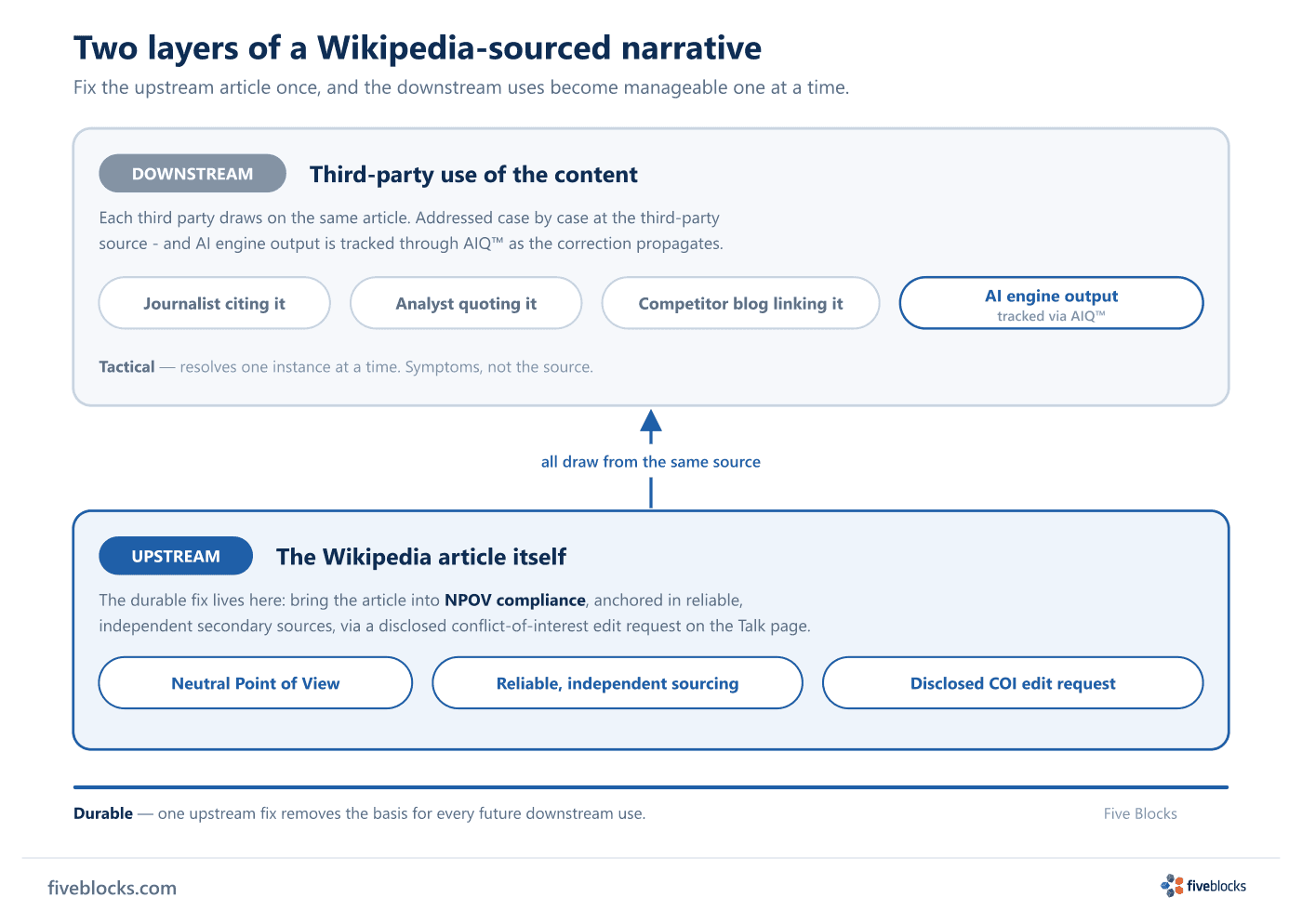
Two layers, two kinds of work
| Layer | What it is | How it’s handled | Effect |
|---|---|---|---|
| Downstream | The third-party use of the content, a journalist, an analyst, a competitor’s blog, an AI engine output | Addressed at the third-party source, case by case: the journalist is approached with corrected, sourced facts; the AI engine is tracked through AIQ to see when a correction has propagated | Tactical, resolves one instance at a time |
| Upstream | The Wikipedia article itself, the shared reference the downstream uses draw from | Get the article into Neutral Point of View (NPOV) compliance, anchored in reliable, independent secondary sources, via a disclosed conflict-of-interest edit request on the Talk page | Lasting; one fix removes the basis for every future downstream use |
Fixing the upstream layer
The upstream work is to bring the article in line with the policies that govern it:
- Neutral Point of View. Articles must fairly represent every significant viewpoint in proportion to its weight in reliable sources, and the editorial voice cannot advocate for or against the subject, opinions are presented as positions, not stated as facts.
- Reliable, independent sourcing. Content should rest on sources that are independent of the subject, secondary, published, and professionally edited, with a reputation for fact-checking. For contentious claims about a living person, Wikipedia’s Biographies of Living Persons policy requires high-quality reliable sources.
- Disclosed conflict-of-interest process. Interested or paid parties are strongly discouraged from editing the article directly and instead propose changes on the Talk page under disclosed COI rules, so uninvolved editors evaluate the change on its merits.
Once the article is accurate and policy-compliant, the downstream layer becomes manageable: corrections to retrieval-driven AI engines can surface within days, while responses leaning on baseline training change more slowly, and AIQ tracks that propagation engine by engine so you know when each downstream use has caught up.
Last reviewed: 19/05/2026
