How do you handle Wikipedia content being scraped and republished with errors?
Fix the error at Wikipedia itself. Scraped and republished copies generally don't update when the article changes, so correct the source and let the corrected version work its way through as aggregators re-crawl and AI training cycles run.
Correct the article at Wikipedia itself, then let the correction spread outward over time. Wikipedia content is reproduced widely: mirror sites and content aggregators republish it under its Creative Commons license, and that same content feeds AI-generated content farms, encyclopedia-clone projects, and AI engine outputs that draw on the article.
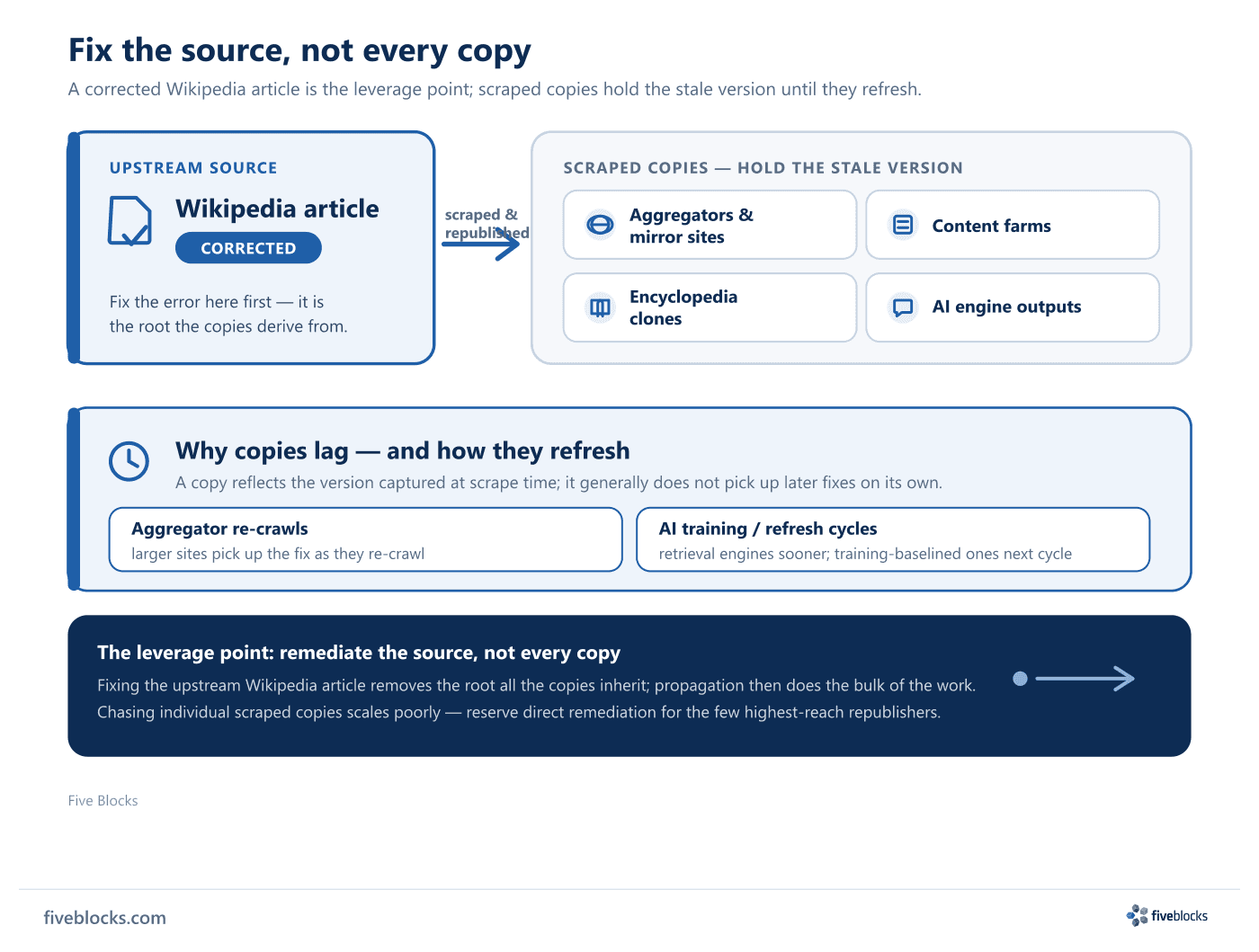
Why scraped copies lag behind
A republished copy reflects the version of the article that existed when it was captured. When the underlying Wikipedia article is later corrected, those downstream copies typically do not pick up the change on their own, so an outdated paragraph can persist across the web after Wikipedia has already been fixed. Refresh happens only as the larger aggregators re-crawl and as AI engines update: retrieval-based engines reflect newer content sooner, and training-baselined engines change only when their next training cycle runs. (See sourcing note: the specific timing of this propagation is not externally documented and is described directionally, not as a measured lag.)
Why the upstream fix has the most effect
- Fix Wikipedia first. The article is the source the copies derive from, so correcting it removes the root the rest inherit.
- Let the spread do most of the work. As aggregators re-crawl and AI engines refresh, many copies pick up the corrected version without individual intervention.
- Target only the highest-reach republishers directly. Chasing every scraped copy rarely scales; reserve direct remediation for the few highest-reach sites when the stakes warrant it.
The principle: remediate the source, not every copy. The upstream Wikipedia article is what to fix; chasing individual republished copies is slower, scales poorly, and leaves the root cause in place.
Last reviewed: 19/05/2026
