What is the difference between ChatGPT Search and Google AI Overview?
ChatGPT Search is a conversational chat interface with live web retrieval built into ChatGPT; Google AI Overview is an AI-generated summary box at the top of a standard Google results page. Both use retrieval-augmented generation and weight authoritative sources, but they reach different audiences through different prompt patterns, and each calls for a different tactical emphasis from a reputation program.
ChatGPT Search and Google AI Overviews look different and serve different audiences, but they work the same way: synthesize an answer from authoritative sources and present it as the user’s first read. For a reputation program, the differences matter because they change which signals you prioritize and where you put the most effort.
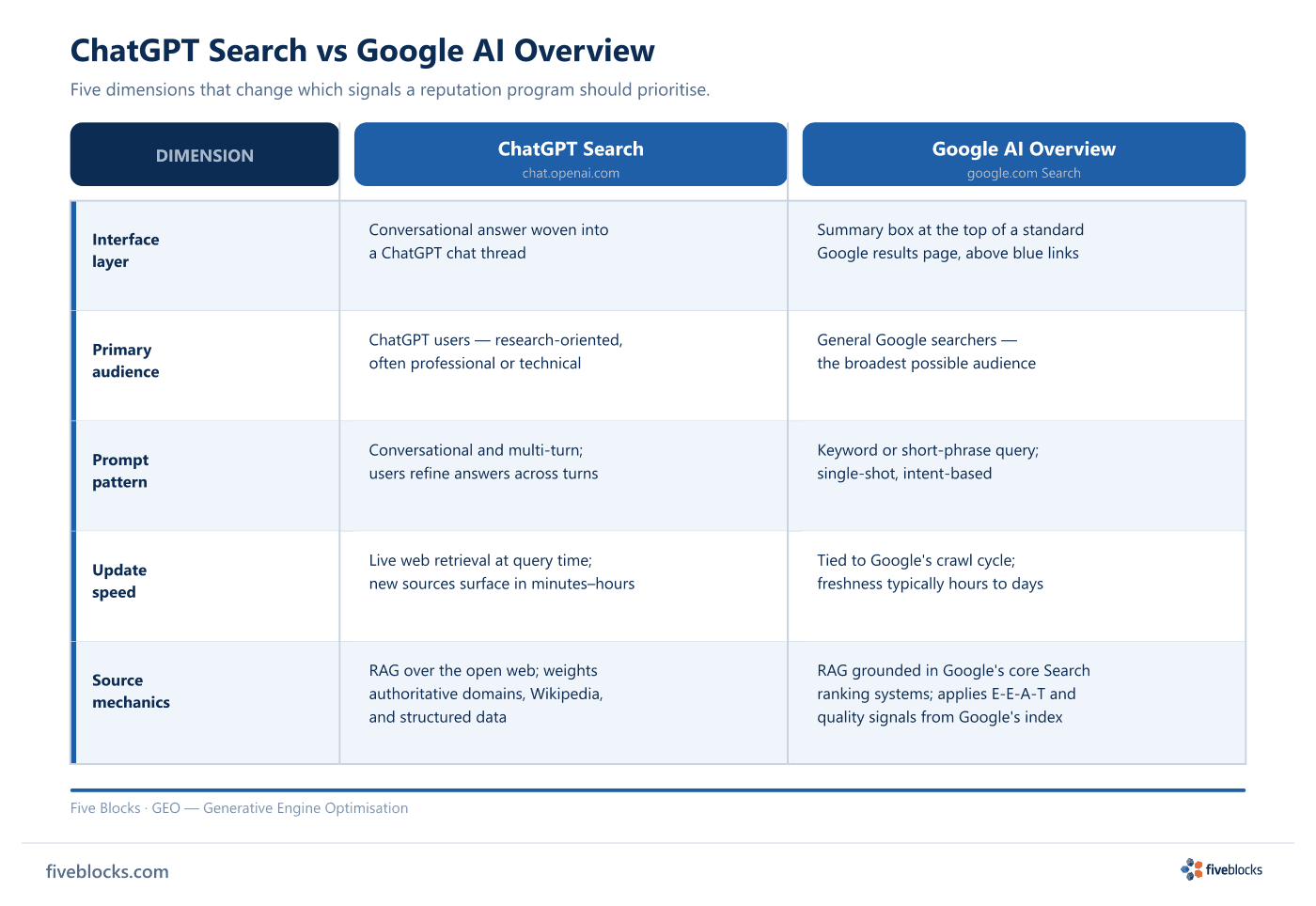
Side-by-side comparison
| Dimension | ChatGPT Search | Google AI Overview |
|---|---|---|
| Interface layer | Conversational answer woven into a ChatGPT chat thread | Summary box at the top of a standard Google results page, above blue-link results |
| Primary audience | ChatGPT users, typically research-oriented, often professional or technical | General Google searchers, the broadest possible audience for any query |
| Prompt pattern | Conversational and multi-turn; users ask follow-up questions and refine | Keyword or short-phrase queries; single-shot and intent-based |
| Update speed | Live web retrieval at query time; newly published sources surface within minutes to hours | Tied to Google’s search index; freshness tracks Google’s crawl cycle, typically hours to days |
| Source mechanics | RAG over the open web; weights authoritative domains, Wikipedia, and structured data | RAG grounded in Google’s core Search ranking systems; applies E-E-A-T and Quality signals from Google’s index |
What to do differently for each
Both engines use retrieval-augmented generation, so the same source-layer work helps both: authoritative third-party coverage, a well-maintained Wikipedia article, clean schema markup, and structured entity signals. The differences are at the margin:
- For ChatGPT Search: conversational prompt patterns mean users often phrase queries as full questions (“What do people say about X?” or “Is X reputable?”). Content that directly answers those question forms: FAQ pages, Q&A-structured editorial, clearly attributed quotes from credible sources, tends to surface in conversational retrieval. ChatGPT also draws on a broad training corpus (books, news, forums, Reddit) in addition to live retrieval, so consistent long-term authoritative coverage across many source types matters alongside freshness.
- For Google AI Overviews: the entry point is a keyword query in Google, so standard E-E-A-T signals, page-level technical factors (crawlability, schema markup, passage-level extractability), and overall index authority apply directly. Google AI Overviews are rooted in Google’s core Search ranking systems, meaning a page already ranking well for a branded keyword is a strong candidate to be synthesized into the Overview. Prioritize pages that are both highly ranked and written in fact-dense, extractable prose.
Last reviewed: 19/05/2026
