How does Google AI Overview affect brand reputation?
Google AI Overviews place a synthesized AI-generated summary above the traditional blue-link results for many queries, so a searcher reads it before reaching the organic listings. The sources Google selects for that summary get amplified; those it does not select lose visibility. Programs that once optimized only for blue-link rankings now need a second discipline aimed at becoming one of those cited sources.
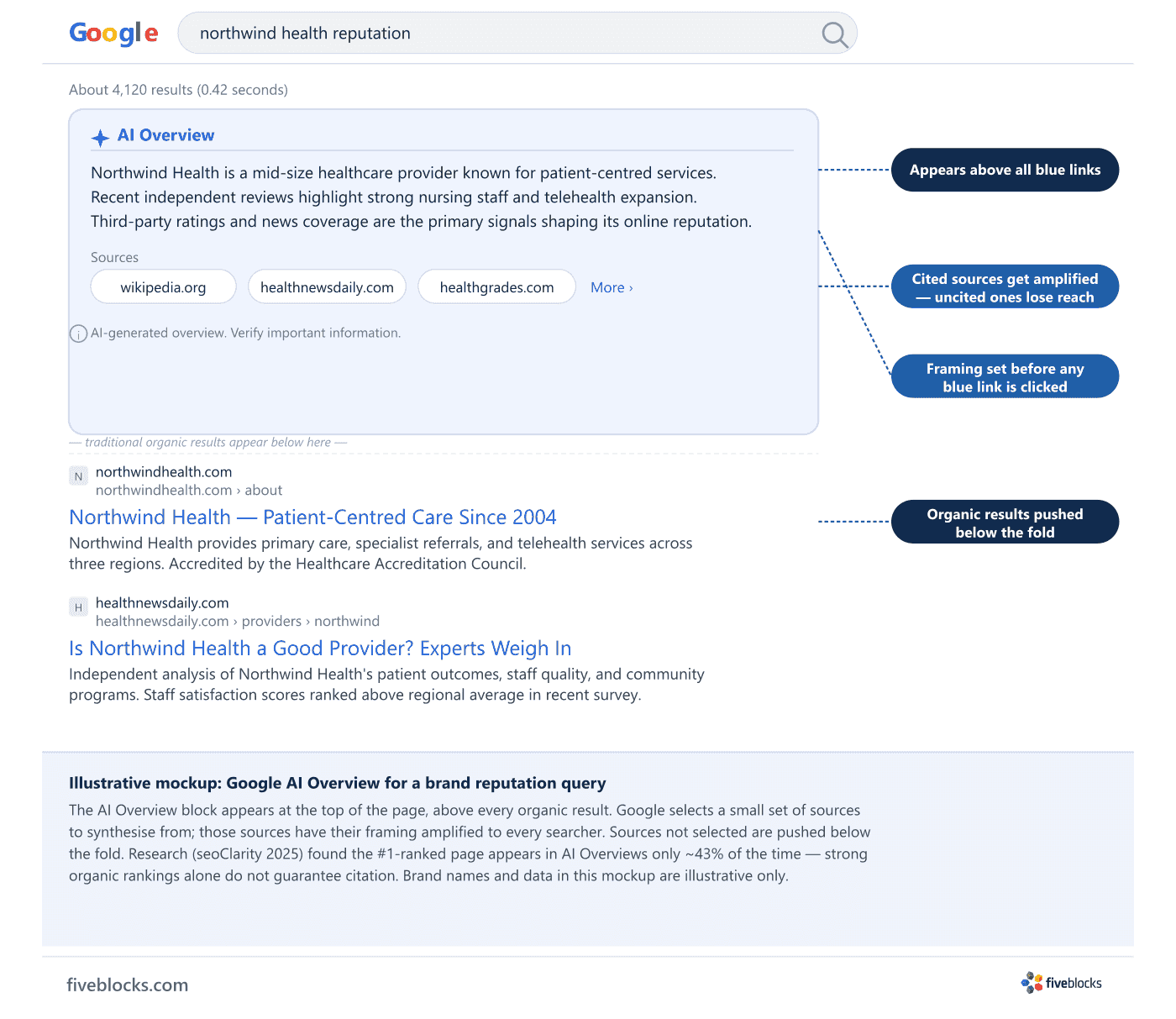
Google AI Overviews are the AI result most teams encounter first, because they appear inside the Google results page the team already monitors. For a query that triggers an Overview, the AI-generated summary sits at the top of the page, often before any blue-link result. Whichever sources Google selects for that summary get their framing amplified; the ones it does not select are pushed below the fold, where attention drops sharply.
Why it matters for brand reputation
- Attention shifts before the blue links. AI Overviews appear above the organic listings, so stakeholders read a synthesized version of your brand before they see any ranked page. Whether that summary reads positive, neutral, or negative sets the frame for everything below it.
- Citation is uneven. A Pew Research study (July 2025) found that Wikipedia, YouTube, and Reddit are the most frequently cited sources in Google AI summaries. Brands and owned properties are cited far less unless the content is structured to be extractable.
- Ranking alone is not enough. Research by seoClarity (2025) found that position-one URLs appear in AI Overviews only around 43% of the time, so even the top-ranked page is often not cited. Strong organic rankings help, but they do not guarantee inclusion.
How to optimize for Overview citation
- Write for extraction. AI engines pull more reliably from content that states facts plainly and is organized into clean, answerable units. Lead with a direct answer, then add context. The same logic that wins featured snippets applies here, since AI Overview selection is closely related to featured-snippet logic.
- Apply schema markup. FAQPage, Article, Organization, and Person schema make page structure machine-readable, so Google can parse what a page asserts and attach it to the right entity. Clean structured data raises the odds that a page is understood well enough to be cited.
- Strengthen the source layer. Because Wikipedia and major outlets appear prominently in AI citation studies, a Wikipedia article, authoritative third-party coverage, and strong entity signals on Wikidata all raise the probability that your brand is represented in the synthesized result, and represented accurately.
- Monitor what the Overview actually says. The same brand query can return different Overview text depending on geography, device, and query phrasing. Ongoing monitoring with a tool like AIQ™ catches when an Overview carries inaccurate or unfavorable framing and identifies which sources are driving it.
Programs that historically optimized for blue-link rankings have had to add this second discipline. The work is less about rank position and more about being a source the system trusts enough to synthesize from.
Last reviewed: 19/05/2026
