How do academic and research citations contribute to entity authority?
Academic and research citations are among the highest-trust authority signals for both Google and the AI engines. Published research, Google Scholar citations, and references from academic-domain sources strengthen entity and topical authority - but only when the scholarship is genuine; manufactured research carries no signal and can backfire.
Academic and research citations are among the strongest authority signals available, because both Google and the AI engines weight sources by credibility, and scholarly sources rank high on that scale. Several mechanisms make this layer work for the right entity, and one constraint decides whether it works at all: the scholarship has to be real.
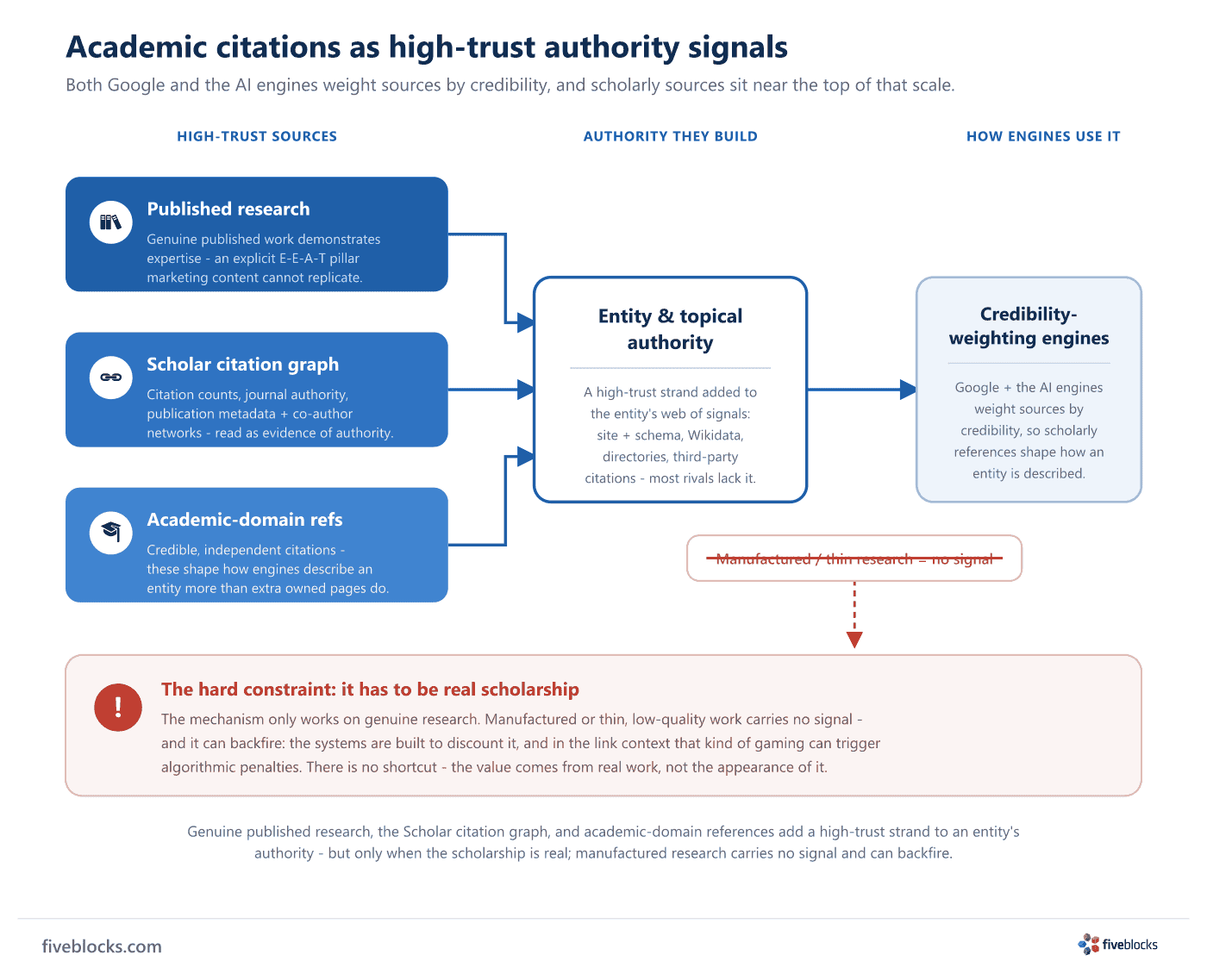
The mechanisms that build authority
- Published research demonstrates expertise
- Genuine published work ties an entity to demonstrated expertise in a way marketing content cannot replicate. Expertise and authoritativeness are explicit pillars of Google’s E-E-A-T framework, and the signals that framework rewards, identifiable expert authorship, bio context, within-text citations, and a credible publishing entity, overlap with the signals the AI engines weight.
- The citation graph is read as evidence of authority
- Systems read citations in Google Scholar and the academic citation graph as evidence of authority. Google Scholar runs separately from the main Google index and weights academic signals such as publication metadata, citation counts, journal authority, and co-author networks, all of which point back to the entity.
- Citation by credible sources outweighs more owned pages
- Search and AI engines weight sources by credibility, so being cited by credible, authoritative, independent sources shapes how the engines describe an entity more than publishing additional owned pages does. Academic and academic-domain references are a strong example of that credible, independent citation.
Who this works for
For the right clients, research-driven firms, executives with genuine scholarship, and institutions, this layer does a lot of work and most competitors never use it. Entity authority is built from a connected set of signals (a Wikipedia article, an accurate Wikidata entry, an official site with schema, presence in authoritative directories, and consistent citations from credible third parties), and genuine research adds a high-trust reference to that set.
The honest constraint: it has to be real
The mechanism only works on genuine scholarship. Manufactured or low-quality research does not carry the signal, and it can backfire: attempts to game authority with thin, spammy material are what the search systems are built to discount, and in the link context they can trigger algorithmic penalties. The value comes from real work, not from the appearance of it.
How we apply it
Where genuine scholarship exists, we make sure it is attributed, structured, and connected to the entity, because AI model outputs cannot be edited directly; influence comes from shaping the sources the models draw on. We then track how the entity is represented across the eight AI engines AIQ monitors, so the effect of strengthening this layer shows up in the engines’ answers over time.
Last reviewed: 20/05/2026
