What is the role of Google Scholar results in professional reputation?
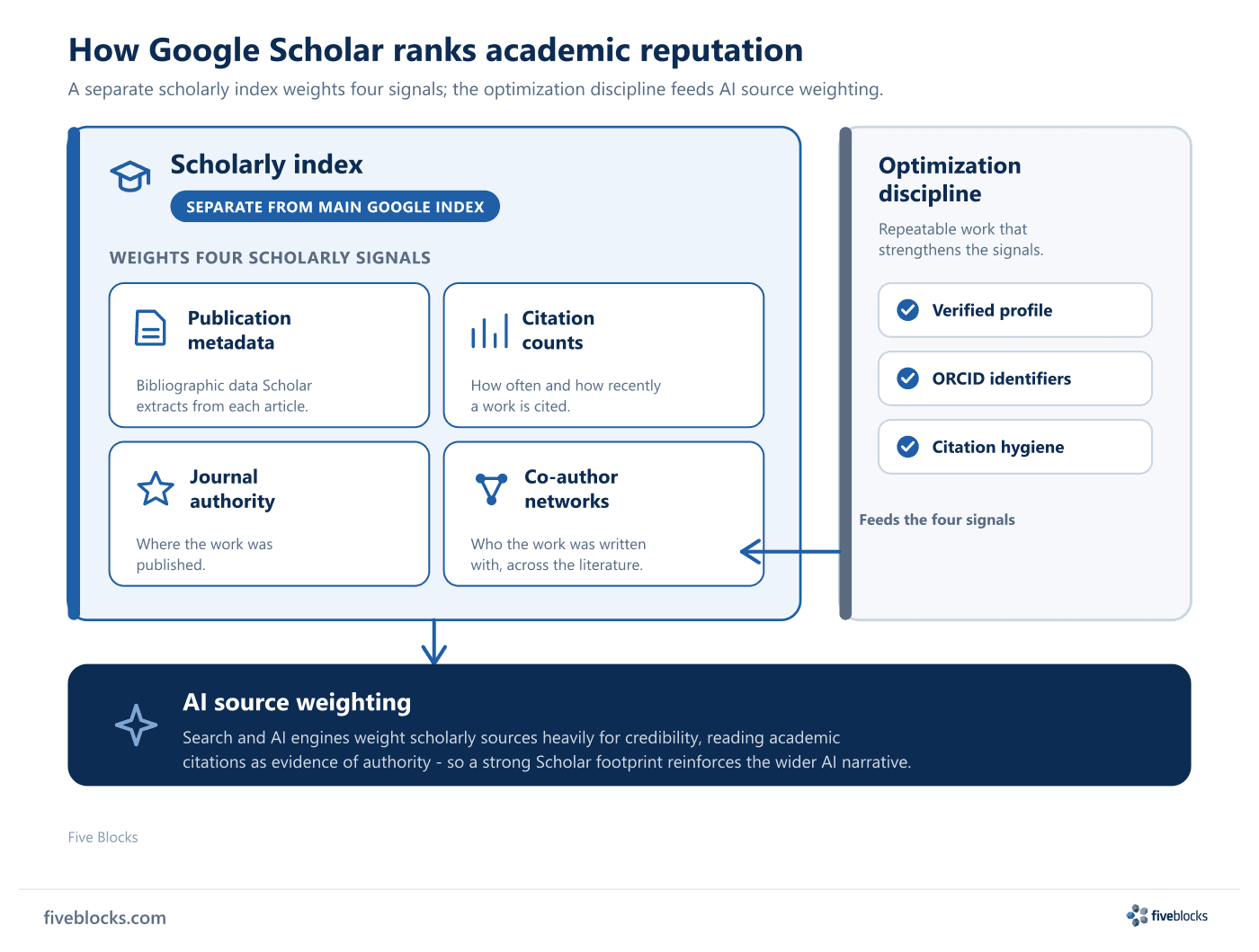
Google Scholar runs separately from the main Google index, ranking academic work by publication metadata, citation counts, journal authority, and co-author networks. For people whose reputation depends on academic credibility, a verified Scholar profile, consistent author metadata, ORCID identifiers, and clean citation hygiene make scholarly work more visible and feed the credibility signals that search and AI engines read.
Google Scholar matters wherever a reputation depends on academic, scientific, or research credibility. It runs separately from the main Google index and weights scholarly signals rather than general web signals. Strong publication metadata, a complete author profile, and proper citation hygiene drive visibility in scholarly search and strengthen the credibility cues that search and AI engines read.
What Google Scholar weights
Scholar indexes the academic literature and ranks it on signals specific to scholarly publishing:
- Publication metadata, the bibliographic data Scholar extracts automatically from each article.
- Citation counts, how often, and how recently, a work is cited in other scholarly literature.
- Journal authority, where the work was published.
- Co-author networks, who the work was written with and how authors connect across the literature.
Who this matters for
For clients whose reputation depends heavily on academic credibility, researchers, scientists, medical experts, and some consultants and consultants-turned-executives, Scholar visibility is its own workstream, not an afterthought of general SEO.
The optimization discipline
The work is structured and repeatable:
- Complete and accurate publication metadata across every paper.
- A verified Google Scholar profile.
- A consistent author name and affiliation across publications.
- Proper citation hygiene.
- ORCID identifiers, which link the author across systems.
How it feeds the wider AI narrative
This work builds entity authority more broadly. Search and AI engines weight scholarly sources heavily for credibility, and they read the citations recorded in Google Scholar and the academic citation graph as evidence of authority. A strong, consistent Scholar footprint strengthens the credibility signals behind the underlying topic, well beyond the individual papers.
Last reviewed: 19/05/2026
