How do you manage an executive’s reputation when they become a public author or speaker?
Treat the new author or speaker role as an added entity layer: build an owned bio or book site carrying Person schema, earn independent third-party coverage of the publication or speaking, mark up the publication metadata so engines can read it, and add or update Wikipedia only where independent notability supports it.
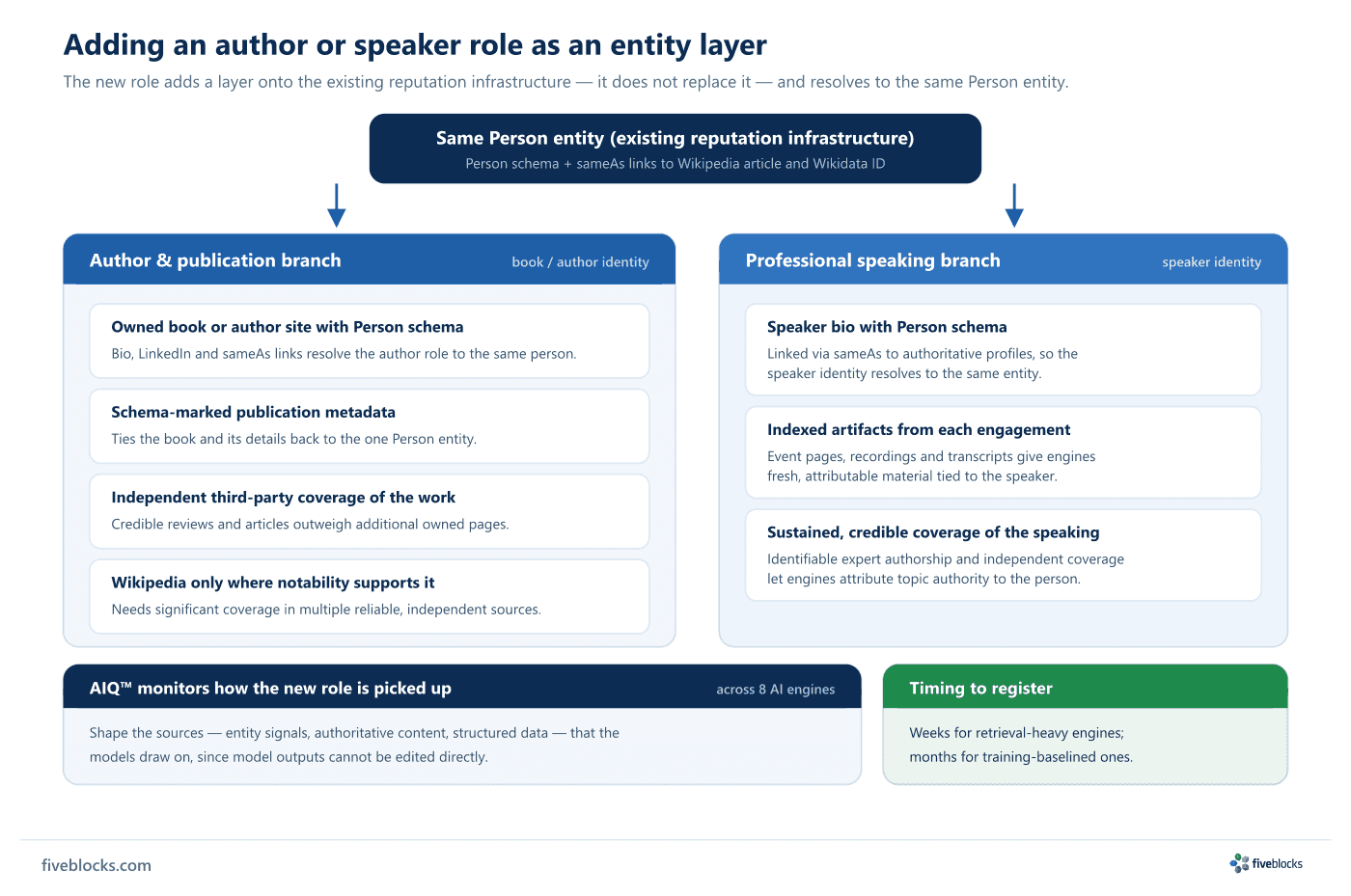
When an executive becomes a public author or speaker, that role adds a layer to their reputation infrastructure. The goal is to make every credible signal about the new role readable by the engines that assemble answers about the person, so the author or speaker identity resolves to the same entity and independent coverage of it carries weight. Two branches of work follow: the author and publication side, and professional speaking.
The author and publication branch
- Owned book or author site with Person schema. Person entity signals include a bio site carrying Person schema, a complete LinkedIn profile, authoritative bio citations, and
sameAslinks. Person schema withsameAslinks connects the bio to the executive’s Wikipedia article and Wikidata identifier, so engines resolve the author role to the existing person instead of a separate entity. - Schema-marked publication metadata. Schema markup is structured data that tells search and AI engines what a page asserts and attaches it to the correct entity. It can tie several role-specific pages back to the same Person entity, so the book and its details read as part of one identity.
- Independent third-party coverage of the work. Engines weight credentialed, independent coverage more heavily than additional owned pages, so reviews and articles about the book from credible outlets shape AI answers more than the author site does on its own. Wikipedia treats books from established publishers with editorial processes as reliable sources, which strengthens the citation base around the work.
- Wikipedia only where notability supports it. A Wikipedia article is viable only when independent notability supports it: significant coverage in multiple reliable, independent, secondary sources. Where the author work clears that bar, AI engines weight Wikipedia heavily. Where it does not, attempting an article risks deletion, so build the independent coverage first.
The professional speaking branch
- Speaker bio on the owned site with Person schema, linked via
sameAsto the executive’s authoritative profiles so the speaker identity resolves to the same entity. - Indexed artifacts from each engagement. Event pages, recordings, and transcripts give engines fresh, attributable material tied to the speaker, and content with clear, credentialed authorship is more likely to be cited.
- Sustained, credible coverage of the speaking. Identifiable expert authorship and independent coverage are what let engines attribute authority on a topic to the person.
How the engines and AIQ fit
AI model outputs cannot be edited directly. Influence comes from shaping what the models draw on: the sources, entity signals, authoritative content, and structured data. AIQ monitors how the eight AI engines it tracks describe the executive, so the team can see whether the new author or speaker role is being picked up and attributed correctly, and which supporting sources still need work.
The change registers gradually. Improving the underlying sources, including a Wikipedia article, produces visible engine-level changes within weeks for retrieval-heavy models and over months for those anchored to their training baseline. The work extends the executive’s authority on the chosen topics; it does not replace the reputation infrastructure already in place.
Last reviewed: 19/05/2026
