How do you use speaking engagements and conferences to build entity authority?
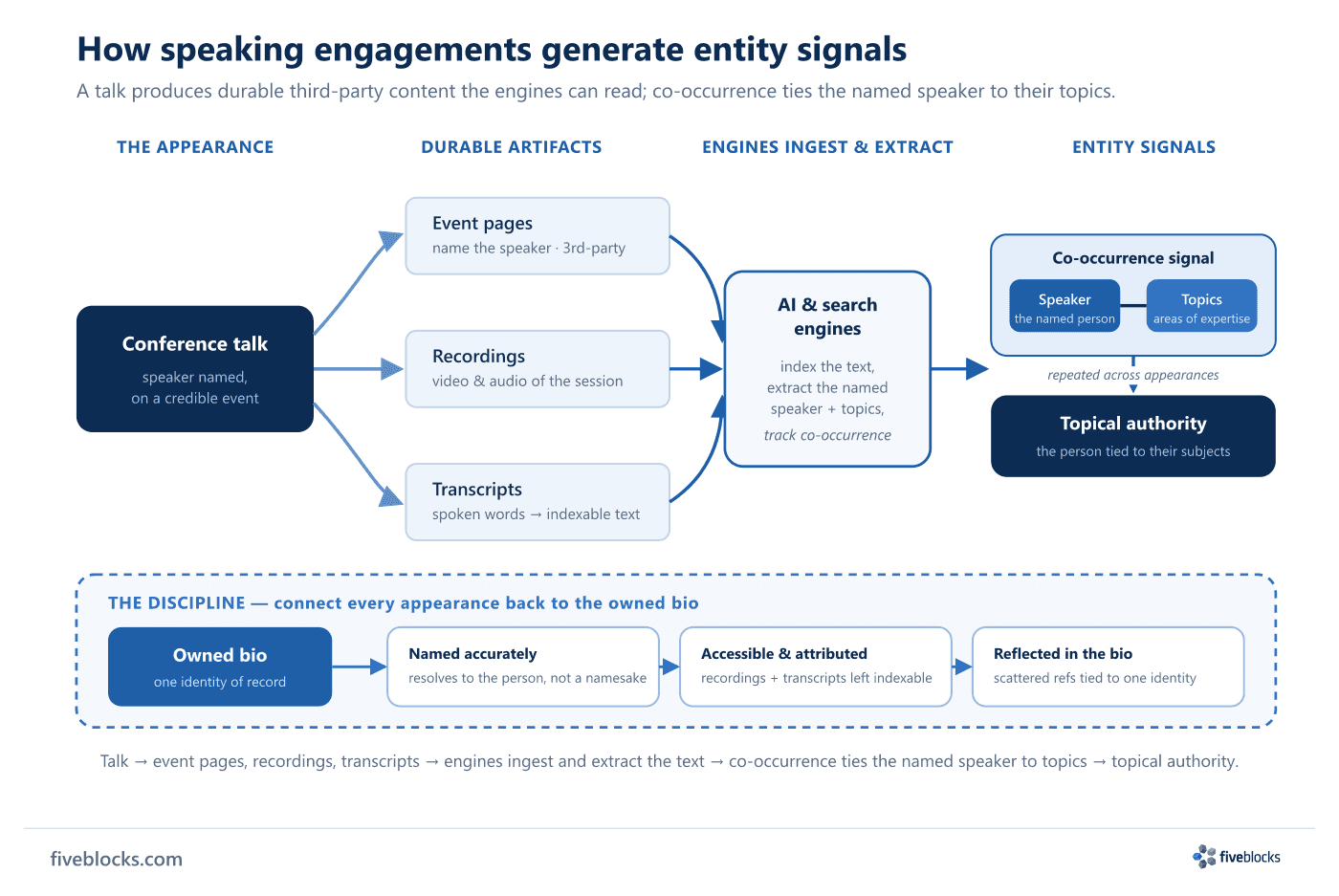
Speaking at recognized industry events builds entity authority by generating durable third-party content - event pages that name the speaker, recordings, transcripts, and press and social coverage - that places the person's name alongside specific areas of expertise. Search and AI engines extract text and track these co-occurrence and co-citation patterns, so a record of relevant appearances helps tie the speaker to their topics, provided the appearances are captured accurately and connected back to the owned bio.
Speaking at recognized industry events builds entity authority by generating a particular kind of third-party content. A talk at a credible conference produces event pages that name the speaker, recordings, transcripts, and often press and social coverage, all of it placing the speaker’s name alongside the specific subjects they are known for. That is the raw material search and AI engines use to associate a person with a topic, and credible third-party content carries more weight than anything a speaker publishes about themselves.
What a speaking engagement actually produces
- Event pages that name the speaker
- A session listing on a credible conference site names the speaker in the context of a topic and carries the event’s own domain authority. It is a third-party reference, not a self-claim.
- Recordings and transcripts
- Where a talk is recorded and transcribed, the transcript turns spoken content into indexable text. Search engines cannot watch a video or listen to audio, but they do index the text of a transcript, which is how that content becomes extractable at all.
- Press and social coverage
- Coverage of an appearance is earned third-party media. The engines cite earned coverage as sources when answering questions about a company or person, and they treat that independence as a trust signal.
Why this strengthens entity signals
The mechanism that ties these appearances to a person’s expertise is co-occurrence. Modern search and AI systems track co-occurrence and citation patterns in natural language, not only links, and use them to infer an entity’s category and associations. The engines learn who is who from co-citation patterns, the same name and the same topic appearing together across independent sources. A consistent record of relevant appearances reinforces the subjects the systems associate with the person. This works together with named, credentialed authorship: engines weight content tied to identifiable experts with credible bios, the same logic behind Google’s E-E-A-T framework. A speaking history is one more credible third-party signal of standing, much as genuine industry recognition is read as evidence of standing.
One caution. The stronger version of this claim, that the engines reliably ingest spoken-word conference transcripts, extract the named speaker, and attribute genuine topical authority from them, is an extension of how engines demonstrably handle written and video-transcript text. We cannot point to an authoritative source that confirms it for live-event audio specifically. We present it as a well-grounded expectation rather than a measured fact, and we do not claim a guaranteed lift from any single appearance.
The discipline: connect appearances back to the entity
- Name the speaker accurately and consistently on event pages, so the reference resolves to the right person rather than a namesake.
- Keep recordings and transcripts accessible and attributed, so the text is available to be indexed and extracted.
- Reflect the appearances in the owned bio, tying the scattered third-party references back to one identity.
For Five Blocks clients, we treat recognized speaking engagements as a source-layer contribution to an executive’s or expert’s entity authority, and we track how the topics the AI engines associate with the person shift over time using AIQ.
Last reviewed: 20/05/2026
