How do you use podcast appearances and transcripts to strengthen entity signals?
Podcast appearances generate third-party content - an episode page, the audio, and increasingly a transcript - that names a speaker in the context of their expertise. Search and AI engines draw on podcast and transcript content and track co-occurrence in natural language, so a series of relevant, credible appearances can reinforce the topics those systems associate with the person over time.
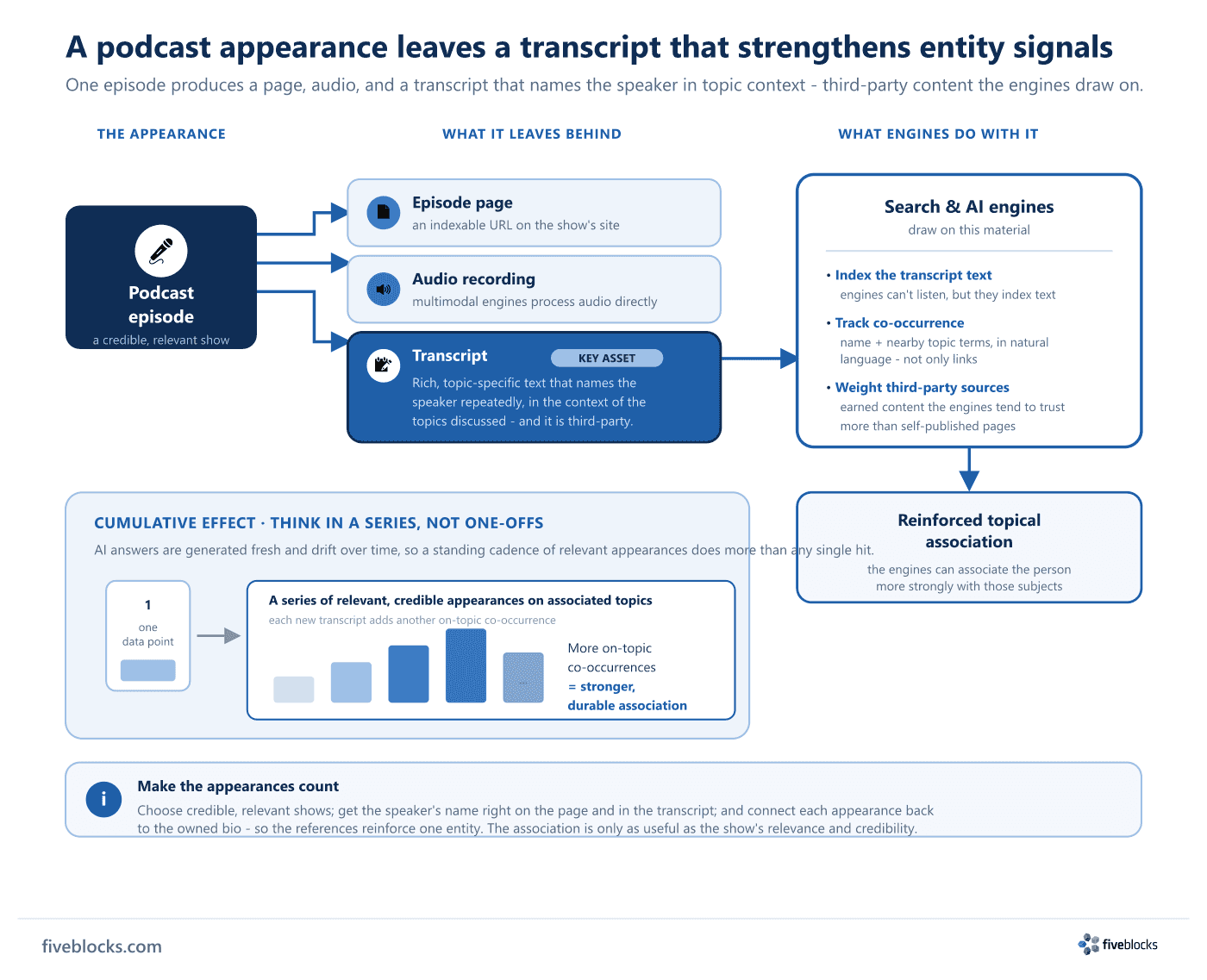
Podcast appearances are an underrated entity-building tool, largely because of what they leave behind. A single appearance on a credible show typically produces three durable artifacts, an episode page, an audio recording, and increasingly a transcript. The transcript is topic-specific content that names the speaker repeatedly in the context of their expertise. Search and AI engines draw on this kind of material. The discipline is to make sure each appearance is credible, relevant, accurately attributed, and connected back to the speaker’s owned bio.
Why the transcript is the asset that matters
- Engines can read spoken content
- Search engines can’t watch or listen, but they index text, so a transcript lets them ingest multimedia content. Engines crawl and embed transcripts into their source ecosystems and can cite them like written articles. Multimodal AI engines also process audio directly, including content such as podcasts and earnings calls, and AI engines are documented as drawing on podcast episodes among other user-generated sources.
- It names the speaker in topic context, repeatedly
- A transcript surfaces the speaker’s name alongside the subjects they discuss. Modern search and AI systems track co-occurrence and citation patterns in natural language, not only links, and use them to infer an entity’s category and associations. That is the mechanism by which repeated, on-topic appearances can reinforce the topics a system associates with a person.
- It is third-party, not self-published
- A podcast appearance is content someone else produced, which is the kind of signal the engines tend to trust. AI engines weight third-party coverage when generating answers about an entity, cite third-party earned media as sources, and weight credentialed external sources heavily when assessing topical expertise. In controlled generative-search tests, AI answers have shown a bias toward earned media over brand-owned content.
How to make appearances count
- Choose credible, relevant shows. The topical association is only as useful as the relevance of the podcast to the speaker’s actual expertise.
- Get the name right. Make sure the speaker is accurately named on the episode page and in the transcript so the engines attach the content to the correct person.
- Connect it to the owned bio. Tie each appearance back to the speaker’s authoritative bio so the references reinforce one entity rather than scattering.
- Think in series, not one-offs. Because AI answers are generated fresh and drift over time, a standing cadence of relevant appearances does more than any single hit.
We treat podcast appearances as a source-layer contribution to topical authority and track how they shift the way the AI engines frame a person with AIQ.
Last reviewed: 20/05/2026
