How do you create content that positions an executive as a thought leader?
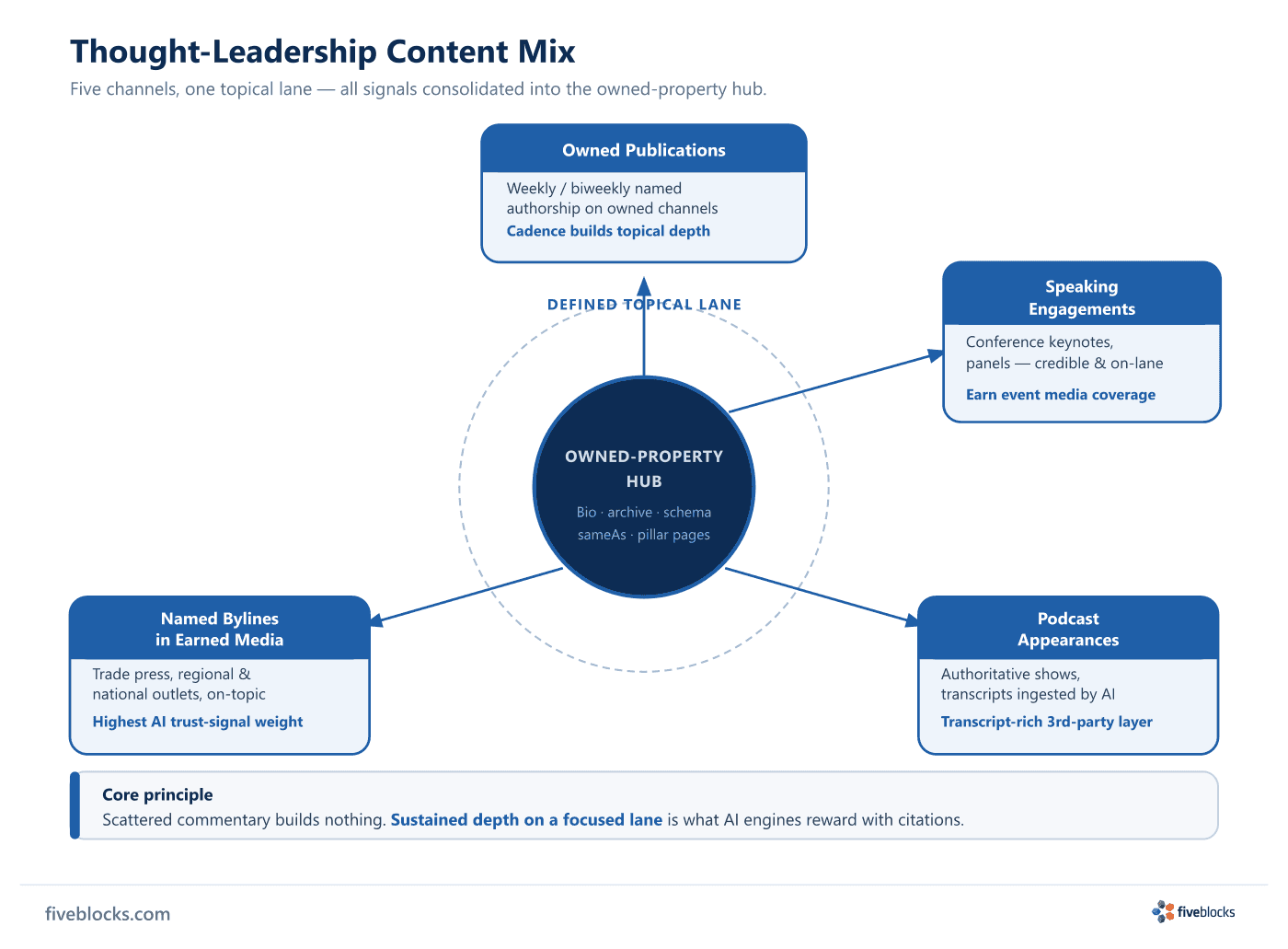
Positioning an executive as a thought leader requires a defined topical lane, consistent named authorship across owned publications and earned bylines, and a mix of speaking engagements and podcast appearances that all tie back to a structured owned-property hub. Scattered commentary builds no authority; sustained depth on a focused subject is what gets the executive cited as a source by the AI engines.
Positioning an executive as a thought leader means building recognized topical authority around a real person. Focus and consistency matter more than volume: commentary scattered across unrelated topics builds nothing, while sustained depth on a focused subject earns the recognition that search engines and AI engines reward by citing the executive as a source on that subject.
Step 1: Define the topical lane
Before producing any content, identify the two or three subjects where the executive has real expertise and where the organization benefits from being seen as authoritative. A lane that is too broad (“leadership”, “innovation”) produces thin signals; a specific lane (“supply-chain resilience in life sciences”, “municipal climate finance”) builds depth the systems can index and cite. Everything that follows should be scoped to that lane.
Step 2: Build the owned-property hub
An executive bio page on the corporate site, with Person schema and sameAs links to LinkedIn, Wikidata, and Wikipedia where applicable, anchors the identity so systems resolve all content back to one entity. The hub should carry:
- A current, expert-authored bio with named authorship and schema markup (supporting Google’s E-E-A-T signals).
- An indexed archive of articles, interviews, and presentations published under the executive’s byline.
- Links to speaking appearances and podcast episodes, with transcripts where available.
Pillar-and-cluster architecture on owned properties deepens the topical signal: a pillar piece on the defined lane, supported by shorter pieces that link back to it, tells search and AI engines that the executive has breadth on the subject rather than a single page.
Step 3: Publish consistently on owned channels
Weekly or biweekly publishing on owned properties keeps the entity active and builds the content base. Monthly long-form pieces under named authorship build topical authority over time. Consistency matters more than volume: a steady cadence signals freshness and ongoing expertise, while irregular bursts do little to build durable authority signals. All content should carry clear bylines so authorship resolves to the executive rather than to the corporate brand alone.
Step 4: Earn named bylines in authoritative outlets
Third-party earned coverage carries much more weight than owned content alone with both Google and the AI engines, which bias toward independent sources as trust signals. Placing bylined articles in relevant trade publications, regional business press, or national outlets on the executive’s defined topic gives the systems credible third-party material that names the executive in the context of their expertise. The publishing source matters: one placement in a credible, topically relevant outlet outweighs many placements in low-authority ones.
Step 5: Secure speaking engagements on credible platforms
Conference keynotes, panel appearances, and industry event talks each produce several reputation assets: coverage by event media, write-ups that name the executive in context, and recordings that can be transcribed and hosted on the owned hub. Choose on relevance and credibility. Appearances at recognized events in the executive’s defined lane carry topical signal; generic conference appearances scatter it.
Step 6: Use podcast appearances as a source layer
Podcast guest appearances on authoritative shows produce transcript-rich third-party content that the AI engines ingest. Each episode page usually names the executive in the context of the topic discussed, and accessible transcripts let models extract and cite views and expertise. Host selection decides the value: credible, topically relevant shows extend the authority signal, while appearances on low-quality shows add little and can introduce weak associations. Reflect appearances in the owned hub so the value consolidates rather than living only on the platform.
Step 7: Track how AI engines describe the executive
Monitoring how the eight AI engines AIQ currently tracks, ChatGPT, Gemini, Copilot, Perplexity, Claude, Grok, Google AI Overviews, and Google AI Mode, describe the executive shows whether the topical lane is registering. When the engines begin citing the executive as a source on the defined topic, the program is working. When they still describe the executive mainly in terms of their organization rather than their expertise, the source layer needs more authoritative content, earned coverage, or entity-signal work to shift the framing.
Last reviewed: 20/05/2026
