How do you build a thought leadership platform for an executive?
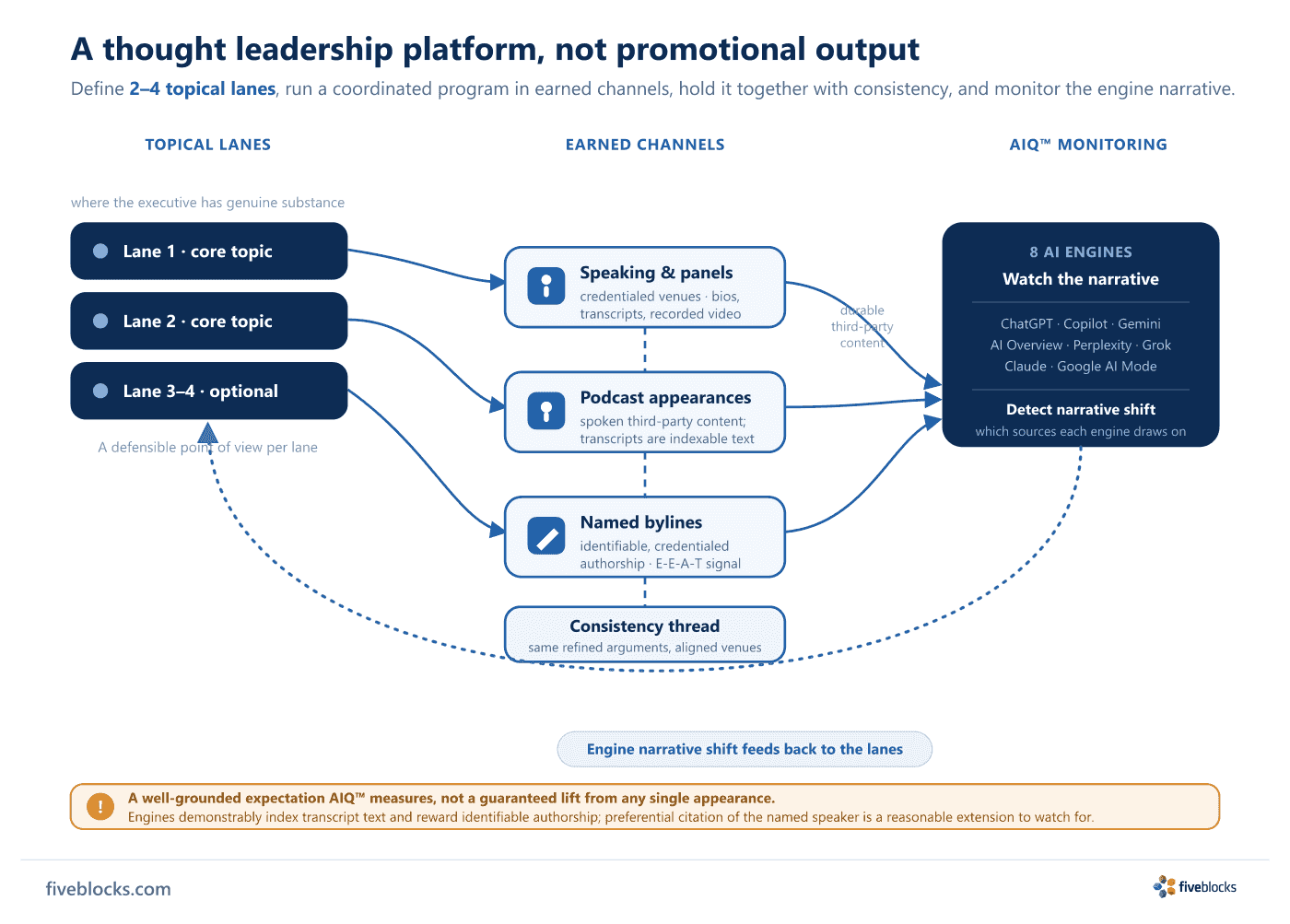
Treat a thought leadership platform as reputation infrastructure, not promotional marketing: pick two to four topic areas where the executive has real substance, then work only in those lanes, through speaking and panels at credentialed venues, podcast appearances, and named bylines. Consistency does the work, meaning the same arguments refined over time in venues that fit the positioning rather than scattered output. Each appearance leaves third-party content that search and AI engines can draw on, and AIQ monitoring across the engines lets the team see whether that work registers in how the engines describe the executive.
Thought leadership done well is reputation infrastructure, not promotional marketing. Volume of output matters less than focus: a defined set of topics, a program that stays inside them, and consistency over time.
1. Define the topical lanes
Pick two to four topic areas where the executive has real substance and a point of view they can defend. Every speaking slot, podcast, and byline maps back to those lanes, which is what lets the engines associate the executive with specific subjects instead of a vague mix. Search and AI systems track co-occurrence and citation patterns in natural language, not links alone, and use them to infer an entity’s category and associations. The same name appearing next to the same topics across independent sources is what those associations are built from.
2. Run the program in those lanes
- Speaking and panels at events that fit the lanes and leave indexable artifacts behind: event pages with bios, transcripts, recorded video. Search engines cannot watch a video or listen to audio, but they do index the text of a transcript, which is how that content becomes extractable at all. Credentialed venues carry extra weight because engines read credible third-party recognition, including awards and prestigious events, as evidence of standing.
- Podcast appearances add more third-party content. AI engines draw on user-generated and spoken material such as YouTube transcripts and podcast episodes, and where an appearance is transcribed, that text can be indexed and cited like a written article.
- Named bylines on owned and earned properties tie identifiable, credentialed authorship to the topics. Google’s E-E-A-T framework rewards bylines that lead to more information about the author and the subjects they write about, and the AI engines weight that same identifiable-expert signal.
3. Hold it together with consistency
Consistency is the thread: the same arguments, refined over time, in venues that fit the positioning. Scattered output dilutes the picture. A coherent record across owned and earned properties reinforces the same lanes again and again; a scattered one hands the engines conflicting signals to resolve.
4. Monitor the engine narrative
AIQ tracks how the eight major AI engines (ChatGPT, Copilot, Gemini, AI Overview, Perplexity, Grok, Claude, and Google AI Mode) describe the executive. That lets the team watch the topical work show up in those descriptions over time and see which sources each engine is drawing on.
One caution about what can be claimed here. The program rests on behavior that is demonstrable: engines index transcript text, draw on podcast and video content, and reward identifiable expert authorship. The stronger claim, that engines reliably pull the named speaker out of a conference or podcast transcript, credit that person with topical authority, and cite them more often as a result, is a reasonable extension of that behavior, but no authoritative source confirms it. Treat the lane-to-narrative effect as an expectation AIQ is built to measure, not a guaranteed lift from any single appearance.
Last reviewed: 19/05/2026
