How do you build a Forbes or Inc. contributor profile for an executive?
A Forbes Councils or Inc. contributor page sits on the publication's high-authority domain, inherits that authority, and often ranks near the top for the executive's name. It pays off only with genuine expertise and a steady cadence; thin, ghostwritten posts backfire now that publisher standards have tightened.
Contributor programs at credentialed outlets (Forbes Councils, Inc. Contributors, and similar) are useful infrastructure when used well and a disappointment when used as cheap content placement. The mechanics are simple. A contributor page sits on the parent publication’s domain and inherits its authority, so a well-built page often ranks in the top five or ten for the executive’s name, and the content published under it accumulates into topical authority that AI engines retrieve.
Whether a contributor profile pays off comes down to one fork: real expertise and a sustainable writing practice on one side, generic promotional filler on the other.
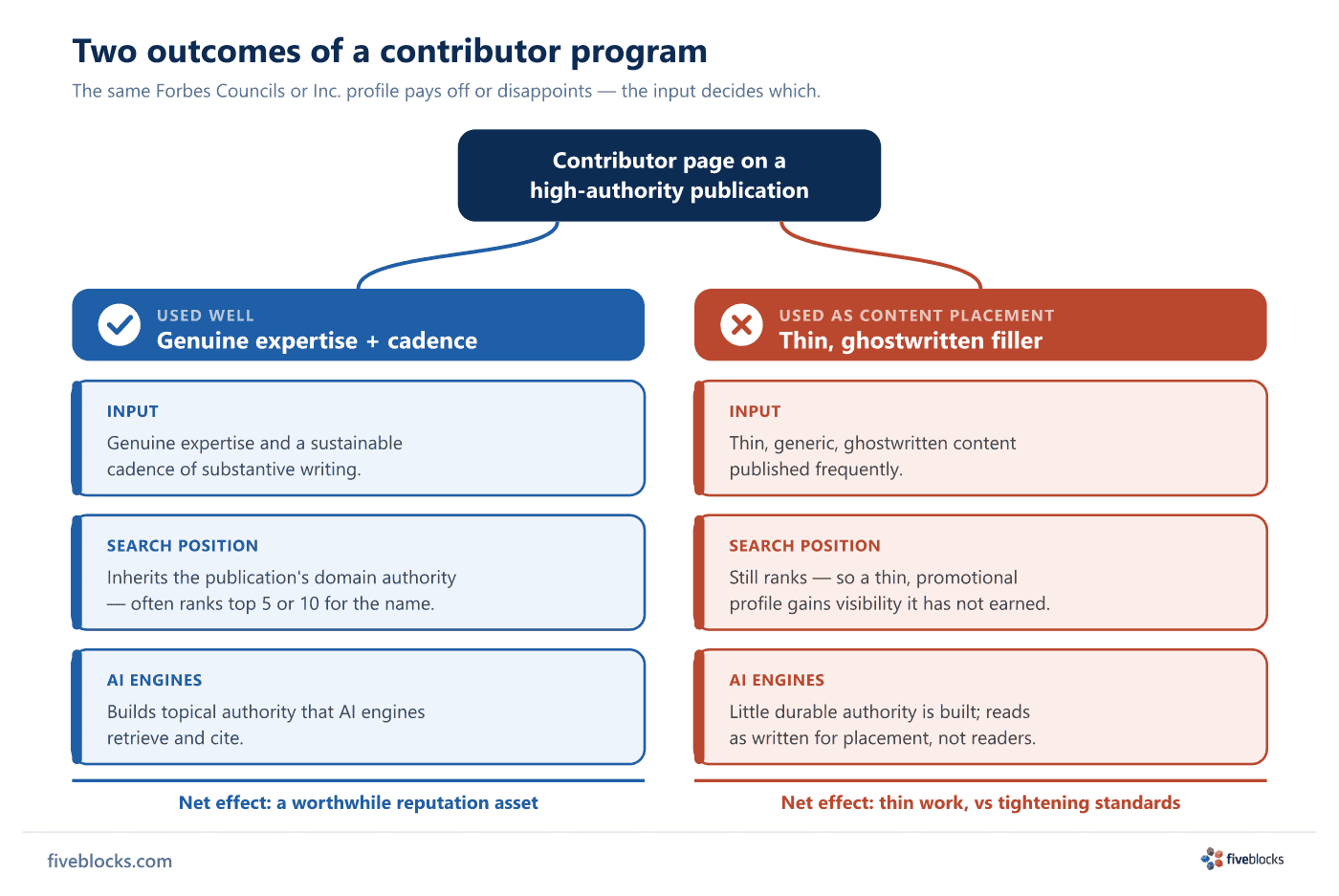
| Outcome | Used well | Used as content placement |
|---|---|---|
| Input | Genuine expertise and a sustainable cadence of substantive writing. | Thin, ghostwritten content published frequently. |
| Search position | The page inherits the publication’s domain authority and often ranks in the top five or ten for the executive’s name. | The page still ranks, so a thin promotional profile gets visibility it has not earned. |
| AI engines | Credible content accumulates into topical authority that AI engines retrieve and cite. | Little authority accumulates, and the writing reads as content made for placement rather than for readers. |
| Net effect | A real addition to the executive’s reputation layer. | More reputation real estate occupied by thin work, at a time when publisher standards are tightening. |
Why the domain matters
The advantage is structural. A URL on a higher-authority domain such as Forbes outranks a comparable URL on a low-authority site. Forbes and Bloomberg profile pages carry the domain authority of their parent publications and frequently appear on page one for relevant name queries. The same credibility weighting carries into AI answers: search and AI engines weight sources by credibility, and they favor entities they recognize as authoritative on a subject. A consistent body of substantive contributor work is one route to becoming that recognized authority.
Why thin content backfires
The downside is structural too. Google’s helpful content updates target content written for search engines rather than users, and its E-E-A-T framework (Experience, Expertise, Authoritativeness, Trustworthiness) rewards identifiable expert authorship, bio context, and citations inside the text. Ghostwritten filler is the opposite of all three. Take a contributor profile where the executive has genuine expertise and the capacity to publish real work. Skip it where the slot would only be filled with promotional content.
Last reviewed: 19/05/2026
