How do you build a thought leadership program that generates search reputation value?
A thought leadership program generates search reputation value when it runs as a compounding cycle: a defined topical lane, consistent publishing on owned and earned properties, and measurement against AI citation and search rank rather than vanity metrics. Authority builds with each successive piece until AI engines cite the executive or firm as a primary source on the topic.
A thought leadership program that generates search reputation value differs from generic content output in three ways: focus, consistency, and measurement against outcomes. It works as a cycle. Each round of publishing builds on the last, and that compounding is what eventually moves the engines from recognizing an entity to citing it as a source.
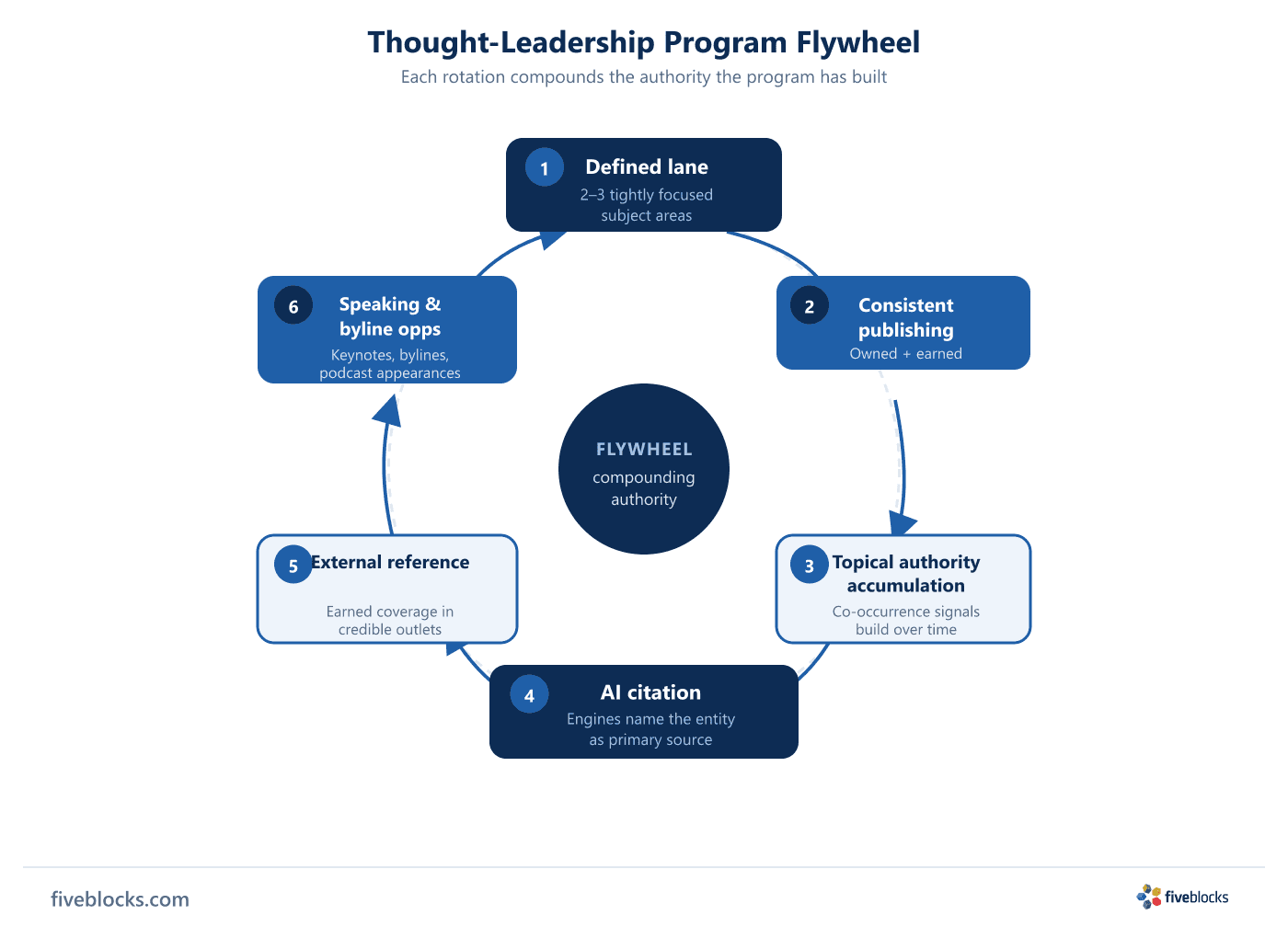
Step 1: Define and protect the topical lane
The cycle starts with lane discipline. Anchor the whole program on two or three tightly defined subjects, narrow enough that sustained coverage builds recognizable depth, wide enough that there is enough to say. A lane like “corporate governance in emerging markets” or “supply-chain risk in life sciences” builds indexable co-occurrence signals; a lane like “leadership” or “innovation” dilutes them. Everything that follows, owned content, earned bylines, speaking slots, podcast appearances, has to stay inside that lane. Drift fragments the signal.
Step 2: Publish consistently on owned and earned properties
Topical authority builds through consistency, not bursts. The cadence that works for most engagements is weekly or biweekly substantive publishing on owned properties, monthly long-form pieces under named authorship, and steady pursuit of earned bylines in credible trade and national outlets. The owned-property hub, an executive bio page with Person schema and sameAs links to LinkedIn, Wikidata, and Wikipedia where applicable, anchors the identity so all content resolves to one authoritative entity. Put a real author’s name on every piece. Search and AI engines weight content attributed to identifiable, credentialed authors more heavily than anonymous corporate prose, because authorship lets them attach expertise claims to a specific entity.
Step 3: Accumulate topical authority signals
As the body of content grows, three signals compound:
- Co-occurrence: the executive’s name appearing next to the defined topic terms across many published pieces builds the language-level map that connects entity to subject in the engines’ understanding.
- Pillar depth: a thorough pillar piece on the defined lane, supported by shorter cluster pieces that link back to it, tells Google and the AI engines that the entity has real breadth on the subject, not a single page.
- Named authorship credibility: bylines tied to an identifiable bio with verifiable credentials reinforce the E-E-A-T signals that both Google and the retrieval-based AI engines factor into source weighting.
Step 4: Earn AI citation and external reference
Once co-occurrence and external citation reach a threshold the engines treat as authoritative, the entity shifts from being described in AI answers to being cited in them, named as a primary source whose view on the topic the engine attributes and sometimes surfaces directly. Third-party earned coverage speeds this up. AI engines lean toward independent sources over owned content, so a placement in a credible, topically relevant outlet moves the source pool faster than more owned pages alone. Speaking engagements and podcast appearances on authoritative platforms generate transcript-rich third-party content the engines ingest, each one reinforcing the topical association from an independent source.
A note on timing: the cycle does not produce measurable AI citation right away. Across Five Blocks engagements, most programs begin to show visible source-attribution shifts in AIQ data after several months of consistent, focused publishing. The exact onset depends on how competitive the topical lane is, how authoritative the outlets are, and how consistent the cadence stays. Plan for a sustained horizon rather than citation within the first few weeks. The longer the program runs consistently, the faster it accelerates.
Step 5: Convert authority into new opportunities, and feed them back into the lane
As AI citation and search visibility rise, they produce downstream opportunities: speaking invitations from conference organizers who find the executive through AI or search, inbound byline requests, journalist outreach for expert comment. These are inputs, not just byproducts. A conference keynote produces coverage and a transcript that strengthens the topical signal. A journalist citation in a tier-one outlet gives the engines an independent authoritative reference they weight heavily. Each opportunity, captured and tied back to the defined lane on the owned hub, adds another turn to the cycle and raises the bar for competitors trying to displace the authority the program has built.
Step 6: Measure against AI citation and search rank, not vanity metrics
Measure the program against the outcomes it is built to produce: search rank for the target branded and topical queries, tracked with IMPACT, and source attribution and framing in the AI engines, tracked daily with AIQ across ChatGPT, Gemini, Copilot, Perplexity, Claude, Grok, Google AI Overviews, and Google AI Mode. When a piece moves rank or changes which sources an engine cites for a relevant prompt, the program is working. When publishing volume rises but neither metric moves, the program is producing content without authority, a common failure that usually points to lane drift, low-quality outlets, or weak named-author credibility. Let the data drive the correction.
Last reviewed: 20/05/2026
