How do you use thought leadership content to improve search results?
Sustained thought leadership in a few defined topic areas builds the signals search and AI engines weight: credentialed authorship, earned third-party citation, and co-citation between the brand and its topics. Over time that makes name queries surface the brand's substantive content and makes engines more likely to draw on it when answering topical questions.
Thought leadership done well is reputation infrastructure, not marketing. What matters is not how much you publish but whether it builds the credibility and entity signals that search and AI engines weight when they decide which sources to trust and cite on a topic.
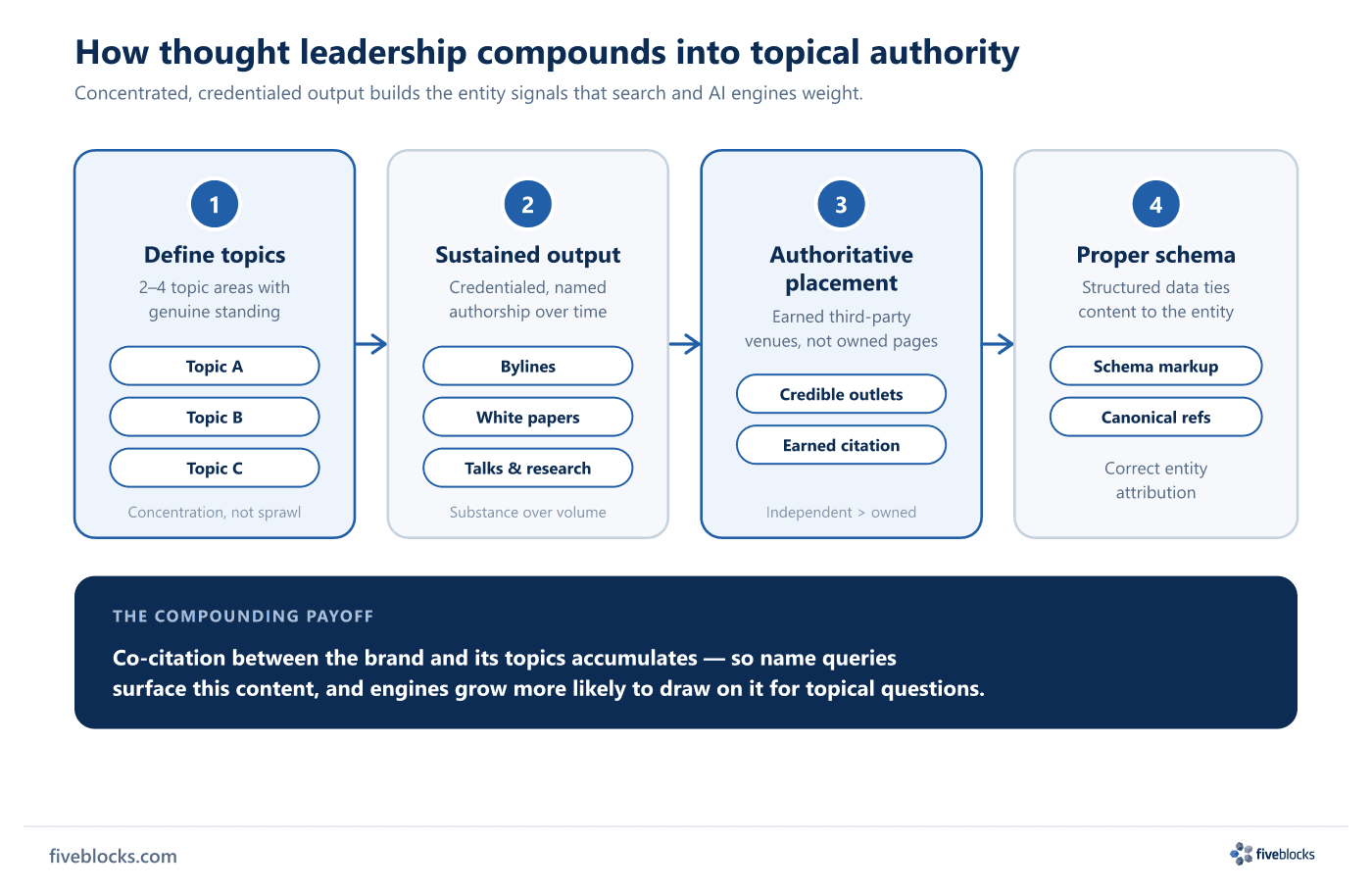
The pattern that compounds
- Define two to four topic areas where the brand or executive has genuine standing. Staying concentrated is what lets engines associate the brand with a topic: modern search and AI systems infer an entity’s category and associations from co-occurrence and co-citation patterns in natural language, not links alone.
- Commit to sustained, substantive output in those areas, such as bylines, white papers, conference presentations, and original research, under clearly named, credentialed authorship. Engines weight content written by named experts with credible bios, because identifiable authorship lets them attribute the work to demonstrable expertise, and Google’s E-E-A-T framework rewards the same signals.
- Place the content in authoritative venues over time. Search and AI engines weight credentialed independent sources heavily against owned pages, so a citation from a credible third-party outlet shapes AI answers more than another page on the brand’s own site.
- Structure the assets with proper schema and consistent canonical references. Schema markup and structured data help engines understand what a page asserts and attach it to the correct entity, which affects whether the content surfaces and how it connects to the brand.
The compounding payoff
As these signals accumulate, name queries tend to return the brand’s thought-leadership content alongside its corporate material. AI engines, which cite earned, credentialed third-party coverage when answering questions about a company, become more likely to draw on that content for topical questions. The brand ends up contributing more of the language used to describe its own category.
The failure mode
The usual mistake is scattershot thought leadership spread across too many topics. The authority signals work through concentrated co-citation and repeated credentialed coverage in a defined area, so output diffused across many unrelated topics builds recognizable standing nowhere.
Last reviewed: 19/05/2026