How should speakers and thought leaders manage their reputation?
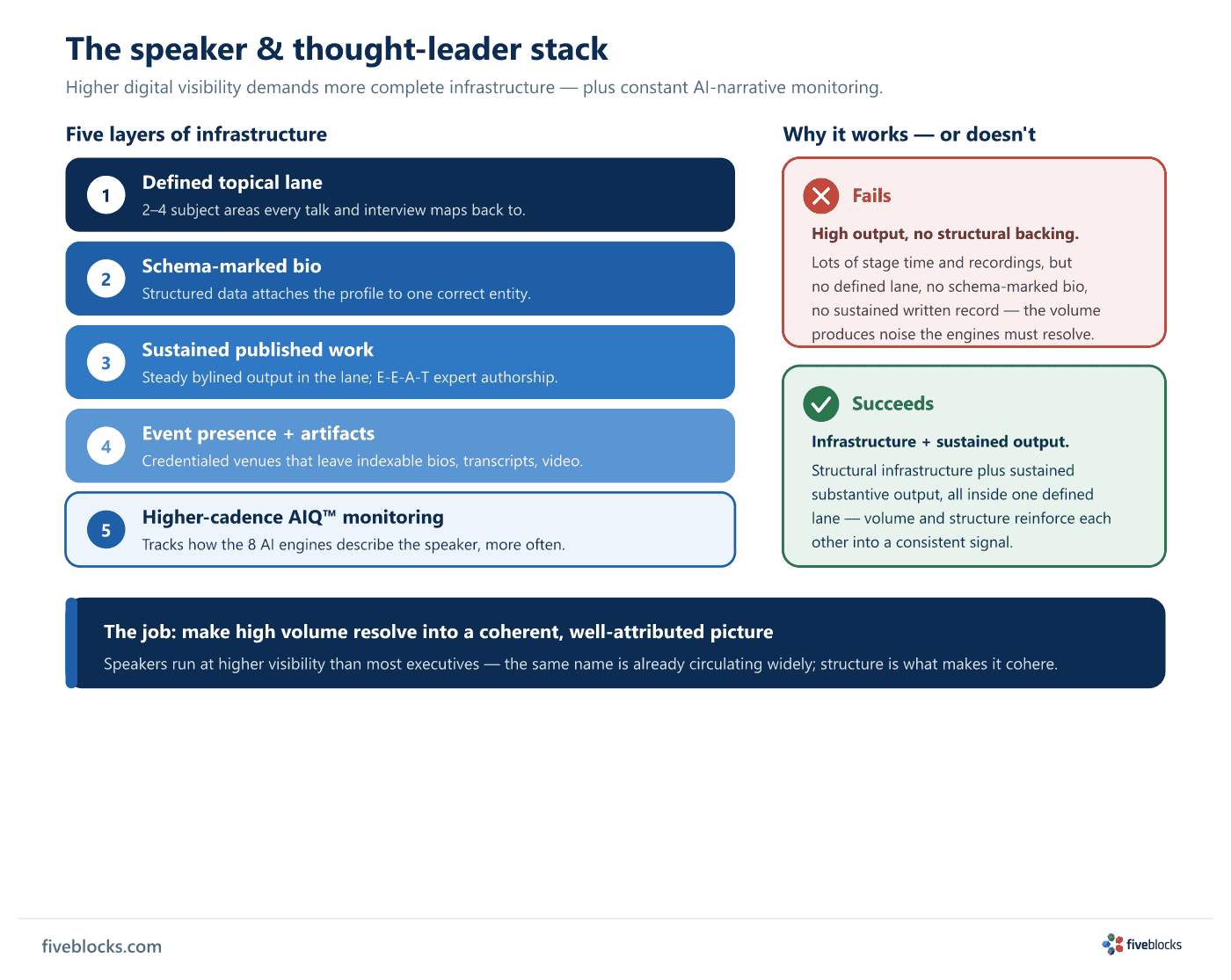
Speakers and thought leaders run at higher digital visibility than most executives, so the infrastructure has to be more complete: a defined topical lane, complete schema-marked bio content, sustained substantive published work, authoritative event presence that leaves indexable artifacts, and constant monitoring of the AI narrative. High-output speaking with no structural backing fails; structural infrastructure plus sustained output in a defined lane works.
Professional speakers and thought leaders run at higher digital visibility than most executives, so the structural infrastructure has to be more complete and the monitoring more constant. The name is already circulating widely across event pages, recordings, interviews, and third-party write-ups. The job is less about generating visibility than about making that volume resolve into one coherent, well-attributed picture instead of a scattered one.
What “more complete” infrastructure means
- A defined topical lane. Two to four subject areas where the speaker has genuine substance and a defensible point of view, so every talk, panel, and interview maps back to the same themes. Search and AI systems infer an entity’s category and associations from co-occurrence and citation patterns in natural language, not from links alone, so the same name appearing alongside the same topics across independent sources is the raw material for those associations.
- Complete, schema-marked bio content. A consistent, structured biography on owned properties. Schema markup and structured data help search and AI engines understand what a page asserts and attach it to the correct entity, which is what keeps a high-volume public profile resolving to one person instead of fragmenting.
- Sustained published work. A steady cadence of substantive bylined output in the defined lane. Google’s E-E-A-T framework rewards identifiable expert authorship and bio context, and those signals overlap with what the AI engines weight.
- Authoritative event presence with indexable artifacts. Speaking at credentialed venues that produce text the engines can read: event pages with bios, transcripts, and recorded video. Search engines extract heavily from transcripts, and AI engines draw on spoken content such as podcast episodes and video transcripts, which they can cite like written articles. To the engines, a talk is worth whatever indexable artifacts it leaves behind. Credentialed venues carry weight for a second reason: engines read credible third-party recognition such as awards and prestigious events as evidence of standing.
Why the monitoring runs at higher cadence
For a high-visibility speaker, topical authority is more contested and more dynamic, so the AI narrative gets checked more often. AIQ tracks how the eight major AI engines (ChatGPT, Copilot, Gemini, AI Overview, Perplexity, Grok, Claude, and Google AI Mode) describe the speaker and which sources each one draws on. That catches drift early and shows when new work registers in those descriptions.
The success and failure patterns
What fails is high-output speaking without the structural backing: plenty of stage time and recordings, no defined lane, no schema-marked bio anchoring the profile to one entity, no sustained written record. The volume gives the engines noise to resolve instead of a consistent signal. What works is structural infrastructure plus sustained substantive output in a defined lane, where the volume and the structure reinforce each other.
A note on what we can and cannot claim. Supported: engines index transcript and bio text, structured data helps attach a page to the correct entity, engines draw on podcast and video content, and identifiable expert authorship is rewarded. The stronger version, that engines reliably pull the named speaker out of a conference or podcast transcript, credit them with topical authority, and cite them more often as a result, is a reasonable extension of that behavior, but we cannot point to an authoritative source confirming it. Treat the infrastructure-plus-output effect as a well-grounded expectation that AIQ is designed to measure, not a guaranteed lift from any single appearance.
Last reviewed: 19/05/2026
