What is the role of Wikipedia references in establishing credibility?
On Wikipedia, references are visible authority signals. An article cited to multiple authoritative, independent sources demonstrates notability, resists vandalism and bias, and gives AI engines a strong, credible signal to draw on.
References carry most of a Wikipedia article. Their quality decides how the editing community treats the article and how the external systems that read it treat it.
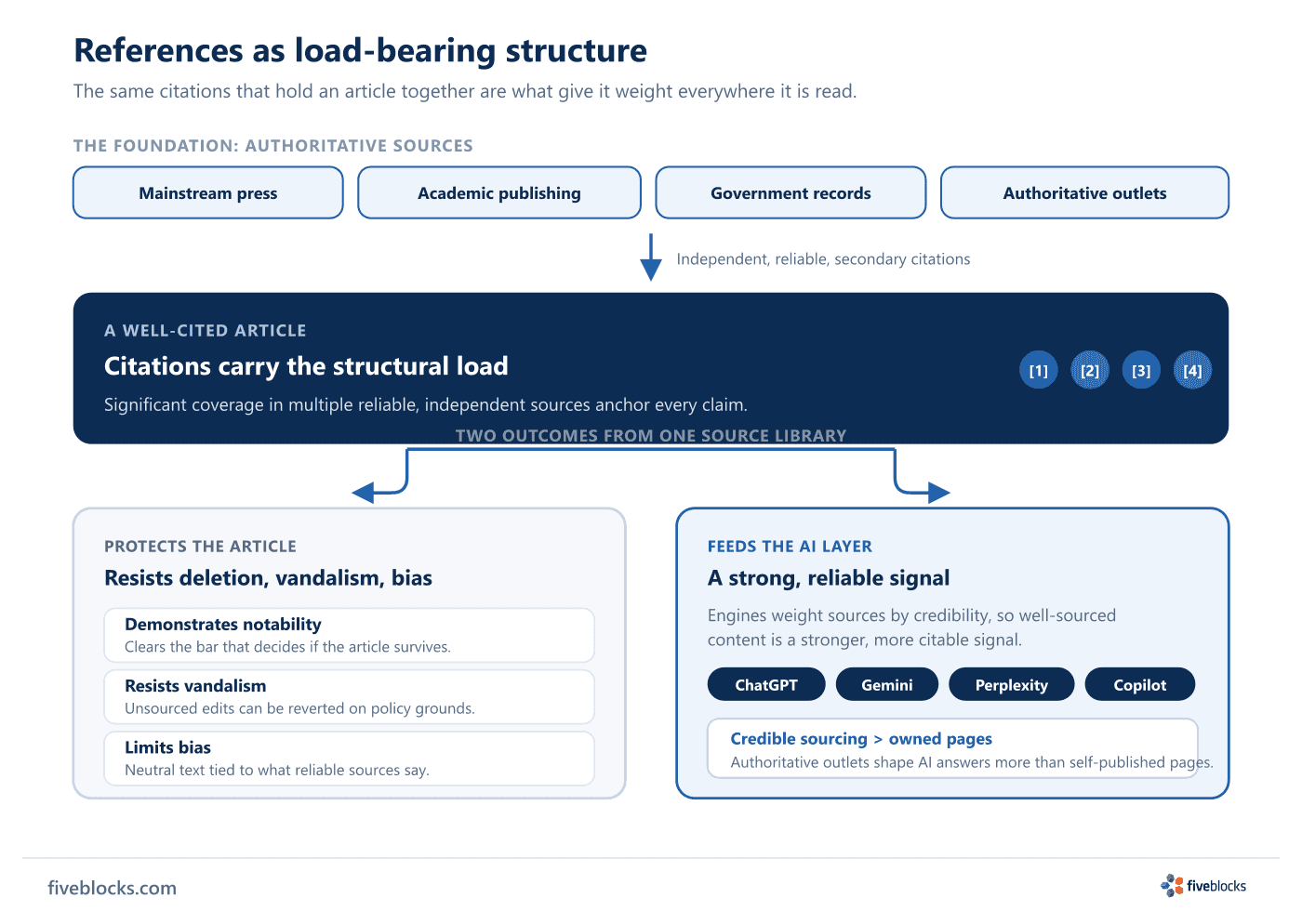
What a strong reference library does for the article
An article cited to mainstream press, academic publishing, government records, and other authoritative outlets is harder to weaken or distort:
- Demonstrates notability. Wikipedia’s general notability standard requires significant coverage in multiple reliable, independent, secondary sources, so a well-sourced article clears the bar that decides whether it survives.
- Resists vandalism and unsourced edits. Because the article is anchored to citations, edits that add unsourced or poorly sourced claims can be reverted on policy grounds.
- Produces neutral, balanced text. Wikipedia’s neutral-point-of-view policy ties the article to what reliable secondary sources actually say, in proportion to how they say it, which limits the room for biased framing.
The same sourcing feeds the AI layer
The source library that protects the article also shapes how it travels downstream. Search and AI engines weight sources by credibility, so content carried by authoritative, independent outlets tends to shape AI answers more than added self-published or owned pages do. A Wikipedia article built on that kind of sourcing is a stronger, more citable input for the engines that summarize the company.
Building the source library is one of the most useful things to do in a Wikipedia engagement. The same citations that hold the article together on Wikipedia are what give it weight everywhere the article is read.
Last reviewed: 19/05/2026
