What is the reputational risk of having no digital presence as an executive?
Having no digital presence is itself a reputational risk. Stakeholders search an executive whether or not that executive has chosen to be visible, and Google and AI engines fill the vacuum with whatever they can find - stale aggregator profiles, old quotes, an outdated LinkedIn, or a same-name result for someone else.
Staying below the radar is understandable for some executives, and occasionally it is the right call, but it almost never produces the intended outcome. Stakeholders Google the executive whether or not that executive has chosen to be visible, and Google returns something – just not what the executive would have chosen. Absence is not neutrality. It is a vacuum, and the search and AI layers fill it on their own terms.
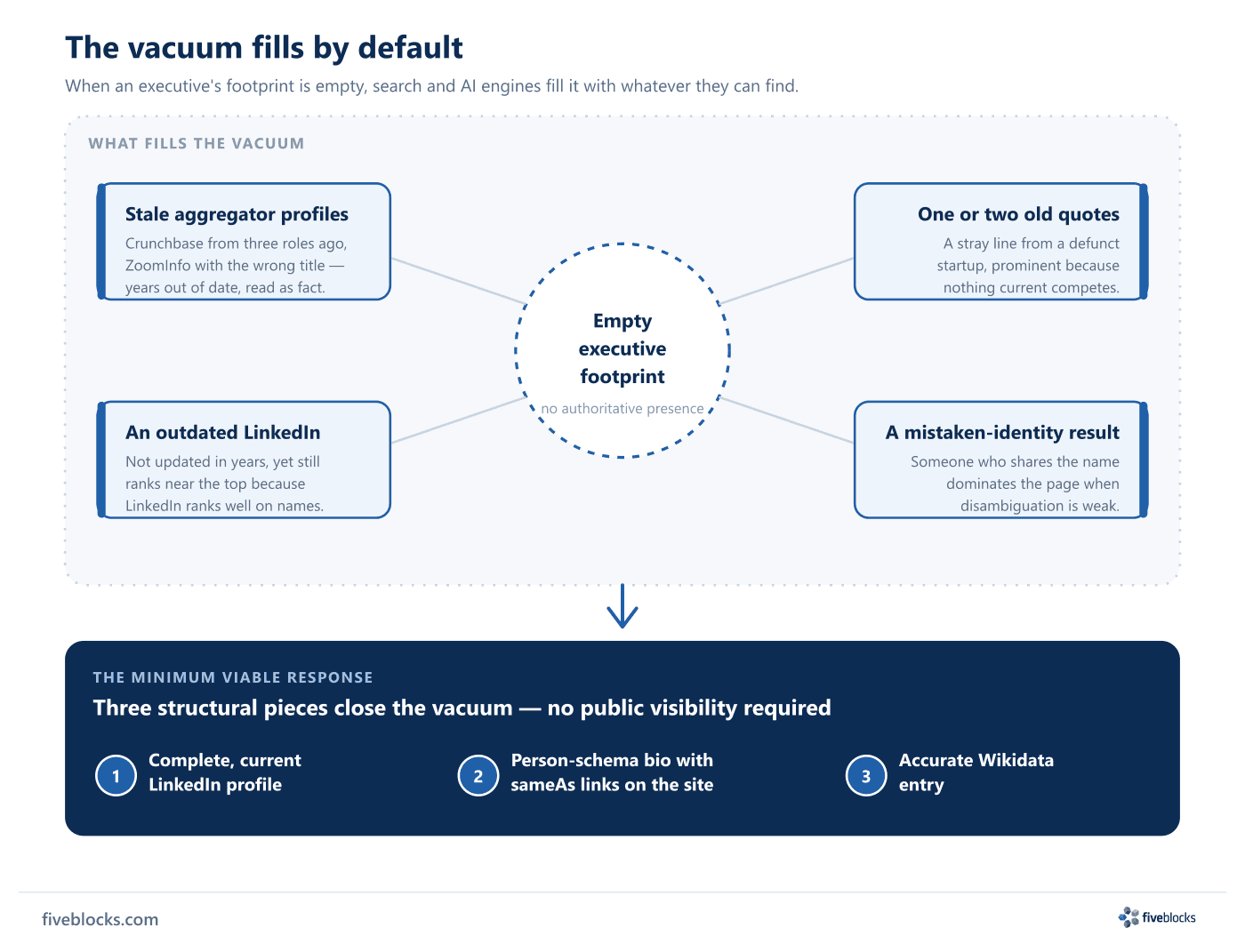
What fills the vacuum by default
- Stale aggregator profiles: A Crunchbase entry from three roles ago, a ZoomInfo listing with the wrong title, and similar secondary profiles that engines treat as corroborating sources even when the data is years out of date.
- One or two old quotes: A stray comment from a defunct startup, or an old press mention that becomes disproportionately prominent because nothing more current competes with it.
- An outdated LinkedIn: A profile that has not been updated in years but still ranks near the top for the executive’s name, because LinkedIn ranks consistently well on name searches.
- A mistaken-identity result: Someone who shares the name dominates the results page. When entity infrastructure is weak – no Wikidata, no schema, no clean disambiguation – both Google and AI engines can conflate distinct people who share a name.
AI engines do the same thing, and they sound more certain doing it. They synthesize biographical claims from whatever fragments they find across the training corpus and live web. A thin footprint gives them little authoritative material to work from, and that is the condition under which engines are most prone to assemble a confident but unreliable picture.
The minimum viable response
Closing the vacuum does not require going public. The minimum viable response is three structural pieces:
- A complete, current LinkedIn profile.
- A Person-schema-marked bio on the company site, with
sameAslinks that tie it to the executive’s canonical identity. - An accurate Wikidata entry, which feeds the machine-readable entity facts that Google’s Knowledge Panel and AI engines draw on.
That alone takes most executives from default-fill to canonical, and it requires no public visibility beyond what already exists.
Last reviewed: 19/05/2026
