What is the reputational risk of not having a Wikipedia page?
Without a Wikipedia article, an entity loses a top-three result for branded searches, gets a thinner Knowledge Panel, draws shorter and less accurate AI descriptions, and can read as less notable than peers who have articles.
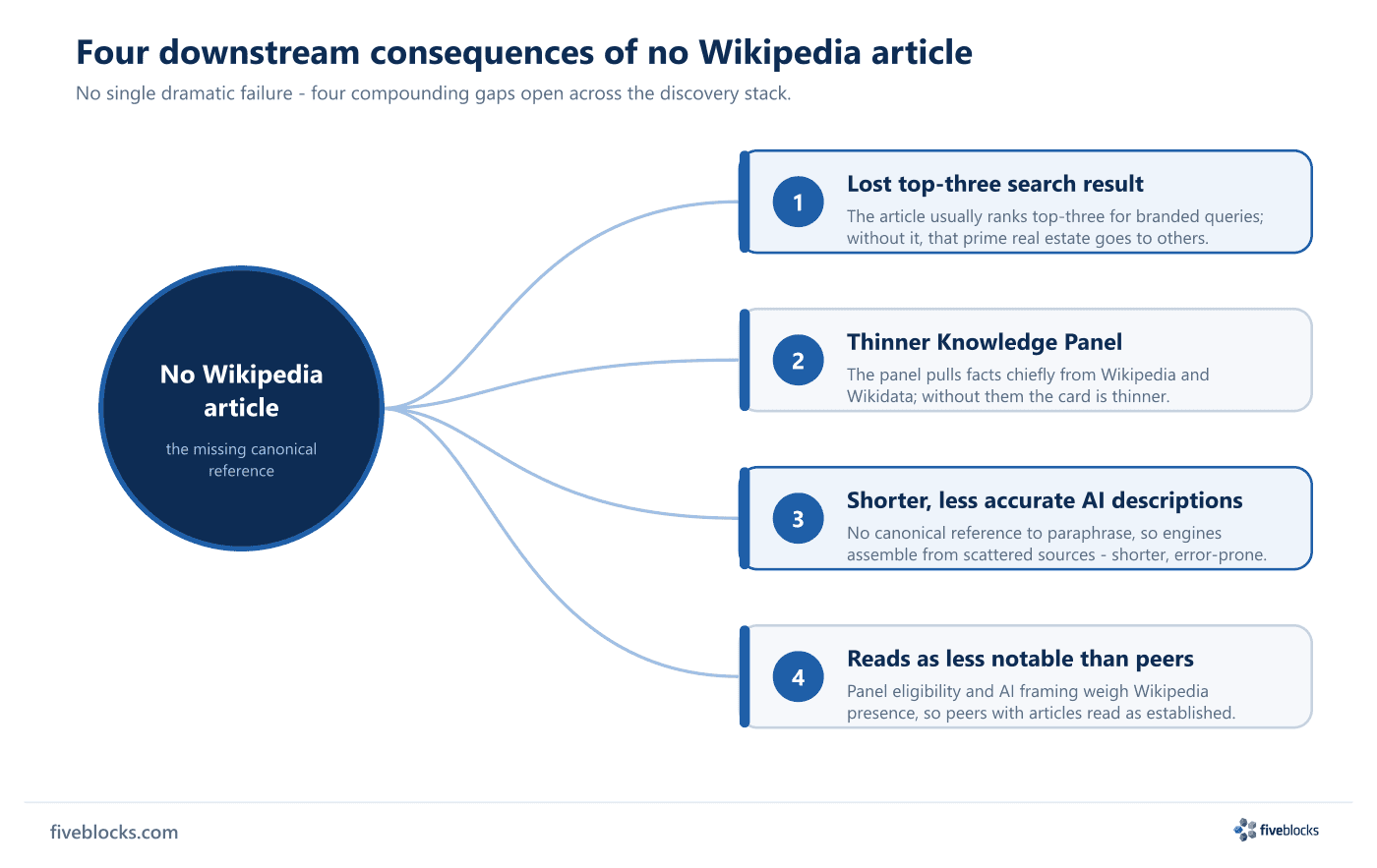
Having no Wikipedia article has measurable consequences across search, the Knowledge Panel, AI answers, and comparative perception. No single failure stands out. Instead, four gaps open up, and each one makes the next worse.
Four downstream consequences of having no article
- A lost top-three search result
- For most branded queries the Wikipedia article ranks in the top three Google results. Without one, that spot goes to whatever else ranks, usually the company’s own pages alongside aggregators, social profiles, and press coverage, so the entity controls less of its own first page.
- A thinner Knowledge Panel
- The Knowledge Panel, if it appears at all, pulls its description and main facts chiefly from Wikipedia and Wikidata. Without the article, it loses one of its primary sources and the card that results is thinner and less descriptive.
- Shorter, less accurate AI descriptions
- When a subject has an article, AI engines paraphrase that single canonical reference, often with high fidelity. Without it, the engine assembles a description from scattered sources, and the result is usually shorter and more prone to errors of fact or emphasis.
- Reads as less notable than peers
- Knowledge Panel eligibility and AI framing are informed by signals like Wikipedia presence, so peers who do have articles read as more established in any comparative diligence, fairly or not.
Whether to pursue an article comes down to two questions: whether the notability bar can be met, and whether the effort of going through the proper process is worth the result. For most established companies and many senior executives, the answer is yes, and the absence of an article is a quiet liability rather than a neutral state.
Last reviewed: 19/05/2026
