How does a Wikipedia page affect Google search results?
A Wikipedia article shapes the Google experience for a subject in three ways at once: it usually ranks prominently in the organic results for branded queries, it supplies content for the Knowledge Panel beside those results, and it heavily influences how AI Overviews and Gemini summarize the subject.
A Wikipedia article does three things in Google search that no other single asset does together. For a branded query, whether the company name or an executive’s name, the article shows up in the organic results, feeds the entity card beside them, and shapes the AI-generated summary at the top. That is why we treat Wikipedia work as a Google-search lever, not just a Wikipedia lever.
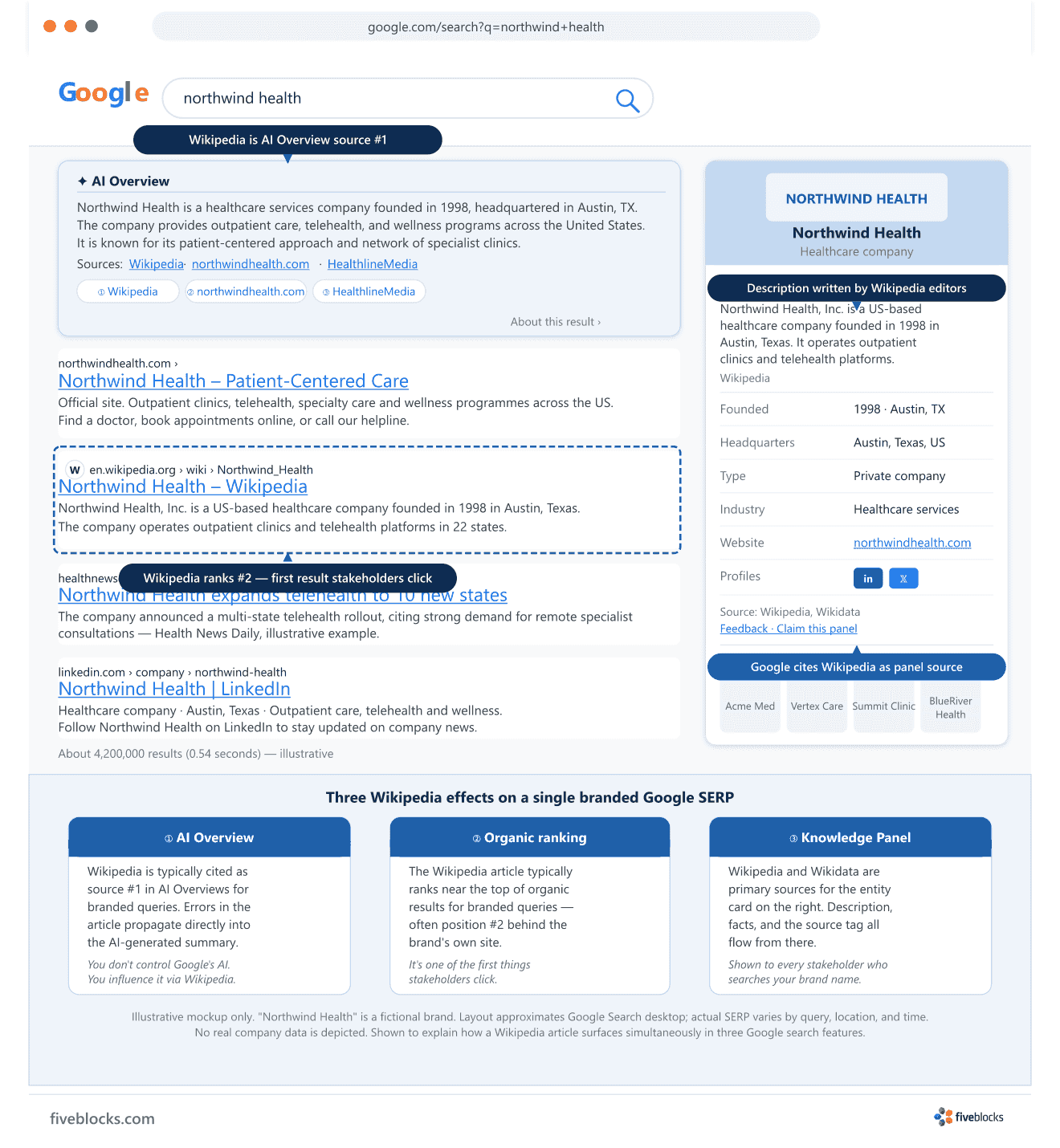
The three Google effects of a Wikipedia article
- Organic ranking for branded queries. For searches on the subject itself, the Wikipedia article typically ranks near the top of the organic results, which makes it one of the first results a searcher clicks.
- The Knowledge Panel. Wikipedia and Wikidata are among the primary sources Google uses to populate the Knowledge Panel that appears in the right sidebar on desktop and near the top of mobile results. The description, founding date, and other facts flow from the article and from Wikidata into the panel.
- AI Overviews and Gemini. Google’s AI synthesis weights Wikipedia and the Knowledge Graph as primary sources, so the article heavily influences how AI Overviews and Gemini describe the subject when answering related queries.
So one article shapes the Google experience for a subject in three ways at once. An error, gap, or non-neutral framing does not stay on Wikipedia. It carries into the organic ranking, the Knowledge Panel, and the AI answer together.
Last reviewed: 19/05/2026
