How do you use X/Twitter threads for reputation building?
X/Twitter threads can rank for niche branded and topical queries and help reputation when they are substantive, structured, and cite authoritative sources. They work as a supplementary owned channel, not a foundation. Grok has native access to X content; other engines treat public X posts as part of the broader web, with variable and generally limited weighting.
X/Twitter threads can help reputation goals when they are built as real content rather than off-the-cuff posts. A well-structured thread, a coherent argument on a defined topic that cites authoritative sources, can rank for niche branded and topical queries, because X has enough domain authority that strong threads sometimes surface in search results. The value is secondary: threads supplement the owned content layer rather than anchor it, and building them takes the same discipline as any other owned channel.
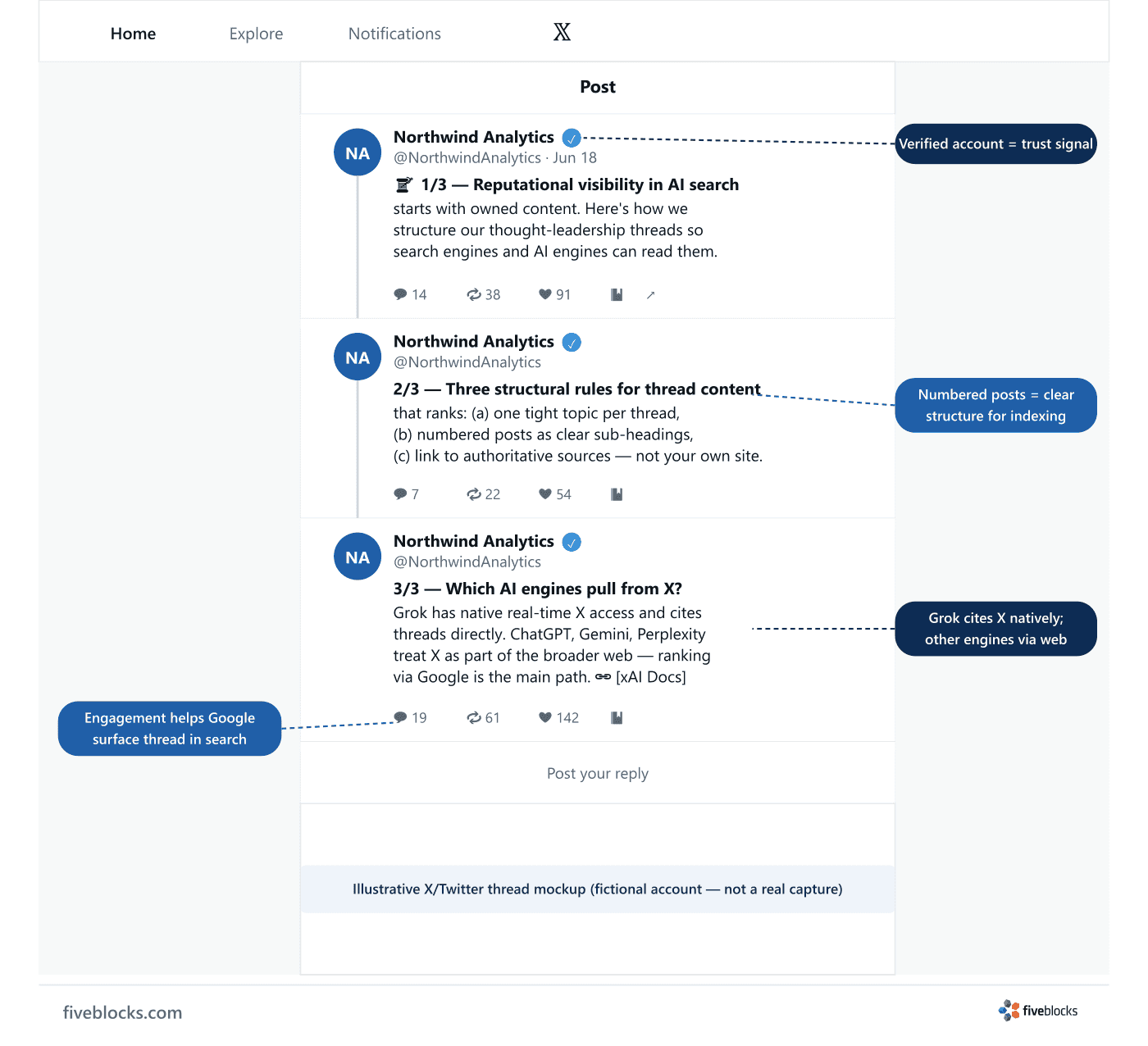
What makes a thread rank and get cited
- Topical focus: A thread on a tightly defined subject builds topical co-occurrence that search and AI engines can read, while scattered commentary builds none.
- Strong headings and structure: Threading the argument into numbered, clearly headed posts makes the content legible to readers and to the systems that index it.
- Cited, authoritative sources: Linking to credible third-party sources within the thread lifts its own credibility and gives the engines a chain of authority to follow.
- Named authorship consistent with the canonical identity: The account name, bio, and handle should align with the broader entity stack so the engines resolve the thread to the right person or company.
- Account verification and activity: A verified, active account with a consistent posting history carries more signal than a dormant one.
Which AI engines ingest X content, and how
The ingestion picture differs by engine. X restricted API access from 2023 onward, and that changed how different engines draw on the platform.
- Grok (xAI): Has native, real-time access to X’s full data stream via the X Search tool. Grok pulls heavily from X when answering questions about current events, public opinion, and named people, which makes X threads the most directly useful for Grok-sourced narratives. (Source: xAI Docs, X Search, confirmed in source library cl-0319.)
- ChatGPT, Gemini, Perplexity, Copilot, Claude: These engines treat public X posts as part of the broader web, where they are indexed and crawlable, but they do not have the real-time data access that Grok has. Their use of X content is variable and mostly reflects what search engines have indexed rather than direct API access. The claim that these engines ingest X threads at meaningful scale is supported in the library only as a general social-content ingestion claim (cl-0658: “AI engines ingest social content including Reddit and public discussion on X”) without engine-specific confirmation, so treat it as directional rather than established for individual engines.
- Google AI Overviews and Google AI Mode: Google indexes X content in standard search where X pages rank, and X posts can appear in web results. The AI Overviews layer can surface this indexed content, though X’s own pages face the same ranking logic as any other site.
Practical implication: If AI engine citation of X content is a specific goal, Grok is the engine most likely to use threads, because it has native X access. For the other six engines AIQ monitors, the thread’s value comes mainly through search, ranking in Google and being crawled into training corpora, rather than through a direct platform-to-engine pipeline.
X as part of the entity stack
We treat a well-run X presence as one owned property within the entity stack, not a standalone reputation play. The profile itself often ranks for branded search. The account should match the canonical identity across the stack, with name, bio, and linked properties aligned with the corporate site and other owned channels. We monitor how the engines use X content for a client’s topics with AIQ™, and track the profile’s search presence with IMPACT™.
Last reviewed: 20/05/2026
