If a story goes viral on Twitter, does that guarantee it’ll rank on Google?
Not usually. Twitter/X virality does not move Google ranking on its own. Google treats social platforms as their own ecosystem and weights credentialed publishing sources heavily. A trending story leaves a lasting Google footprint only when mainstream or trade outlets pick it up, publish about it, and enter the news index.
Social-platform virality and Google news ranking are weakly correlated. A story can trend on X and then disappear without leaving any trace on Google if no credentialed outlet covers it. The social platform is its own ecosystem, and Google generally treats it that way.
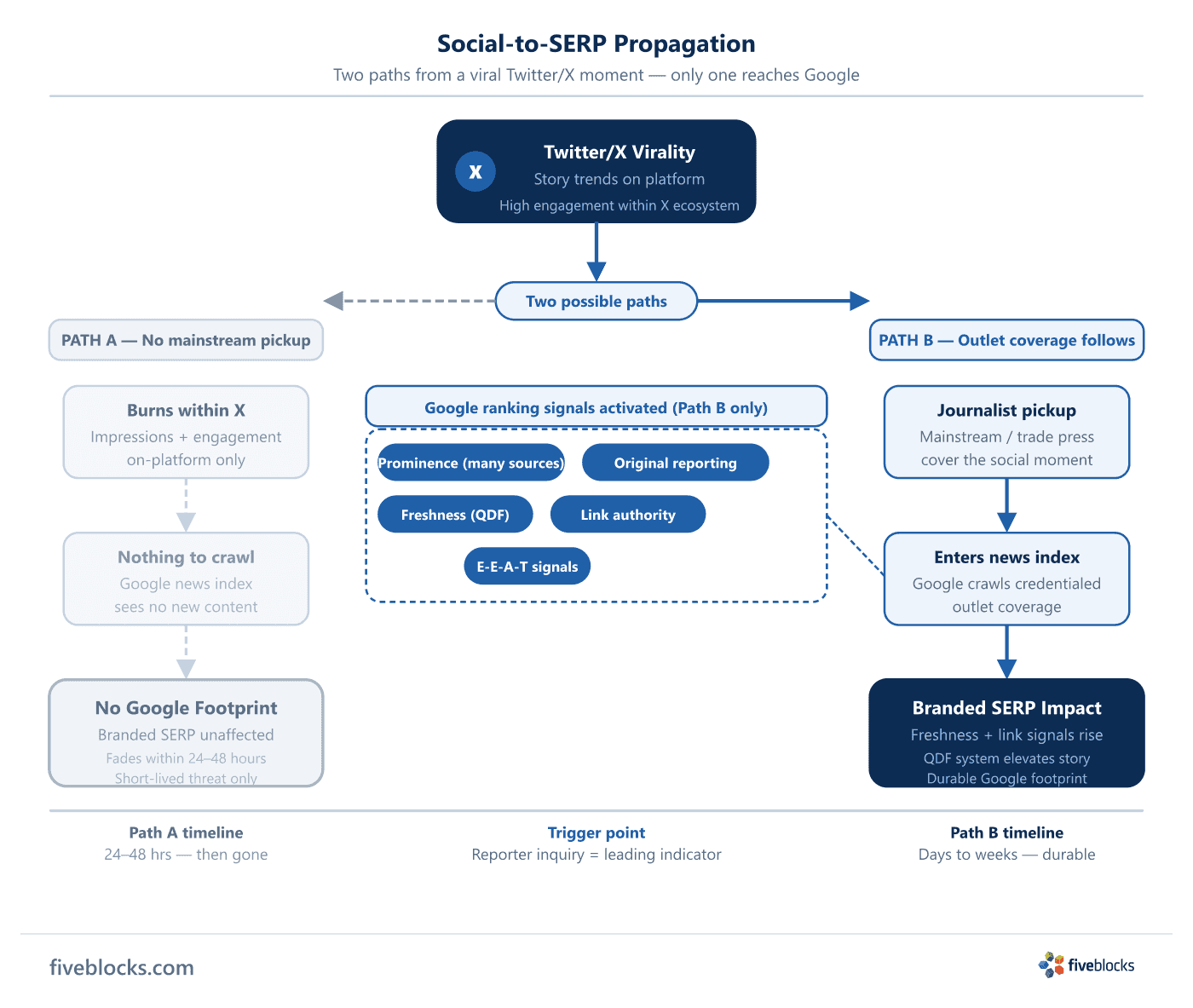
Two paths from a viral moment
- No mainstream pickup. The story burns on X, draws impressions and engagement within the platform, and fades. Without outlet coverage, Google’s news index has nothing to crawl or rank, so the branded SERP stays unaffected beyond the brief window when X posts might appear as individual results.
- Outlet coverage follows. When mainstream news, trade press, or regional papers that pick up a national wire publish about the social moment, the story enters Google’s news index. Google’s prominence signals then activate: the story is heavily covered, cited by multiple sources, and carries original reporting. Freshness and link authority build up, and that can push the story into branded SERPs.
What this means for reputation work
Monitor both layers, but respond at the layer that matters. A viral social moment without coverage is loud and short-lived; the same moment with coverage is the lasting threat. What that means in practice:
- Watch whether a social moment is drawing journalist interest. Early reporter inquiries are the leading indicator that the social story is about to become a Google story.
- Once outlet coverage publishes, Google’s “query deserves freshness” systems can raise the story quickly in search results for the brand name.
- Owned content prepared ahead of time and authoritative third-party placements are what can compete with a newly indexed news story at the SERP level. Social counter-messaging alone does not touch the Google footprint.
Last reviewed: 19/05/2026
