How does Google index social media profiles?
Google indexes most public social profiles. For the majority of executives and public figures, the LinkedIn profile ranks in the top one or two results for a name SERP because of LinkedIn's domain authority. X (formerly Twitter), YouTube, and Instagram appear when the account is active and substantive. Every indexed profile also feeds the entity graph through sameAs signals that flow into Google's Knowledge Graph and AI engines.
Social profile indexing shapes what a name search returns. For most executives and public figures, the LinkedIn profile ranks in the top one or two positions for the name SERP because LinkedIn carries domain authority that personal websites take years to build. X profiles often rank for individuals with active accounts. YouTube and Instagram appear when the person has substantive content on those platforms.
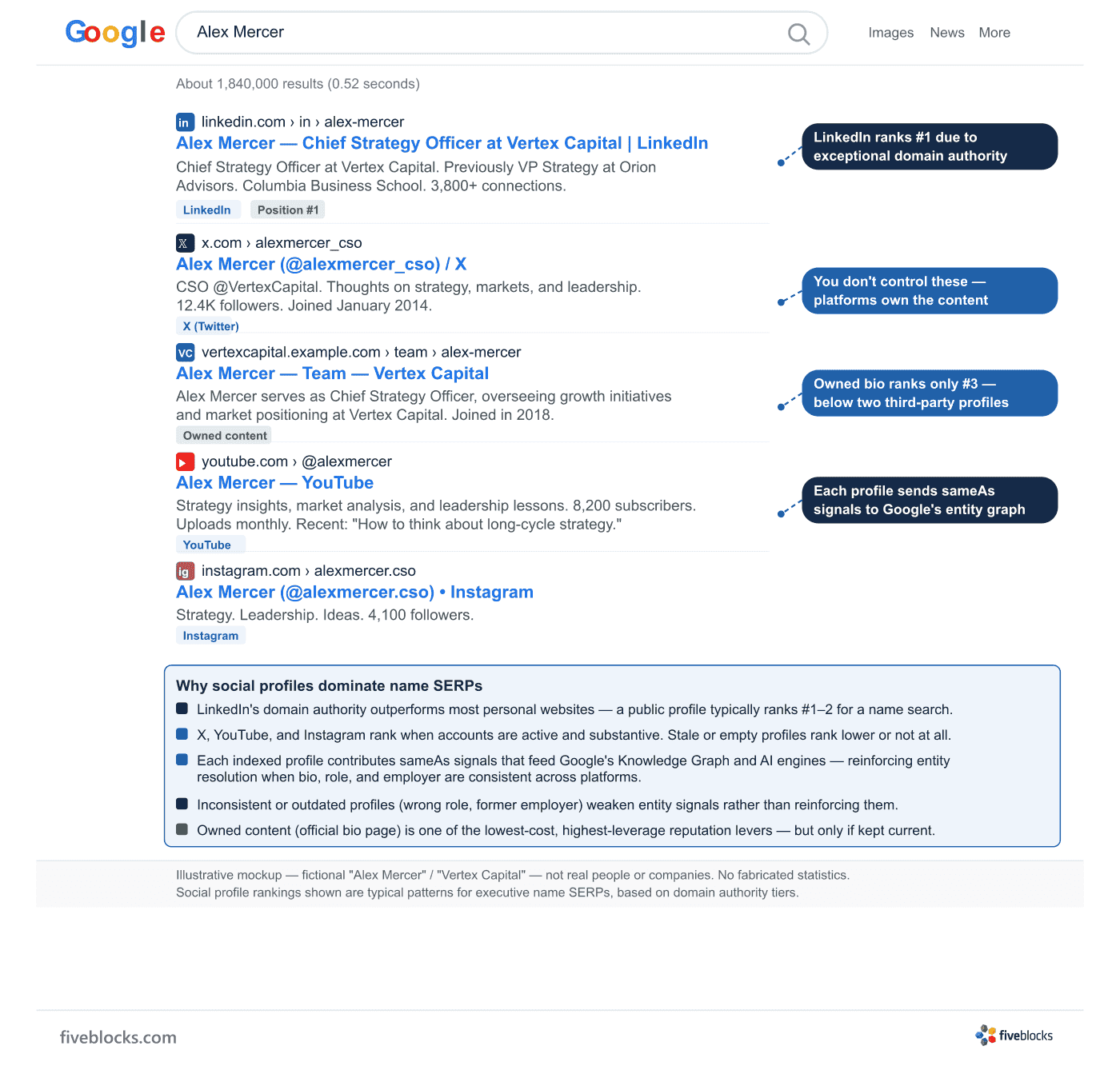
- LinkedIn’s domain authority makes it the most reliable ranking asset for a personal name query. A public LinkedIn profile is typically the number one or number two Google result for a name search. The profile also anchors the entity: when the bio, current role, and employer match the rest of the entity stack, they confirm how Google resolves and describes the person.
- X (formerly Twitter)
- X profiles rank for individuals with active, substantive accounts. For executives and public figures who post consistently, the X profile commonly appears on page one. X content also feeds Grok, xAI’s AI engine, which pulls heavily from X’s real-time data.
- YouTube
- YouTube is the second-largest search engine in the world and its pages carry strong authority in Google results. For individuals with a channel or recurring video presence, YouTube ranks on the name SERP. AI engines including Perplexity and Google AI Overviews cite YouTube regularly, drawing answers from video transcripts and descriptions.
- Instagram pages index and appear in name SERPs for individuals with substantive public accounts, though the platform’s authority for personal name queries is generally lower than LinkedIn’s or YouTube’s.
Reputation implications work in both directions
Well-maintained profiles support the entity: consistent bio, photo, current role, and organization. Each indexed profile also adds to the entity graph through sameAs connections, the relationship between a LinkedIn page, a Wikipedia article, a Wikidata entry, and an official site that tells Google and AI engines these references describe the same person. Stale or inconsistent profiles work against the entity: a LinkedIn profile listing the wrong company or a role from five years ago weakens the signal instead of confirming it.
Profile maintenance as a reputation lever
Profile maintenance costs little and returns a lot in executive reputation programs. The pages rank without paid placement, the sameAs connections they enable are free, and one well-maintained LinkedIn profile can hold the first position of a name SERP for years.
Last reviewed: 19/05/2026
